
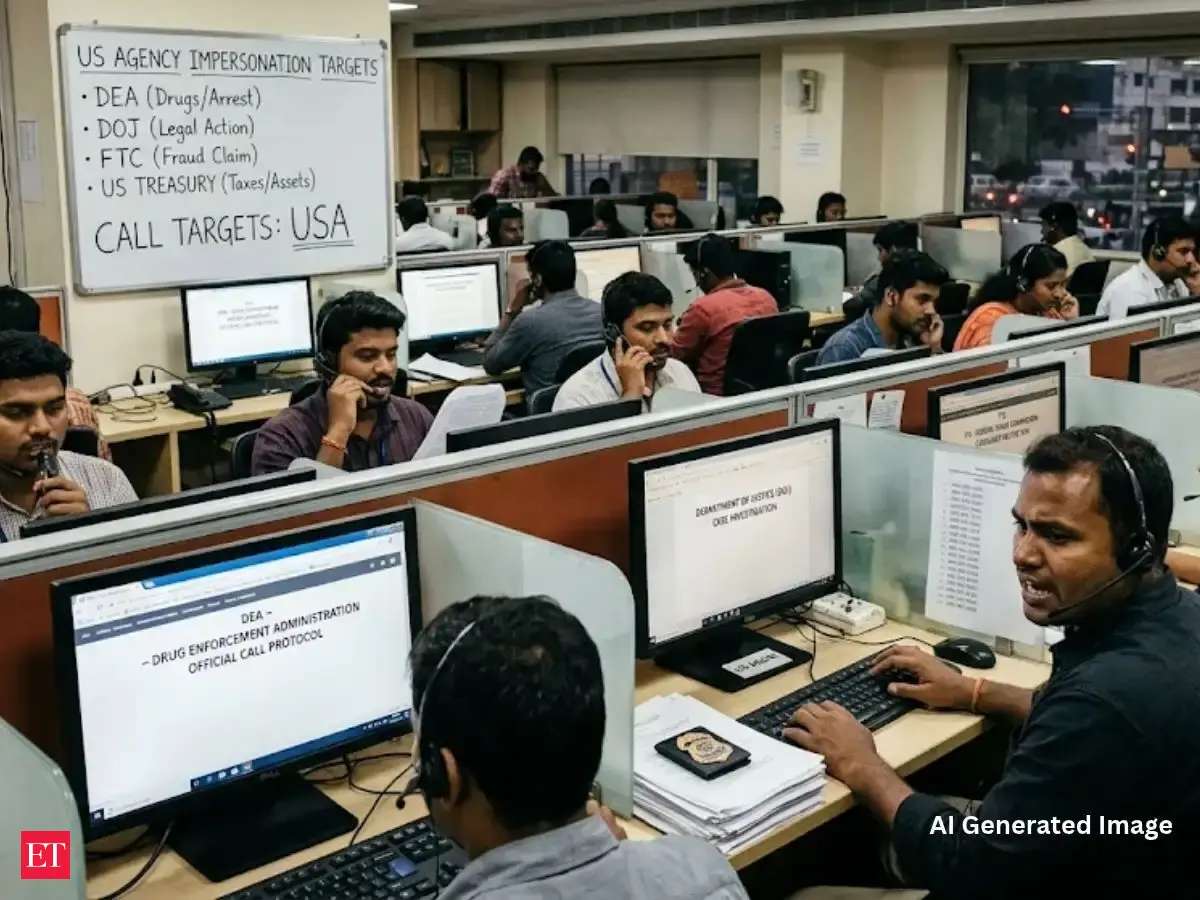
The Enforcement Directorate arrested seven people for running a fake call centre that cheated US citizens of Rs 261 crore. The group impersonated federal officials to scare victims into paying via cash, gold, and crypto. They used lead lists of 20 lakh people to target victims between July 2025 and September 2026.
The Enforcement Directorate has uncovered a fake call centre syndicate that allegedly defrauded US citizens of millions. Investigators arrested seven individuals involved in this international money laundering operation. The syndicate impersonated US federal officials and pressured victims to pay money through various channels. Seized evidence includes forged documents and the personal information of numerous US nationals. The investigation continues to identify additional participants and trace the flow of illegal funds.
The Enforcement Directorate (ED) has uncovered an elaborate international fake call centre syndicate that allegedly cheated US nationals of US$27.39 million (approximately Rs 261 crore) by impersonating officials of American federal agencies, threatening victims with legal action and extracting money through multiple channels. The agency has arrested four more accused in the money laundering case, taking the total number of arrests to seven.
The four accused, Harshil Nayanbhai Raval, Jaswant Singh, Chetan Munjal and Pranav Pithadia, were arrested on November 3 under the Prevention of Money Laundering Act (PMLA), 2002. They were produced before the Special Court (PMLA) at Nampally in Hyderabad, which remanded them to judicial custody.
The ED's investigation has found that the syndicate allegedly collected the money through 927 approved transactions between July 2025 and September 2026. The funds were obtained through cash and gold collections, courier parcels, bank transfers, Bitcoin and gift cards before being converted into Indian currency and routed through cryptocurrency and hawala networks.
How the fake call centre syndicate allegedly targeted US citizensAccording to the ED, the syndicate operated organised calling floors in India, with employees assigned roles as dialers, bankers and closers. Its callers allegedly contacted US nationals using the pretext of fraudulent purchases or suspicious charges on their accounts.
Once they established contact, the callers allegedly impersonated officials of American agencies, including the Drug Enforcement Administration (DEA), Department of Justice, Federal Trade Commission and Department of the Treasury. They threatened victims with legal action and used forged identity cards, badges, official letters and court documents to make the claims appear genuine.
The victims, many of whom were elderly US residents, were allegedly pressured into handing over cash and gold to designated pick-up agents. Others were instructed to send cash through courier services, transfer money to US bank accounts controlled by money mules or purchase gift cards.
The ED said the syndicate also used lead lists containing around 20 lakh US individuals, along with American telephone numbers and auto-dialer servers hosted in Germany and Finland, to reach potential targets.
Fake US government documents and stolen identities used to intimidate victimsThe agency's forensic examination of seized digital devices revealed material allegedly used to identify, profile and intimidate victims. Investigators found Social Security Numbers belonging to 140 US nationals, along with their dates of birth, addresses, bank details and photographs of US driving licences.
The devices also contained forged documents purportedly issued by American authorities. These included notices of seizure and liens on financial accounts, asset forfeiture notices, Treasury assurance letters, a fake US Court of Appeals order and purported legal notices from the Federal Trade Commission and the US Supreme Court.
At least 11 forged identity cards and badges bearing the names of special agents and officials from different US federal agencies were also recovered.
The ED said the seized devices contained details of 397 US bank accounts across at least 15 banks, including Wells Fargo, Bank of America, Thread Bank, Column N.A. and Lead Bank. These accounts allegedly belonged to recruited money mules, victims whose accounts had been taken over, or individuals whose identities had been stolen or synthetically created.
Gold, cash, Bitcoin and hawala channels used to move the alleged proceedsThe syndicate allegedly relied on several methods to collect money from victims and move it across borders. Apart from cash and gold pick-ups and courier parcels, victims were directed to transfer funds to US bank accounts or purchase gift cards.
Cryptocurrency, particularly USDT (Tether) on the TRON network and Bitcoin, was allegedly used extensively to transfer the proceeds. The ED said some victims were also made to deposit cash through Bitcoin ATMs.
The money was subsequently converted into Indian currency through cryptocurrency and hawala channels and routed through accounts in Dubai and other countries, including Hong Kong.
What the ED found during searches at fake call centresThe ED conducted searches at four premises in Patiala, Pune and Chandigarh on September 15. During the operation, investigators detected three operational fake call centres, two in Patiala and one in Pune. Around 220 people were found working at these centres at the time.
Digital devices, cash and documents were seized. Forensic analysis of 79 devices, comprising 65 mobile phones, 13 laptops and computers, and one data storage disk, revealed chats, financial ledgers, calling records, victim details and cryptocurrency wallets allegedly linked to the syndicate.
The analysis has so far identified 549 US nationals as victims and targets. The seized mobile phones also contained 6,463 US telephone numbers that the accused had allegedly called or messaged.
What roles did the four newly arrested accused allegedly play?The ED has outlined specific roles for the four accused in the alleged network.
Pranav Pithadia allegedly owned and managed the Patiala calling floors, which employed 242 people, including 110 dialers. He allegedly handled payment approvals and settlements and directed the movement of proceeds through US money mule accounts and Dubai-based accounts.
Harshil Nayanbhai Raval allegedly maintained the fake call centres' master accounts, recording their earnings, partners' shares and remittances of proceeds to Dubai. He also allegedly invested the proceeds in properties.
Jaswant Singh allegedly coordinated cash collections from US victims through pick-up teams and courier parcels. He was also accused of arranging the conversion of the money into Indian currency through tokens and hawala channels.
Chetan Munjal, described by the ED as a 25 per cent partner in Rabditta Corporates, which operates Kala Ghoda restaurants, allegedly provided protection to the call centre operations. The agency said the company reportedly received Rs 23.19 lakh in proceeds of crime.
Seven arrested as ED traces international money laundering networkBefore the latest arrests, the ED had arrested Vikas Nimar on July 27, Tarachand Nimar on August 5 and Mohd Irfan Ansari on August 10. All three are currently lodged in Central Prison, Chanchalguda, Hyderabad.
The agency initiated its investigation on the basis of scheduled offences involving cheating, forgery and criminal conspiracy under the Bharatiya Nyaya Sanhita (BNS), 2023, corresponding to Sections 420, 467, 471 and 120B of the Indian Penal Code (IPC), 1860.
Further investigation is underway to identify additional proceeds of crime, trace the money trail and establish the involvement of other individuals and entities in the alleged laundering network.