
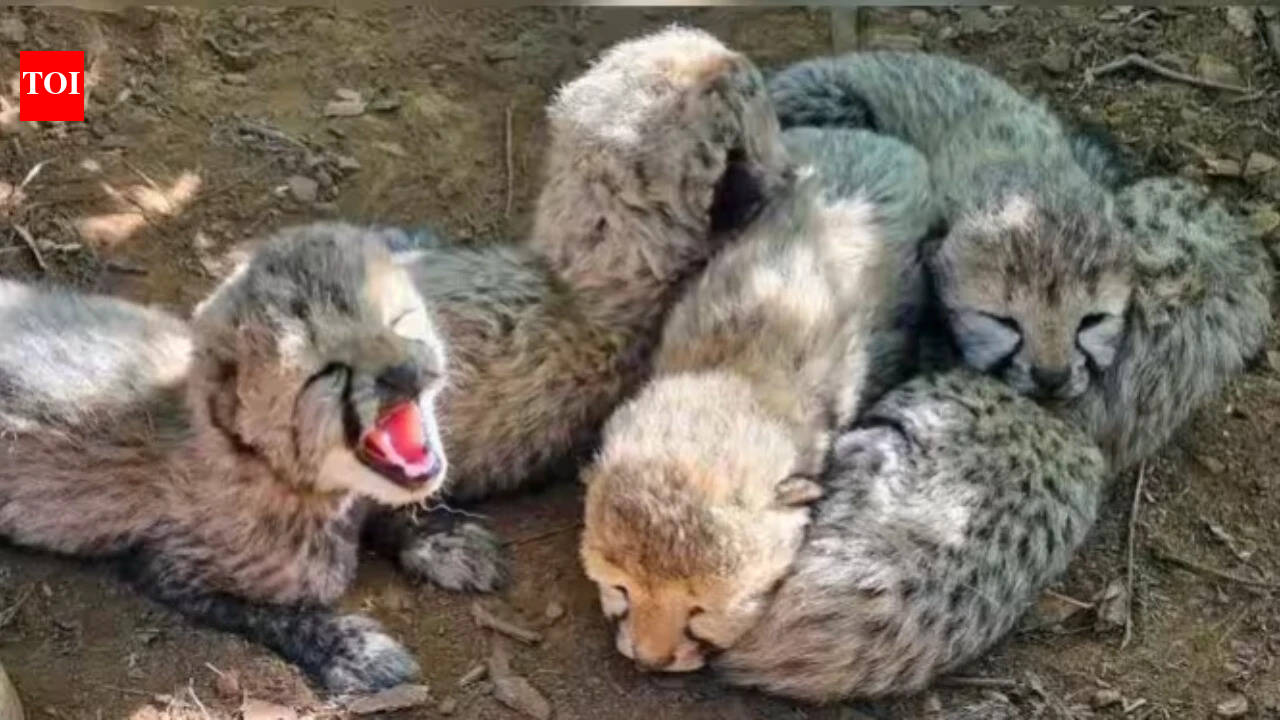
A radio-collared cheetah cub at Kuno National Park was shot at close range, with pellets found in its abdomen on Monday. The 19-month-old cub is stable but remains under treatment in Jabalpur. Special forces rushed in to investigate the attack. Wildlife activist Ajay Dubey said, "Strong action should be taken."
BHOPAL: A radio-collared cheetah cub at Kuno National Park in Madhya Pradesh was shot at close range, sources said, with pellets found lodged in its abdomen on Monday.
The 19-month-old male, one of cheetah Nirva's cubs, is under treatment. His condition is stable but he is not yet out of danger, according to sources.Three or four pieces of metal have been detected inside its abdominal cavity, said sources.The cub has been shifted to a medical facility in Jabalpur for further treatment. It would be the first attack of its kind on a cheetah since the species was reintroduced in the country in September 2022.Cheetahs were declared extinct in India in 1952. Their return is the centrepiece of Project Cheetah, a wildlife programme that brought the big cats from Africa to Kuno, a protected forest in central India.Born at Kuno to Nirva, a mother whose journey helped bring the species back to the country's grasslands, the young male had spent his short life under the watch of the project's monitoring teams.A monitoring team found him injured on the evening of October 25, while he was ranging near the Morena's Territorial Forest Division bordering Sheopur district.He was rescued overnight and brought to Kuno for medical examination and treatment and then shifted to Jabalpur.
Morena is long known for its ravine-dotted terrain and a deep-rooted gun culture and is often described as the arms capital.Since Prime Minister Narendra Modi launched the project in 2022, all cheetahs have been monitored round the clock by the Madhya Pradesh forest department. The monitoring team's prompt detection and overnight rescue reflect those efforts, say officers.The Special Tiger Strike Force, a specialised wildlife protection unit, has been rushed to the area and officers are on high alert.The forest department will also seek help from the Special Task Force, a state police unit, to trace those responsible, officials said. Wildlife activist Ajay Dubey said strong action should be taken against those accountable.People associated with the project since its very beginning say the Union environment ministry (MoEF) and the Madhya Pradesh forest department have taken very good care of the cheetahs, and the results have been very positive."Project Cheetah has exceeded expectations in terms of reproduction rates, far outpacing predictions and rates in Africa, and it continues to apply more resources to ensure success than any other government initiative has done in the past," said Susan Yannetti of The Metapopulation Initiative
Weapon and motive
Investigators suspect a bharmar, a traditional muzzle-loading firearm that is loaded through the barrel and fired with gunpowder.
Such weapons are reportedly still in use in some pockets of the region.However, officials said a forensic and ballistic probe is under way to ascertain whether the weapon was a bharmar or a country-made 12-bore gun, a common shotgun gauge, based on the nature of the pellets and the number of metal pieces recovered.Some officials suspect the shooter fired in panic after a chance encounter in the jungle, possibly mistaking the young cheetah for a leopard. Sources said the shot was fired at close range.A local tribal community traditionally known for hunting bushmeat is among those being looked at, sources said, but no link has been established. Officials stressed that the community's traditional associations do not imply collective involvement.
What officials say
In a statement, Kuno authorities said an investigation was under way to ascertain the cause of the injuries and that "all possible angles" were being examined.
The statement, issued by the Additional Principal Chief Conservator of Forests and Field Director of the Cheetah Project, did not mention a shooting.State chief wildlife warden Samita Rajora said the case was being investigated from all angles and that it was too early to comment. "The cause of injury is being examined," she said.
A risk already on record
The first action plan of Project Cheetah acknowledged that bushmeat consumption is widespread in the region and that many locals eat meat frequently.
It also noted that residents often possess country-made firearms, bows, arrows and other hunting tools.To curb poaching and protect the project, experts had recommended working with the animal husbandry department to set up poultry farms as an alternative source of meat. Little progress has been made on this front.
A pattern of threats around Kuno
Poaching has been a recurring problem around the park.
In April 2022, months before the first cheetahs arrived from Namibia, a leopard was killed by poachers in Kuno's buffer zone.Deer poaching has been a persistent issue, with groups from nearby villages often entering protected areas to hunt. In August 2023, authorities seized a rifle hidden near a river close to the park's entrance and arrested three other suspected poachers in the same area.Forest officials have also long suspected such groups of stealing camera traps to avoid detection.In 2024, a patrol team at Kuno allegedly foiled an attempt by suspected poachers to enter the Moravan West Range, where the recently released cheetahs Aagni and Vaayu were roaming.According to local media reports, the poachers opened fire when surrounded and fled. Suspicion fell on local tribesmen hunting for bushmeat, though Kuno officials could not be reached for confirmation at the time and the poachers were never identified.
Inside the bharmar: the old-style gun investigators suspect in this case
A bharmar is a country-made, muzzle-loading, smoothbore gun, still reportedly used in some pockets of central India.
The shooter loads it by hand through the barrel with black powder, a wad of cloth or paper and a projectile, which can be a single lead ball or a handful of crude lead shot, and a priming charge or percussion cap ignites the load.
With no rifling, the gun is inaccurate beyond short distances and is typically fired from close range, and loose shot can leave several pellets embedded in tissue or organs, say experts.