
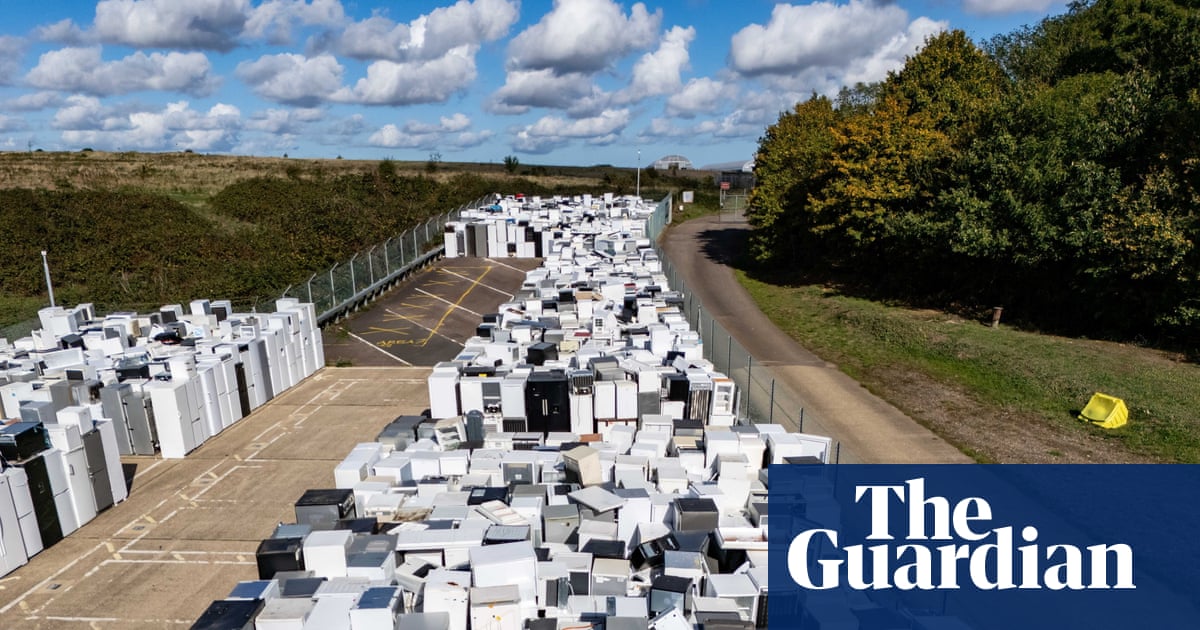
This summer, 26 local authorities in the UK stopped accepting fridges for recycling, leaving piles of appliances across the country. In Norfolk, over 3,000 fridges sit in a field. Kate Murrell said, "It's not what we want to see here, or what the local residents want to see either."
This summer alone, 26 local authorities in the UK had to stop accepting fridges and freezers for recycling. Now the appliances are piling up around the country - with no proper disposal date in sight
Not much is happening in the tiny Norfolk hamlet of Little Hautbois on the day I visit. The pub, once popular with airmen from RAF Coltishall, stopped being a pub a long time ago, even before RAF Coltishall stopped being RAF Coltishall. It's not Saturday, so there are no weddings at Hautbois Hall. Nor is it 19 May, so the restless, headless ghost of Thomas Boleyn isn't driving his carriage across the bridge over the River Bure, as he is said to do on the anniversary of the execution of his daughter, Anne. Today, a lovely autumn one, all is as it should be.
But half a mile down a narrow country lane is an incongruous and baffling sight: a strip of gentle hillside made up of large white rectangular blocks, piled up and sparkling in the sunshine. A glacier, you might think, if you were in Norway rather than Norfolk. (And ice is involved, as it happens.) As you get nearer, the picture becomes clearer; the blocks have coils on one face, doors and handles on the opposite one, plus the manufacturers' names. It's a glacier of fridges, more than 3,000 of them.
Kate Murrell, the assistant director of waste management at Norfolk council, is here to let me in. The fridges are surrounded by a security fence with CCTV cameras. "It's not what we want to see here, or what the local residents want to see either," says Murrell. The nearest local resident, Stuart Brown, tells me over his garden fence that it is "a bit of an eyesore".
These eyesores are not particular to Norfolk. All around the UK, old fridges are piling up, including in Nottinghamshire, Durham, Oxfordshire, Gloucestershire and Newport, the last of which found itself with a mountain of 80,000 appliances over the summer. So what is behind it?
In part, it is because fridges and freezers are difficult to dispose of. David Santillo, a senior scientist with Greenpeace Research Laboratories, based at the University of Exeter, explains that they contain gases and materials that are harmful to the environment if the appliances are not dismantled correctly. Thus, by law, fridges have to be dismantled at specialist processing plants. The problem is that the number of these plants is shrinking rapidly in the UK.
In Norfolk, a fire at an electrical waste and treatment facility in Thetford in April meant there was nowhere to recycle fridges and freezers for two or three months, which caused a pile-up. "If you got a new fridge and took the old one to the tip, they turned you away," says Murrell. Then came this summer's record-breaking temperatures, which caused more fridges and freezers to break down - and some processing plants to shut temporarily. As Murrell says: "During Covid, people upped their refrigeration capacity at home," so there are even more appliances to deal with.
After the Thetford fire, Norfolk council ran out of treatment facilities to which it could send fridges. Thetford was one of just eight full-scale processing plants for fridges in the UK; another major plant in south Wales shut down when the recycling company Unimetals filed for liquidation and a plant in the West Midlands closed in February due to a fire. This summer alone, 26 local authorities had to stop accepting fridges and freezers. Compared with Newport's 80,000 fridge mountain, this Norfolk site maybe doesn't look so terrible, though the stark contrast with its bucolic surroundings certainly adds to the shock value.
"It's nationwide," says Jon Hubbard, the chair of the Local Government Association's neighbourhoods committee. "I'm hearing more and more reports of councils struggling. In my own local authority in Wiltshire, I see large quantities of fridges and freezers piling up. It's certainly not getting any better."
Santillo says the main danger with these appliances is the refrigerants. "Lots of different chemicals are used as refrigerants. Very old fridges could contain CFCs, which are ozone-depleting substances. There are almost certainly going to be HFCs, which are potent greenhouse gases. Others will contain propane and isobutane. Commercial fridges can contain ammonia."
Once removed and isolated, he says: "The refrigerants can be recycled and reused or, in the case of some of the old ones, they would need to be incinerated. Then you have the foams used for insulation, which can contain hazardous substances such as fluorinated compounds that also have to be recycled or incinerated."
While some of the fridges at Little Hautbois are clearly quite old, others look pretty recent - in working order even. Murrell says they probably are. Often the fridges are disposed of because the owner wants an "upgrade, or it's a new kitchen and they want one that fits in with this, not that". Some just aren't built to last or are impossible to repair.
Santillo says manufacturers could do a lot more to stop fridges and freezers needing to be disposed of. "They could find ways of making them last longer. They're a significant investment and some of them aren't very robust." It doesn't help that we no longer get things fixed. "The weakest link is always the compressor; once that goes, it becomes so expensive to fix that people tend to just get a new fridge."
Hubbard points a finger in another direction - at the producer compliance schemes that coordinate the collection, recycling and disposal of fridges and freezers in the UK. The idea is that the polluter pays, but because treatment capacity has been hit so hard, producers haven't been able to keep up, so councils are having to handle and fund the collection, storage and treatment of these goods. "We're picking up the phone, and they're not answering," says Hubbard of the schemes. "They need to come up with a proper business plan to get back up to full-scale recycling again. In the short term, they need to come up with a solution to storage." At the moment, this is also falling to local authorities. "It's costing money that should be spent on libraries, sports centres, fixing potholes, delivering health and social care," he says. Murrell says more help needs to come from central government: "What the country needs is a more resilient infrastructure to deal with fridges and freezers at the end of their lives."
The other worry, says Hubbard, is the risk of fly-tipping when council disposal services are forced to halt. "Council-tax payers are being scammed by people who claim to be legitimate waste disposal organisations, collect your fridge and then dump it where they shouldn't. And if that fridge can be tracked back to a resident, it's the resident who gets prosecuted." He advises people to take photographs of any disposal company's licence.
And the piles of fridges building up? "Recycling fridges should be about containment," says Santillo. "You have to take the refrigerant out, contain it, then that goes on for further treatment. That's clearly broken down and they're just being dumped. They certainly shouldn't be left to fall apart and fragment in the environment."
He has an additional concern. "If you have piles of fridges and freezers, they're going to become home to wildlife; they're great places to attract animals that like to live in small spaces." Murrell says that here in Norfolk, pest control come in regularly and haven't discovered any new residents, gnawing away at fluorinated insulation. But looking up at the kestrel hovering overhead, I wonder. I don't think it's after putrefied turkey twizzlers.
Norfolk is now accepting fridges, but only at seven of its 19 recycling sites, which is all that can be managed. "That's a way of reducing the volumes we get in," says Murrell. "Customers might have to travel a bit further and so think twice about disposal at the moment."
A spokesperson for the Department for Environment, Food and Rural Affairs says these delays are "frustrating" and that the minister responsible for waste crime has written to producer compliance schemes asking them "to take all reasonable steps to fix this fast, as this cannot go on any longer".
The spokesperson added: "We appreciate the challenges facing local authorities, and are working closely with them, the Environment Agency and industry to manage the impact of capacity shortages, including allowing temporary storage sites and looking at long-term solutions to ensure this does not happen again."
In the meantime, the site here outside Little Hautbois is full, with no room for any more fridges. Nor are the ones already piled up here going anywhere at the moment, and Murrell is not hopeful that this will change any time soon. "Until we see national capacity really increase, councils like us are going to see disruption to the services. I think this one's stuck for quite a while."
Chances are then that next 19 May, when Thomas Boleyn comes riding through with his phantom horses and carriage, he'll look to the side of the road and think: "What an eyesore!"