
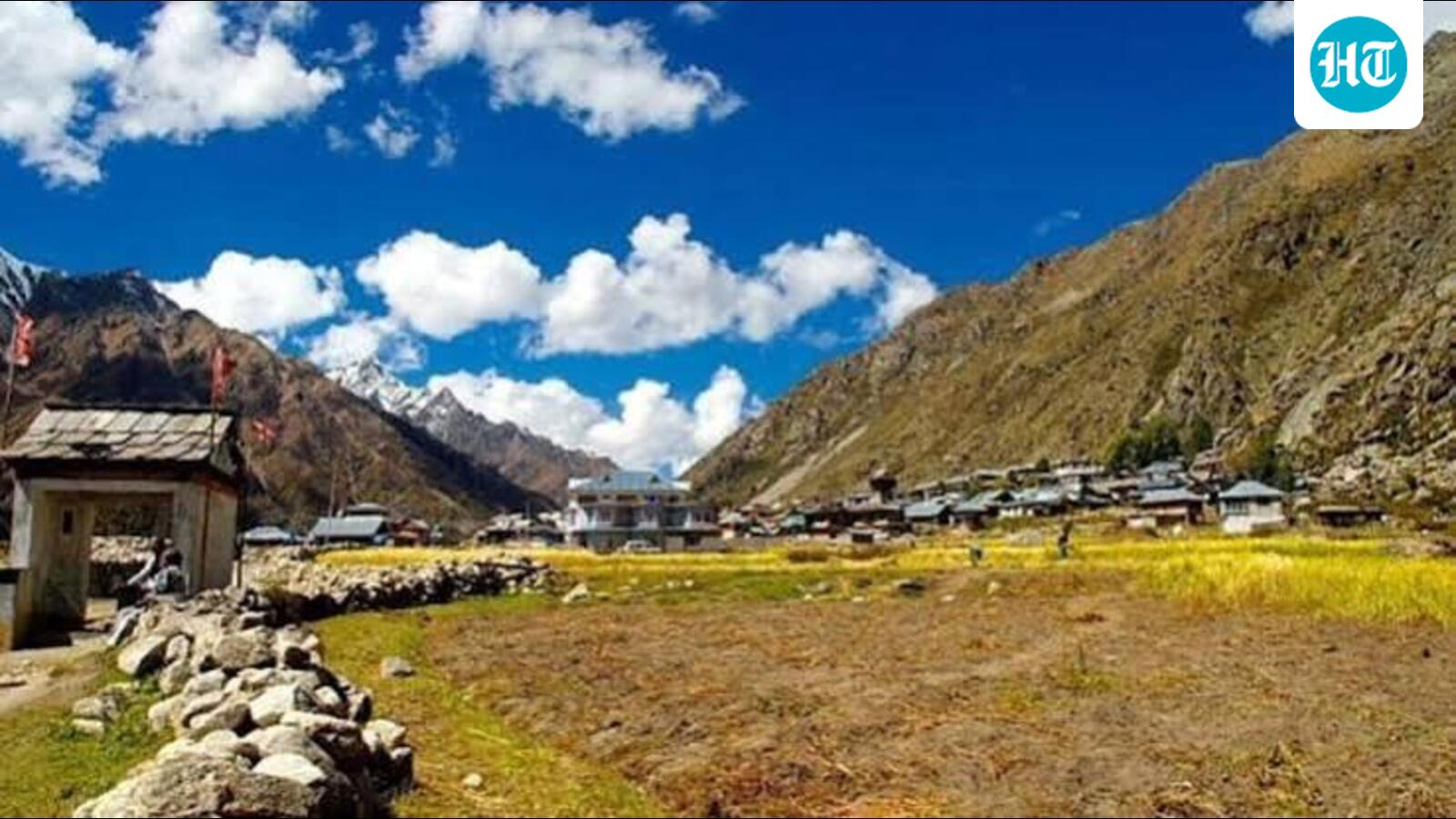
Villages across Himachal Pradesh are adapting to climate change by shifting crops and reviving water springs. A new CEEW study shows farmers in Mandi, Kullu, Sirmaur, and Shimla districts now use resilient farming methods. Duni Chand Rana said, “State moving from reactive to proactive measures” to tackle frequent flash floods.
Farmers in Bajaura who moved from apple to pomegranate and now persimmon, women’s groups in Thana Kashoga reviving their baoris, and one of the state’s first village disaster management committees in Shoghi are among the adaptation efforts under way in all 12 gram panchayats across Mandi, Kullu, Sirmaur, and Shimla districts.
These findings are from a new independent study by the Council on Energy, Environment and Water (CEEW), supported by the International Centre for Integrated Mountain Development (ICIMOD), was released on Saturday.
The study shows that the farmers are changing what they grow in Sandhu, Shimla. Community members report that natural farming has spread to more than 20 families after it proved profitable and more resilient to extreme climate events. In Bajaura, Kullu, the shift to persimmon came as plant viruses began hitting pomegranates. In Parara, Sirmaur, people have adopted integrated farming, combining garlic with special apple varieties.
Villages are bringing natural water sources back. Thana Kashoga in Sirmaur once had 35 perennial baoris (spring-fed water tanks), though only 10 remain. Trained by the People’s Science Institute and the Centre for Business and Entrepreneurial Development, women’s groups now clean them monthly, and five springs have been revived, with five or six more underway.
Panchayats are organising for disasters. For instance, Shoghi, near Shimla, set up a village disaster management committee with the NGO ADRA India after the 2023 landslides and floods. Since then, it has trained villagers in first aid and evacuation. However, few villages in the state have established such committees so far.
The Himachal Pradesh State Disaster Management Authority (HPSDMA), which supported the study, launched The Aapda Rakshak Scheme in 2026.
‘State moving from reactive to proactive measures’
Releasing the CEEW study, “How can himalayan communities anticipate risks and adapt to a changing climate?”, managing director, Horticultural Produce Marketing and Processing Corporation (HPMC), Duni Chand Rana, said, “CEEW’s research draws on ground-level evidence from across Himachal Pradesh, capturing how gram panchayats are experiencing climate extremes and identifying measures to strengthen their resilience. Increasingly frequent flash floods, cloudbursts and heavy rainfall are disrupting lives, essential infrastructure, horticulture, supply chains and tourism.”
Nishant Thakur, additional secretary, revenue, disaster management, HPSDMA, said, “Recent floods and landslides have caused over ₹20,000 crore in losses, highlighting the need to strengthen disaster preparedness. The state is leveraging GIS, rapid incident reporting systems and emerging technologies to identify risks and improve response. Our focus is now on shifting from reactive to proactive measures, developing gram panchayat-level disaster management plans with support from research institutions.”
Shreya Wadhwan, programme lead and co-author on the study, CEEW, said, “The cases we documented follow one pattern: a local champion, such as a farmer, a women’s group or a village committee, and a supporting hand from a krishi vigyan kendra, an NGO or a government scheme. Where both are present, impact multiplies. The next step is to make such pairings the norm, so that panchayats can act before a hazard becomes a disaster.”
Dr Amina Maharjan, ICIMOD, said, “The Hindu Kush Himalaya is warming faster than the global average, and what happens in its mountain villages impacts the 1.9 billion people downstream. Himachal’s panchayats show that adaptation can start with villagers, and the experience of Nepal, Bangladesh and Bhutan shows that building foresight into climate adaptation and disaster management is possible. We hope this evidence travels across the region.”
Rajeev Ahal, executive director, HITA, said, “Climate adaptation requires states, districts and villages to work together to map risks, plan responses and implement strategies suited to their local contexts.”