
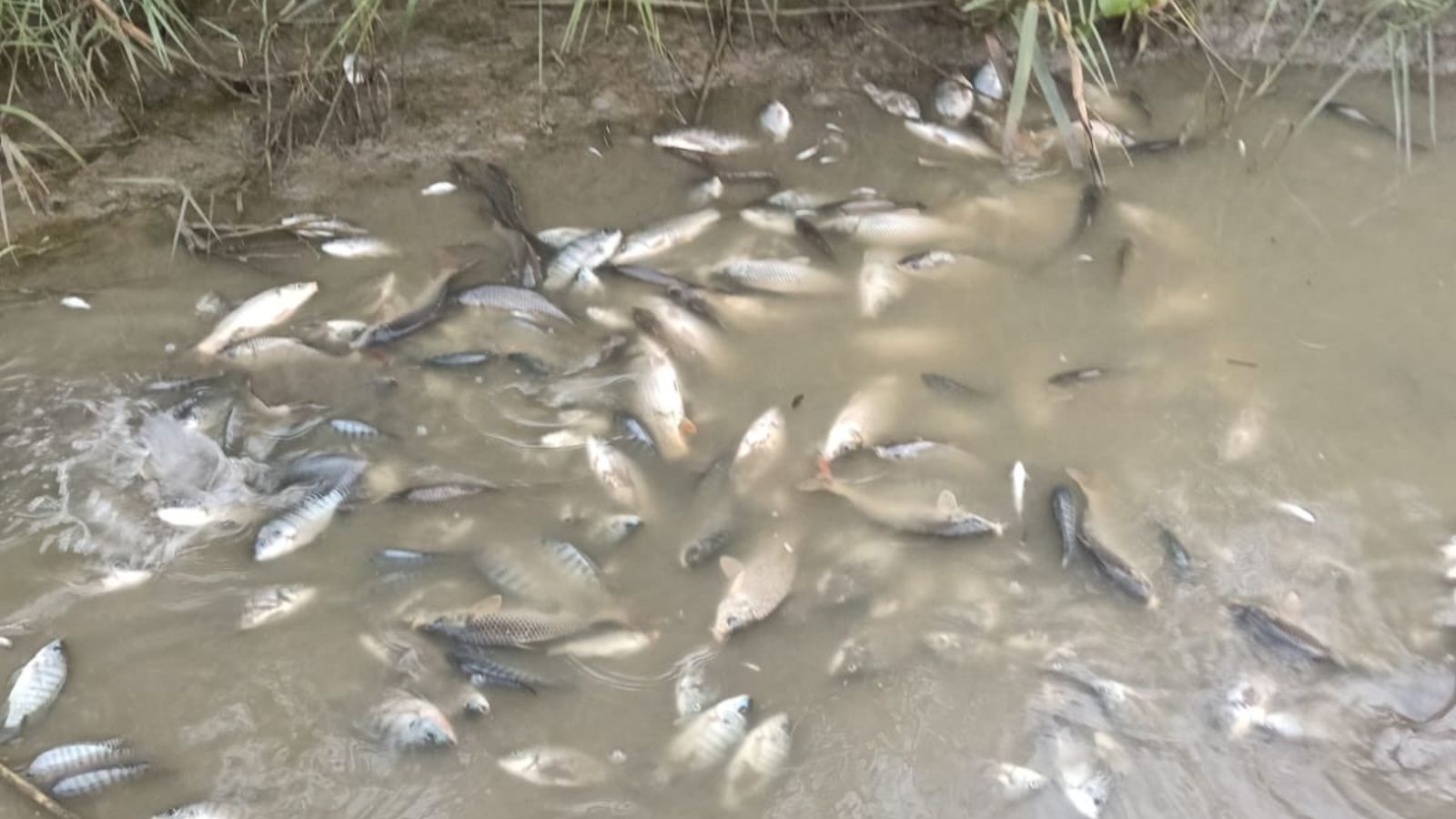
Thousands of dead fish were found along the Yamuna banks near Burari on October 14. Expert Bhim Singh Rawat said, "This latest incident is particularly unusual and poses a serious threat to the river's remaining aquatic biodiversity." Many locals blamed illegal chemical waste discharge from Haryana for this recurring tragedy.
मूल अंग्रेजी लेख का निम्न अनुवाद AI द्वारा किया गया है। AI द्वारा अनूदित लेखों में त्रुटि हो सकती है। किसी भी शंका या स्पष्टीकरण के लिए मूल अंग्रेजी लेख देखें।
Thousands of dead fish found along the banks of the Yamuna near Burari in North Delhi on Wednesday have sparked concerns among experts.
The incident occurred in the stretch upstream of the Wazirabad Barrage, where recurring fish deaths have occurred. Species including Tilapia and Common Carp were found washed ashore and floating in shallow water.
Bhim Singh Rawat, an expert on Yamuna and member of the South Asia Network on Dams, Rivers and People (SANDRP), said the recurring mass mortality of fish in this stretch was concerning. "This latest incident, occurring just after the monsoon season, is particularly unusual and poses a serious threat to the river's remaining aquatic biodiversity," he said.
Several drains in Haryana carry wastewater from industrial and urban areas into the Yamuna. These include the Dhanaura drain and drains No. 2 and 8, which receive wastewater from areas including Karnal, Panipat and Sonipat.
In submissions to the National Green Tribunal (NGT), official records had identified 105 illegal discharge points leading to Drain No. 2 in Panipat. Of these, 48 had been reported closed, while action against the remaining 57 was pending.
Last November, the CM Flying Squad and the Haryana State Pollution Control Board intercepted 13 tractor-tankers and registered cases against 27 people over alleged illegal dumping of industrial waste in areas including Kurar, Chhajpur and Jalalpur.
The New Delhi Nature Society, a nonprofit, shared photographs and videos of the incident on X on Thursday, reporting that the fish deaths occurred on October 14.
The society said locals had alleged that chemical waste was being discharged into the river from Haryana through canals. The allegation has not been independently verified.
Environmentalists have also raised concerns over restricted environmental flows in the Yamuna. Rawat said that the current rate is around 10 cubic metres per second (cumecs), against average hourly inflows of approximately 300 cumecs at the Hathnikund barrage in Haryana.
Mass fish deaths were reported in the Burari stretch in May last year as well.
Earlier this year, in May, hundreds of fish died at Sanjay Lake in East Delhi during a heatwave and as water levels receded. The incident was triggered as the lake relied on 10 million gallons per day of treated water supplied by the Delhi Jal Board from the nearby Kondli sewage treatment plant (STP) and a high-density polyethylene pipeline was severely damaged, which had completely stalled the fresh water supply.