
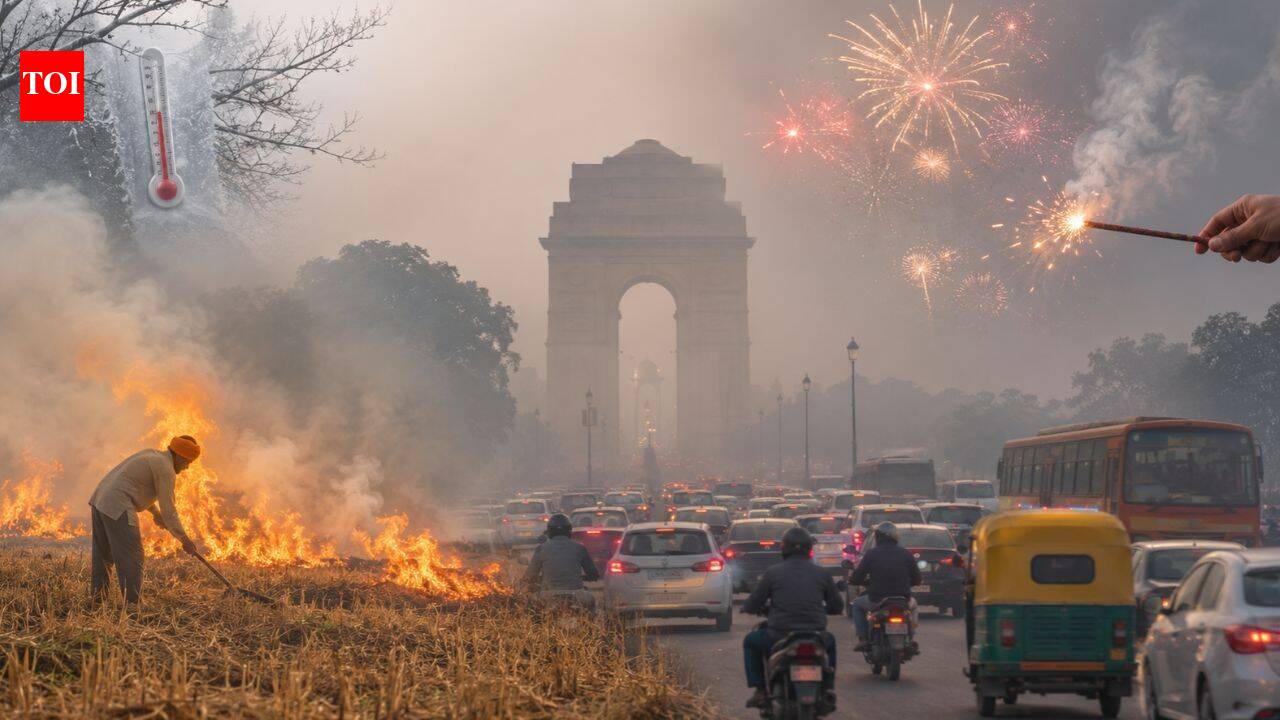
Delhi has entered its most polluted fortnight, running from November 1 to 15. Data showed this period often records the year’s highest AQI levels. Anumita Roychowdhury said, "As seasonal farm and waste fires combine with local traffic emissions, industrial combustion, and festive firecrackers, the airshed becomes a hotspot." Stay safe.
NEW DELHI: The worst of Delhi's pollution season may be here. The capital has entered the fortnight that usually records the year's highest AQI levels, coinciding with a peak in farm fires, increased traffic around festivals, additional emissions from firecrackers and unfavourable meteorological conditions that trap pollutants.
An analysis by TOI of CPCB data from 2015 till now revealed that Nov 1-15 is the capital's most polluted period in a year, with a high number of severe days and average AQI of 374.This year, Diwali will be celebrated on Nov 8 and the share of stubble burning in Delhi's air quality is expected to rise significantly in the coming days. Ahead of the wedding season and festivals, the city also witnesses an increase in traffic congestion. Firecrackers, moreover, add to the existing pollution load.Anumita Roychowdhury, executive director-research and advocacy, Centre for Science and Environment, said Delhi has once again entered its most difficult winter phase, where plummeting temperatures, calm winds, and atmospheric inversion trap toxic emissions close to the surface."As seasonal farm and waste fires combine with local traffic emissions, industrial combustion, and festive firecrackers, the airshed becomes a hotspot.
Yet forecasting trends in gross pollution and source emissions remains challenging. It is, therefore, necessary to track more diligently real-time action and emission changes on the ground in Delhi and across NCR," said Roychowdhury.
Last year, this period was relatively better due to an early Diwali and the low impact of stubble burning. It still saw three severe days, with an AQI above 400 on a scale of 500. In 2024, Delhi saw eight 'severe' days in Nov, and of these, two were recorded in the first half of the month. In 2023, the city recorded six severe days in the Nov 1-15 period.The second most polluted fortnight in a year, analysis of CPCB data showed, is Dec 16-31, with average AQI of 346. This fortnight witnesses low temperatures and dense fog which traps pollutants. It also records increased traffic and use of firecrackers due to wedding season, Christmas and New Year's Eve. Last year, this period saw five severe days, including a severe-plus day when AQI touched 461.The third most polluted spell is typically Jan 1-15 when unfavourable meteorological conditions, including dense fog, low temperatures and calm winds, continue. From 2016 to 2026, average AQI for Jan 1-15 was 329.3.CPCB has been calculating the AQI since April 2015.
The Nov 16-30 period is close behind, with average AQI of 329, followed by Oct 16-31 when winter starts setting in, with average AQI of 281.