
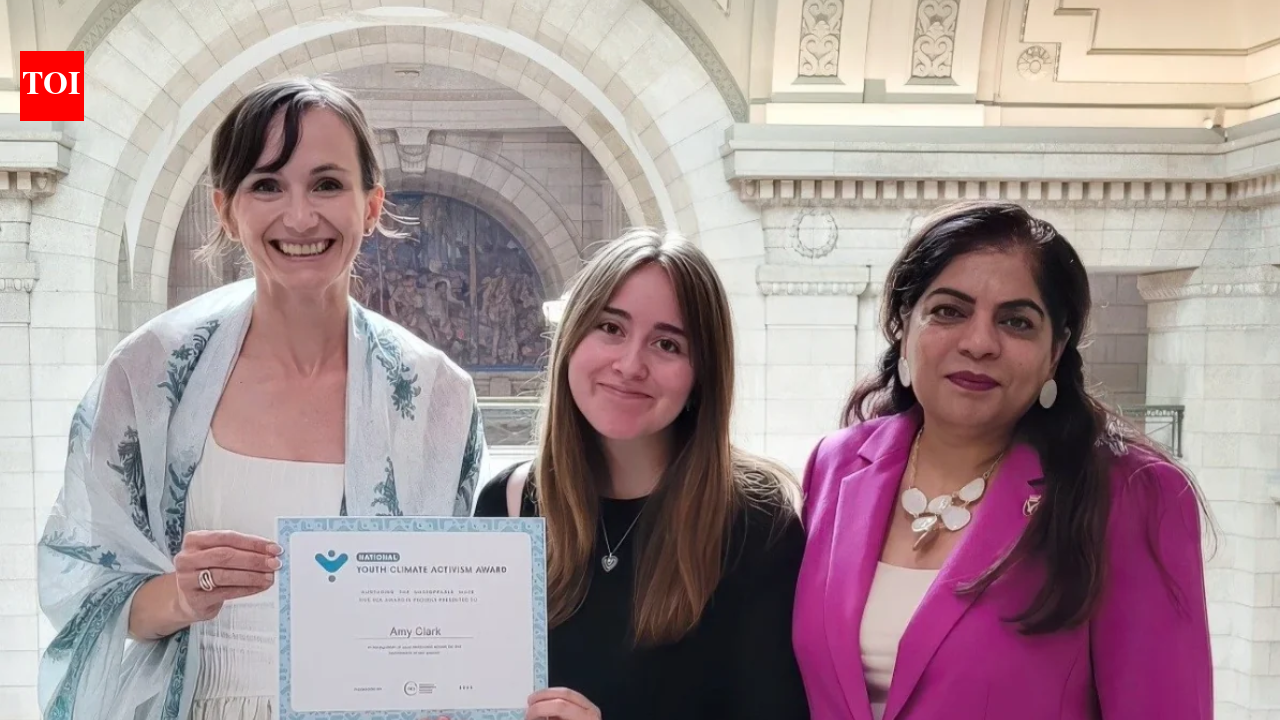
Amy Clark, a student from southern Manitoba, built a homemade cloud chamber to study radon gas risks across three Canadian provinces. Her project won a gold medal at the Bison Regional Science Fair. Now, she is developing a device that generates electricity from vibrations to help lower carbon emissions.
Amy Clark, a student from southern Manitoba, built a homemade cloud chamber to study radon gas, described by the Youth Climate Activism Award page as the second leading cause of lung cancer. She used soil samples from Manitoba, Saskatchewan and Alberta to investigate radon activity across the Canadian Interior Plains, and the Manitoba samples showed the highest radioactive activity among those tested. The project won a gold medal at the Bison Regional Science Fair. This year, she turned to kinetic energy harvesters, developing a device that generates electricity from vibrations to reduce reliance on disposable batteries and lower carbon emissions.
How Amy Clark uses science to solve real-world problems
According to the Youth Climate Activism Award page, Amy has competed in science fairs since Grade 7. She combines her interests in physics, engineering and environmental science to tackle real-world challenges affecting both people and the planet.In her answers to the submission questions, Amy says she has done science fairs for four years. She also describes living in a small community in rural southern Manitoba, where she has seen fields dry up in drought every summer and snow arrive later every winter.
She says she started using science fairs as a way to turn her worries into something useful.
Amy Clark built a homemade cloud chamber to study radon risks
Amy focused her research on radon gas last year. It describes radon as a naturally occurring radioactive gas and the second leading cause of lung cancer. To study radon risks across the Canadian Interior Plains, she built her own homemade cloud chamber, which the page describes as a device that allows ionising radiation to become visible to the human eye.The project was titled "Beneath the Surface". Amy collected soil samples from Manitoba, Saskatchewan and Alberta. She used them to investigate where radon exposure risks may be highest and how climate may influence radon prevalence over time.
Amy Clark earns national recognition for radon research
The Youth Climate Activism Award page reports that the Manitoba samples showed the highest levels of radioactive activity among those tested. It adds that radon is the second leading cause of lung cancer worldwide, and that Amy hopes her work will help inform both the public and policymakers about this often-overlooked environmental health risk.The project won a gold medal at the Bison Regional Science Fair, where Amy also received the Best Environmental and Climate Change Project Award, a SHAD scholarship and an award from the University of Manitoba. She was then selected to represent Team Bison Manitoba at the Canada-Wide Science Fair in Fredericton, where she received the Canadian Nuclear Society Nuclear Science and Technology Award. She spoke with environmental scientists and Manitoba government ministers about the importance of environmental research and policy, helping to raise awareness about radon exposure and climate-related risks.
Amy Clark explores sustainable energy through kinetic energy harvesting
This year, Amy turned her attention to sustainable energy solutions through research on kinetic energy harvesters. Her project explores ways to improve the efficiency of these systems by studying resonators and energy containment amplification to reduce reliance on disposable batteries and lower carbon emissions. In her submission, Amy says her research into energy containment, known as Q-factor, led her to develop a device that generates electricity from vibrations.
The project earned another gold medal at the Bison Regional Science Fair, along with the Best Intermediate Project Award and a second SHAD scholarship. Amy was selected for a second time to represent Team Bison Manitoba at the Canada-Wide Science Fair, held this year in Edmonton. Looking ahead, she says she wishes to keep working with scientists to investigate how climate change is shifting radon gas levels in Canada. She said, "My goal is to prove that innovation is our best defence against climate change."