
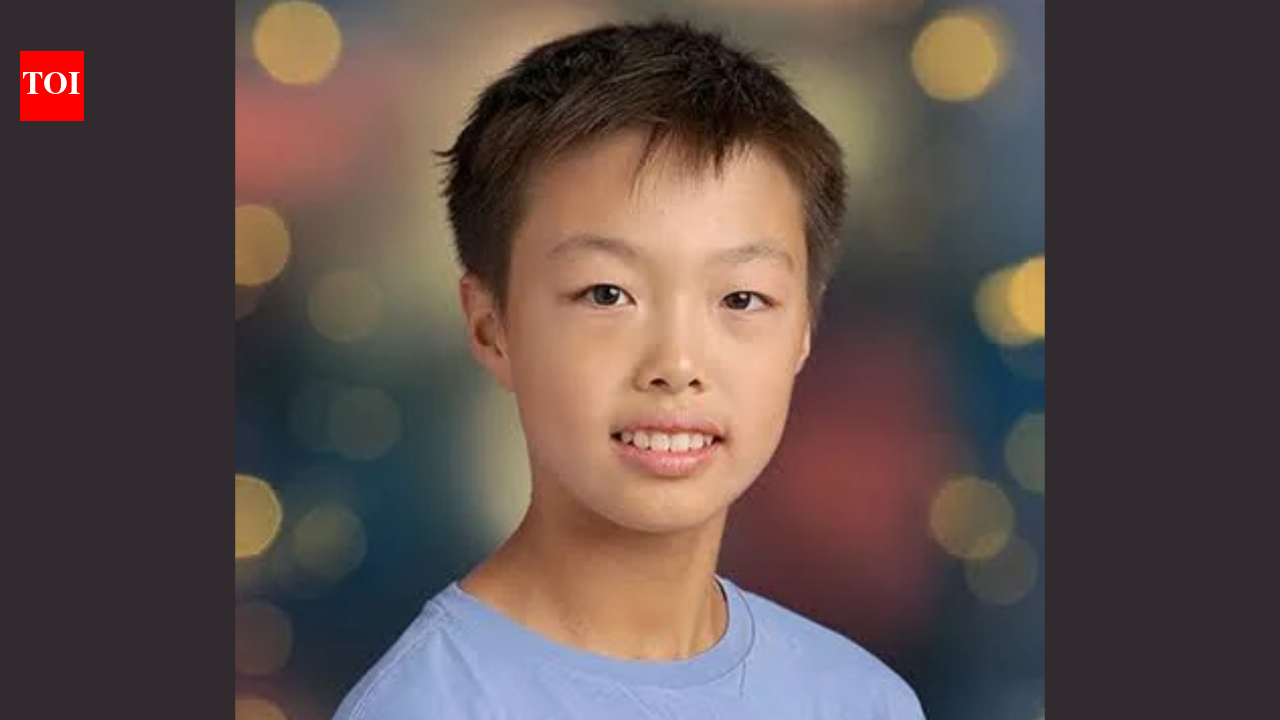
Bowen Wang, a seventh grader from San Carlos, won the $3,500 first-place technology award at the 2026 Thermo Fisher Scientific Junior Innovators Challenge. He built an AI tool called Aftershock Oracle to predict earthquake aftershocks. Bowen said, “They follow distinct, predictable patterns that correlate to the mainshock, making them” easier to study.
Bowen Wang, 2026 Junior Innovator. Source: Society for Science
A 12-year-old student from California has won a top national technology prize. He designed an artificial intelligence tool that can forecast earthquake aftershocks. Bowen Wang is a seventh-grade pupil at Central Middle School in San Carlos. He built a program called Aftershock Oracle. It predicts where secondary quakes will strike, how often they will happen, and how strong they will be after a major earthquake. His research won him the First Place Technology Award and a $3,500 prize at the 2026 Thermo Fisher Scientific Junior Innovators Challenge. The Society for Science organized the contest in Washington, D.C. It is the top national science, technology, engineering, and mathematics (STEM) contest for middle school pupils across the United States. Bowen lives in Northern California. His family’s closeness to active fault lines inspired his research. “My house is only a few miles away from the San Andreas Fault,” Bowen stated in his competition profile published by the Society for Science. “Over the past year, there have been several earthquakes that woke me up at night.” Scientists have always found main earthquakes very hard to predict. But Bowen saw that aftershocks follow clear physical patterns linked to the first rupture. That makes them a better fit for studying with data.
Comparing artificial intelligence models
To build the Aftershock Oracle tool, Bowen gathered decades of earthquake data kept by the United States Geological Survey. He studied quakes recorded between 1950 and 2025. He collected details about the edges of tectonic plates. He also split the first main quakes from the aftershocks that came later. He used this past data to test three machine learning models: Logistic Regression, Random Forest, and Extreme Gradient Boosting, known as XGBoost. According to his project documents published by the Society for Science, all three models predicted well. But XGBoost was the most precise. Bowen put XGBoost into his own custom interface. Users can enter basic facts about a first earthquake, such as its magnitude, depth, and epicenter location. The system then gives probability-based predictions. They show where, when, and how badly aftershocks are likely to hit nearby areas. Bowen pointed out that first earthquakes make the headlines. But aftershocks create serious dangers for first responders, damaged buildings and roads, and communities trying to get people out of collapsed buildings. “They follow distinct, predictable patterns that correlate to the mainshock, making them possible to study and predict,” Bowen noted in his Society for Science profile.
National competition recognition
The Thermo Fisher Scientific Junior Innovators Challenge picks its 30 national finalists from thousands of middle school pupils. These pupils entered local and regional science fairs across the United States. Bowen reached the national stage after presenting his work at connected science fairs, including the San Mateo County Science and Engineering Fair, as shown in regional STEM network records. In the final judging rounds in Washington, D.C. , a panel of professional scientists and engineers scored the finalists. They looked at scientific rigor, technical problem-solving skills, and how well each finalist could explain their work to the public. Bowen’s first-place technology award includes $3,500 to support his education and his ongoing research projects. The Society for Science noted that Bowen’s work shows how young researchers can use free, open-source earthquake data to build practical tools for public safety and disaster management.
Athletic discipline and career plans
Besides his computer science research, Bowen keeps a busy schedule outside school. He plays ice hockey and reads a great deal. “Hockey helps build mental discipline and trains me to stay focused under pressure,” Bowen shared in his Society for Science profile. He added that reading is a basic part of his daily life, stating: “Reading has redefined the way that I look at myself, and I think of it as not just a hobby, but a part of who I am. ” Looking ahead, the San Carlos student plans a career in structural and civil engineering. He wants to blend modern design with protecting the environment. “One day, I will start my own firm and prove that practical, modern design and ecological responsibility can coexist,” Bowen stated in his official finalist biography. The Society for Science confirmed that Bowen and the other 2026 Thermo Fisher Junior Innovator winners will serve as ambassadors for youth STEM programs. They will encourage primary and middle school students to take on independent research projects in their own communities.