
Palestine highlighted the environmental impact of the war in Gaza at the COP31 conference in Antalya, Türkiye, which ended on November 22. Turkish President Recep Tayyip Erdoğan said, "What has unfolded in Gaza is not merely a genocide, but also an 'ecocide' - the destruction of the environment."
The war in Gaza has destroyed not only homes, hospitals and schools, but also farmlands, water sources, sewage systems and the natural environment, the very foundations on which any society's future depends. In this context, climate justice for Palestine goes beyond environmental protection. It is fundamentally about Palestinian people's rights to their land, water and natural resources. At the UN Climate Change Conference (COP31), held in Antalya, Türkiye, Palestine sought to draw international attention to this critical issue. While the conference concluded on November 22 with no comprehensive agreement, discussions on the environmental devastation in Palestine, the Israeli occupation and the urgent need for reconstruction brought an important political dimension to the global debate on climate justice.For Palestine, the significance of COP31 lay not in securing substantial funds for reconstruction, but in bringing up climate crisis, the Israeli occupation and the environmental destruction caused by war, and Palestinians' rights over their natural resources onto the international platform.
This was made possible largely through Türkiye's diplomatic initiative.The reality is that climate crisis cannot be separated from war, occupation and political oppression. Where homes, farmlands, water sources, power infrastructure, and sewage networks have been systematically destroyed, discussions about climate adaptation and environmental protection are no longer simply technical or developmental matters - they become questions of survival and justice.The address delivered by Turkish President Recep Tayyip Erdoğan at COP31 was particularly significant. Describing the environmental destruction in Gaza as an "ecocide", he called on the international community to recognise the ecological consequences of Israel's attacks.
He stated, "What has unfolded in Gaza is not merely a genocide, but also an 'ecocide' - the destruction of the environment."Palestinian pavillion's exhibit at COP31 in Antalya, Türkiye. Photo: Afroz Alam SahilErdoğan also drew attention to the loss of centuries-old olive trees in Palestine, the contamination of soil and water, and the widespread destruction of urban areas.My attention was first drawn to this issue during an address in Ankara on October 27, 2026. I was present at the auditorium of the Turkish Presidency's Directorate of Communications, where its head, Burhanettin Duran, was speaking at the opening session of a panel.
Referring to Gaza, he pointed out that war does not simply claim human lives; it also devastates the environment. The consequences of Israeli attacks extend beyond the loss of life and the destruction of buildings. The carbon emissions generated by warfare can further intensify the climate crisis. Also read: Three Years of Israel's Genocide in Gaza and India's Complicity in ItDuran stated that carbon emissions resulting from Israeli attacks on Gaza since October 7 exceed the annual emissions of hundreds of individual countries. His remarks raised an important question: if wars can cause such extensive environmental damage, why does this aspect receive so little attention in global discussions?It was precisely the question that needed to be raised at COP31 too.
If climate justice is about ensuring shared responsibility and making the protection of human life a priority, then restoring environments devastated by war must also be part of the conversation. Why should the burden of war fall entirely on those whose homes, farmland, and lives have been destroyed? Who will take responsibility for the damage inflicted on their land, soil, water and natural resources? And can the global pursuit of climate justice ever be complete without addressing these questions?Antalya's voice in support of PalestineOn November 12, Palestinian Prime Minister Mohammad Mustafa received a standing ovation and sustained applause in the presence of representatives from 196 countries, marking one of the most notable moments of the conference.
The Anadolu Hall at the COP31 venue echoed with applause in support of Palestine.Welcoming Mustafa, Türkiye's Minister of Environment, Urbanization and Climate Change, the conference president, Murat Kurum, reaffirmed Türkiye's longstanding support for Palestine, with Gaza. He said, "We stood with them in the past, we stand with them today, and we will continue to stand with our Palestinian and Gazan brothers in the future. We hope that the voice emerging from Antalya will serve as a stand against both climate-related injustices and the world's silence over the suffering of humanity."The Palestinian pavilionThe State of Palestine's pavilion at COP31 became one of the focal points of the conference.
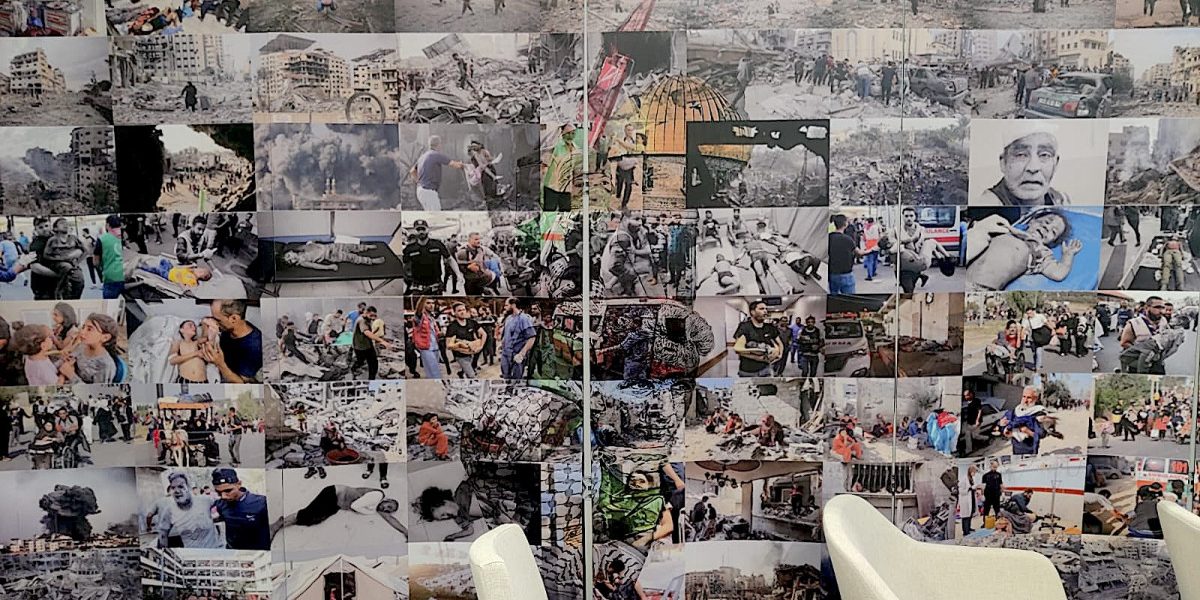
On November 16, Kurum personally visited the pavilion. Palestine's participation went far beyond discussions of environmental and climate policy. It provided a platform to highlight issues such as its international identity, the pursuit of climate justice, and the environmental inequalities deepened by the Israeli occupation.Palestinian pavillion at COP31 in Antalya, Türkiye. Photo: Afroz Alam SahilPerhaps the most striking feature of the pavilion was the way it portrayed the devastation caused by the war in Gaza. A large wall was covered with photographs of demolished buildings, piles of rubble and the immense human toll of the conflict, and bearing the words "Free Palestine".
Alongside these images, the pavilion also presented information on climate change, water management, solid waste disposal and environmental protection.The Palestinian pavilion's exhibits changed every day. On one of the days, a space was created using black fabric to resemble a refugee tent. On another, the focus shifted to schools destroyed by Israeli bombardment. Through these displays, the organisers sought to convey that the devastation of the war in Gaza cannot be measured simply in terms of rubble or statistics on the loss of life and property. The war has also inflicted severe damage on the environment itself, the very foundation on which the life and future of any society depend.Also read: There Is Gaza at COP30Through the pavilion, the Palestinian Environment Quality Authority sought to demonstrate that the consequences of war extend beyond human lives and infrastructure to the destruction of land, natural resources and water sources.
However, the pavilion did not focus solely on destruction. It also highlighted Palestine's environmental initiatives and its vision for the future. Equally important was its effort to introduce Palestinian culture and national identity to the international community. Importantly, Türkiye excluded Israel from COP31 altogether, going so far as to refuse invitations to Israeli officials.Gaza climate corridorDuring COP31, Türkiye put forward another important initiative. Kurum, in collaboration with the D-8 countries, proposed the establishment of a "COP31 Antalya-Gaza Climate Corridor". The proposal envisages providing Gaza with solar-powered mobile water purification plants, energy units for healthcare centres and wells, equipment for sewage and drainage systems, waste management vehicles, and emergency humanitarian assistance.The initiative is noteworthy because it seeks to address Gaza's humanitarian needs through climate and environmental solutions.
In a region devastated by war, access to clean energy, safe drinking water, and effective waste management goes far beyond conventional development projects. These are fundamental human necessities and essential conditions for environmental recovery and reconstruction.The initiative's real success will, however, depend on its implementation. Existing official statements do not specify a concrete financial budget, individual contributions expected from participating countries, or any binding financial commitments.It is easy to talk about assisting countries affected by climate change. But will the international community also demand justice for people who have no control over their own land, water, and natural resources?War and climate justiceThe bigger question to ask is: will the existing climate finance framework recognise the particular circumstances of countries and regions where development has been disrupted by war and occupation?
And will the rights and political aspirations of local populations be protected in investments made in the name of reconstruction?These questions go beyond Palestine. Today, in many parts of the world, war, displacement and political instability have intensified the climate crisis. Also read: Climate Talks in Overtime as Countries Wrestle With Response to Worsening Global WarmingPalestine's case, however, is distinct because its environmental devastation cannot be separated from decades of occupation, control over natural resources, and the denial of political sovereignty.In this respect, COP31 was significant for Palestine.
Its real importance lay not in any major financial announcement, but in the effort to bring a critical question onto an international climate forum, one that is often separated from the conversation: can we talk about climate justice while ignoring the realities of occupation and war?While the conference did not provide an answer to this question, Palestine's success was placing it before the international community. The real test now is whether the solidarity expressed at the conference will translate into tangible financial assistance, environmental reconstruction, and the restoration of Palestinians' right to control their own natural resources.Palestine needs more than sympathy or financial assistance for reconstruction.
It needs access to its farmlands, control over its water resources, reliable energy for its people, and the restoration of its environment. Above all, it demands the right to determine its own future. Climate justice means not only rebuilding after a catastrophe, but also ending the very injustice that makes such a catastrophe possible.Afroz Alam Sahil is a journalist and author. He can be contacted at @afrozsahil on X.