
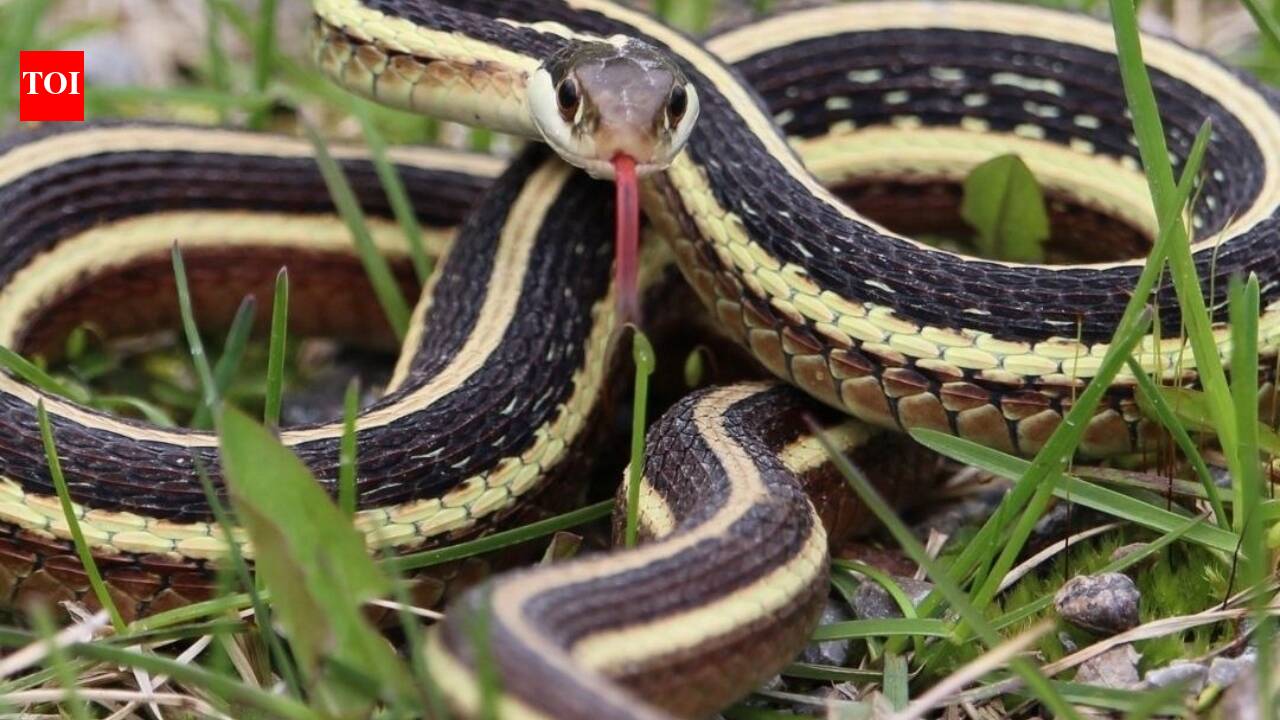
Researchers discovered that a North American eastern ribbon snake was wrongly identified as a unique species in India’s Andaman Islands. A specimen from 1891 and a recent photo from Swaraj Dweep showed the same snake. The 2023 study in Zootaxa finally solved this long-standing puzzle about the mysterious island reptile.
Expecting to find a North American snake in India's remote
Andaman Islands? Now that sounds like something out of a nature thriller, right? But what if there's actually a true backstory behind this odd connection that starts with a century-old museum specimen, a mystery snake sighting, and a big mix-up in the world of science?Let's start from the top: the creature at the centre of the mystery is the eastern ribbon snake (Thamnophis saurita), a slender, striped snake native to eastern North America. For more than a century, a specimen collected in India's Nicobar Islands was classified as a distinct local species, known as Tropidonotus nicobarensis. But when researchers revisited the preserved specimen and compared it with a snake photographed on Havelock Island (now Swaraj Dweep) in the Andaman archipelago, they discovered something unexpected -- both were actually eastern ribbon snakes all along!The findings, published in the scientific journal Zootaxa in 2023, resolved a long-standing taxonomic puzzle while raising another intriguing question: how did a North American snake end up in the Indian Ocean?
The mystery of the 1891 specimen from the Nicobar Islands: What happened and how?
The story stretches back to 1891 when British naturalist William Lutley Sclater pored over a preserved snake specimen from Kamorta Island, tucked deep in the Nicobar group. The specimen was said to have been collected by Frederik Adolph de Röepstorff, a colonial administrator and passionate naturalist who spent years roaming the islands. Sclater decided he'd found something new, and Tropidonotus nicobarensis was born -- at least on paper. This specimen became the 'holotype', which is the gold standard for the species.
But something about its identity never quite added up. Despite that single specimen, no one seemed to find another like it in the wild again.
It lingered in weird limbo, becoming one of India's reptile oddities -- a species known only from a single museum jar.
Fast forward to 2023. Researchers Justin L. Lee, S.R. Chandramouli, and Aaron M. Bauer took a fresh look at the long-forgotten specimen. They compared it not just to the museum record, but to a snake recently photographed on Havelock Island (now Swaraj Dweep) in the Andamans. That new snake looked eerily similar, and when they really dug in, it turned out both belonged to the eastern ribbon snake species. Turns out, the supposed 'Nicobar snake' was never a local mystery at all; it was a visitor from much further away, misfiled in the annals of science.
The Havelock Island sighting that reopened the mystery
That solved one big question, but opened another: how did a North American species find its way to a string of islands on the other side of the world? The answer isn't crystal clear, but the best guess is human involvement.
In 2022, Chandramouli reported a snake seen and photographed on Havelock Island. Its features matched the old description of Tropidonotus nicobarensis, which got people wondering: had the supposed lost species turned up again?Turns out, it hadn't. A closer look pinned it as another eastern ribbon snake. The evidence pointed to the snake being an introduced animal, not a natural resident. That's unusual, as for a species never previously documented outside North America (except for some spots like the Bahamas or California) suddenly appearing in the Andamans is quite an expansion of its known range.
Meet the eastern ribbon snake: What is this slender North American reptile?
The eastern ribbon snake is a true wetland specialist: fast, slim, and built for life near the water's edge. It darts after frogs, tadpoles, or little fish, earning its stripes as one of the most agile reptiles in its world. Completely non-venomous and not much of a threat to humans, it usually slips away before anyone gets a good look.
Until now, the ribbon snake had never been seen outside its native continent, save for a few stray populations in places like the Bahamas and, oddly, California (where people accidentally introduced them). The Havelock Island encounter set a new record for how far this reptile could wind up from home, puzzling scientists and naturalists alike.
Plus, the most exciting part of the eastern ribbon snake story isn't really about discovering something new; it's about the thrill of uncovering that 'something new' wasn't what it seemed after all.
For conservationists and researchers, the story of the eastern ribbon snake is more than just a curious blip. It shows why museum specimens are so valuable, as these old treasures let scientists revisit mysteries, double-check assumptions, and sometimes, as in this case, rewrite what we thought we knew. It's also a reminder that islands like the Andamans are especially sensitive to outside species. A stray import, even one as innocuous as the ribbon snake, can upset fragile ecosystems.