
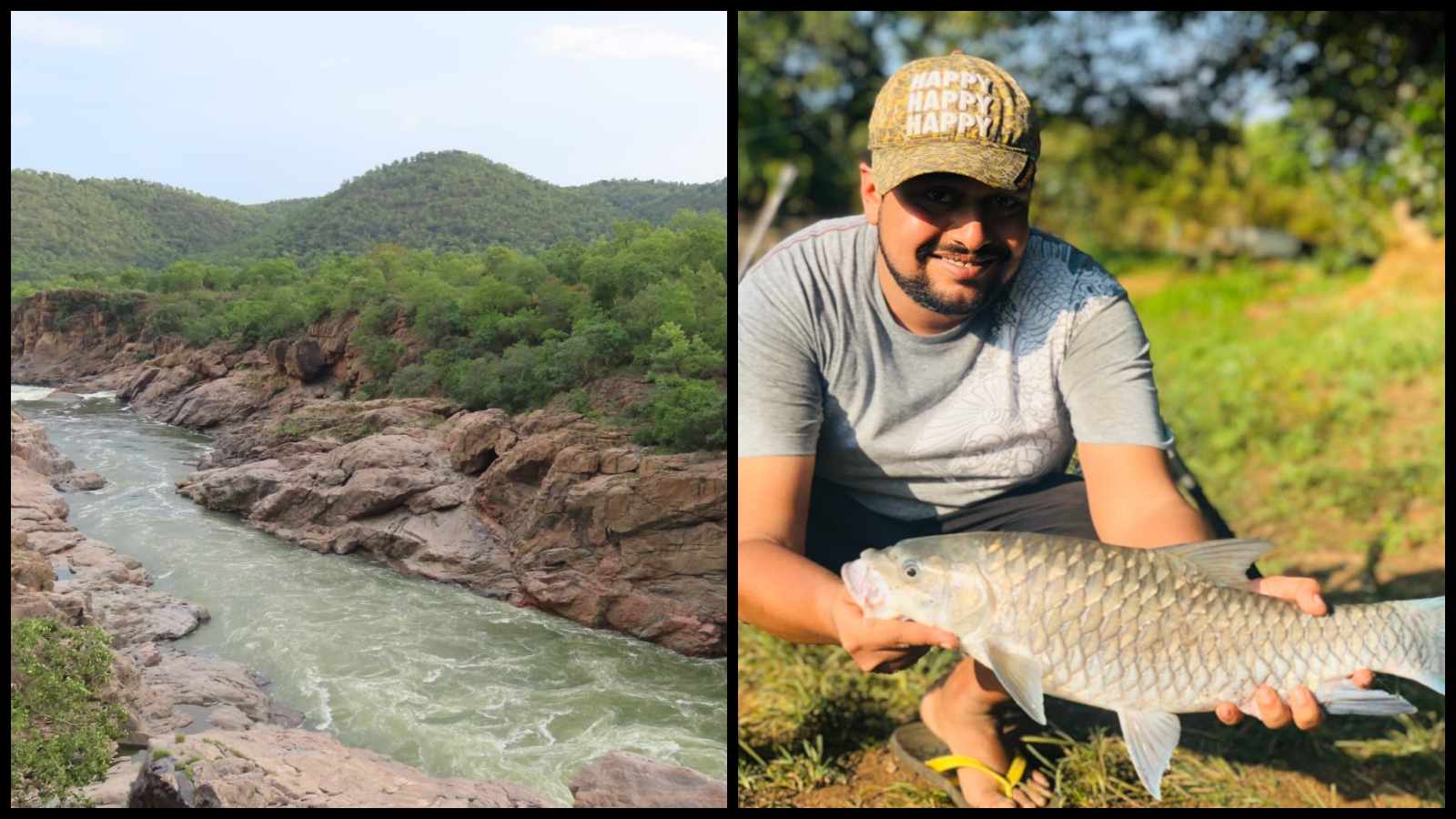
The critically endangered humpback mahseer faces survival threats in the Cauvery River due to poaching and habitat loss. Once a prized catch for anglers, this giant fish is now rarely spotted. Naren Sreenivasan, who caught a 35-kg mahseer years ago, said, "I do believe that one fish really left an impression."
Once a prized catch for anglers, the critically endangered humpback mahseer is fighting for survival in the Cauvery, its habitat threatened by altered river flows, poaching and competition from introduced species. Conservationists are racing to protect the river giant.
It's one of their most vivid memories. Twenty-six years ago, 13-year-old Naren Sreenivasan was angling with his father on the banks of the Cauvery, when he felt a strong tug. For the next quarter of an hour, a fight ensued between a puny teenager and what they could only assume was a big fish.
"He said that his arms were tired, and asked if I would take the rod. I told him that if I landed the fish, it would become my catch. Then, he pulled it out by himself. That was the biggest fish he had caught by himself," 70-year-old Bengaluru-based businessman Ajit Sreenivasan tells The Indian Express.
Even at 13, Naren Sreenivasan knew the magnitude of the catch -- what he had pulled out of the depths of the Cauvery was a 35-kg humpbacked mahseer, a critically endangered freshwater fish endemic to the Cauvery River basin in the Western Ghats.
If the mahseer is royalty among India's freshwater fish, the humpbacked mahseer, also known as the orange-finned mahseer or the Tiger of the Cauvery, is an emperor. Its scientific name is Tor remadevii. Rarely spotted, it can grow to nearly the size of a human and can weigh over 50 kilograms. Anglers who catch one must content themselves with a photograph of the titan -- hauled out of the water, weighed and swiftly released unharmed into the depths of the Cauvery.
"That fish really stuck with me. I'm a biologist by training, and have worked on large mammals, snakes, and scorpions but I keep coming back to fish. I do believe that one fish really left an impression," says the now 39-year-old Naren Sreenivasan.
The humpback of Cauvery
One of the Western Ghats' most iconic freshwater fish, the humpbacked mahseer has held anglers in awe since the days of the British Raj. It has historically been recorded across much of the Cauvery basin and its tributaries -- including the Kabini, Bhavani, Moyar and Pambar rivers -- spanning parts of Karnataka, Kerala and Tamil Nadu.
There is no exact census of the remaining wild population in the Cauvery. However, experts agree that the fish is now locally extinct across much of its historic range, surviving in only a handful of isolated breeding populations, primarily within protected areas such as the Cauvery Wildlife Sanctuary.
Overfishing, dam building and water pollution have contributed to the fragmentation of its population.
"They evolved in high-flow, highly oxygenated, clean-water environments -- something that now works against them as the original flow of the Cauvery is altered," says Sandeep Menon, secretary of the Karnataka-based non-profit Wildlife Association of South India (WASI). "This may not be a problem in the monsoon, but as flows are managed for agriculture and drinking water during the dry season, the breeding habits of the fish can be confused by irregular flows of water. The fish is genetically programmed to swim upstream and spawn during rain or a sudden flood of water. We are artificially creating those events on a day-to-day basis, which confuses the fish."
Overfishing, poaching and dynamiting -- the use of explosives to stun or kill schools of fish -- pose further threats, although the Fisheries Department is trying to crack down on the practice.
The loss of a species like this could have dire ecological consequences. The humpbacked mahseer is what biologists refer to as a "flagship" species, much like tigers, elephants and rhinos on land.
"They are large-bodied migratory fish, and there are ecological roles that these species play. For example, they are also predators, and if you lose predators like this, there are going to be cascading effects. The whole balance of how species survive in equilibrium will also be disturbed.... Larger mahseer are also prey for crocodiles here and there. When they are juveniles, they are also prey for other species of fish and birds," Naren Sreenivasan says.
The consequences are showing. Says Naren Sreenivasan: "In 2024, there was this 24 kg female fish that we tagged and were following for six months. She was one of the fish with stable and predictable movement patterns. It was a drought year, and the water issues between Karnataka and Tamil Nadu had begun brewing. On May 15 that year, a lot of water was released into Tamil Nadu. The mahseer, which were in the deeper part of the river, began migrating, but we couldn't find Mara".
The signal returned two weeks later. "About 6 km above her summer range, we retrieved her tag in a shallow pool. The only reason it could have come out is if the fish were dead. She must have gotten stuck in the pool and died there," Naren Sreenivasan says.
The push to conserve
With its numbers dwindling, the species is listed as Critically Endangered on the IUCN Red List of Threatened Species. Despite this, the mahseer is not protected under Indian laws, and its conservation now depends on government officials, expert anglers and wildlife non-profits such as the Wildlife Association of South India (WASI).
For those unfamiliar with sport fishing, the link between angling and conservation might be hard to see. But experts say it has been crucial in radio-tagging the fish and collecting data on catches, helping the Fisheries Department and other government agencies protect the endangered species.
WASI's angling data documents the catches by its members from 1976, providing a valuable resource for researchers.
The non-profit also hires guards to prevent poaching and dynamiting. "The fee collected by WASI goes towards guards from the local community around three stretches of the Cauvery that the organisation protects," its secretary Sandeep Menon says. "The area has been established as a fish sanctuary in collaboration with the fisheries department. Members of the local fishing communities are also trained to radio-tag and track large mahseer through the waters of the Cauvery, bringing the conservation efforts to the grassroots."
As part of conservation efforts, the Karnataka government is working with WASI and the Forest Department to breed the mahseer in captivity at Harangi. "First, we collect the mature female and male brood fish, we segregate them and give a hormone injection to induce breeding. We take the eggs afterwards and fertilise them," says Sachin SM, assistant director of fisheries in Kodagu district.
The fingerlings are fed a diet rich in fats and proteins until a release site is chosen.
According to experts, conservation efforts appear to be working, at least in raising awareness.
"Earlier there was a time when people used electricity, dynamite and poison in the river. Now people are more aware of fish and ecosystems. It is not that it never happens, but there are strict rules, and those caught dynamiting can be imprisoned," says Sachin.
Aweing anglers for generations
Despite its dwindling numbers, a fish of the mahseer's stature has spawned its own legends. One tale from Kodagu holds that eating mahseer flesh at a certain time of year could cause serious illness. Old inscriptions and carvings in Karnataka also depict Lord Vishnu in his Matsya avatar with characteristics of a mahseer. The fish is also found in temple tanks adjoining rivers.
But it doesn't take a legend to hold dedicated anglers like Naren Sreenivasan in awe. All it takes is a sighting.
"Sometimes, around 5-6 pm, the fish moves out of the depths of the Cauvery and rolls to the surface like dolphins," he says. "I have seen this only 3-4 times, but I have spoken to fishermen who have called me and told me when the mahseer is coming to the surface."
Then there are stories of the big fish's courtship ritual.
"During the monsoon, they congregate in large numbers. Seven or eight males will pursue a female," he says.
These are the memories that keep anglers coming back. WASI member and lifelong angler Shayan Subaya describes the thrill of finally landing a mahseer.
"People think that fishing is one fellow sitting on the rod and you catch something. You will spend hours and weeks. Some of our older guys have stories of jumping into the river and swimming to the other side so that you don't lose the fish. It can take a lot out of you," he says.