
Sweden buried geocell grids beneath two forest-road sections near Grums. A February 2025 article from VTI said field tests showed these sections had 52% to 64% higher load-bearing capacity than a thicker untreated section. This fix helps forest roads handle heavier trucks and wet weather better than older road standards.
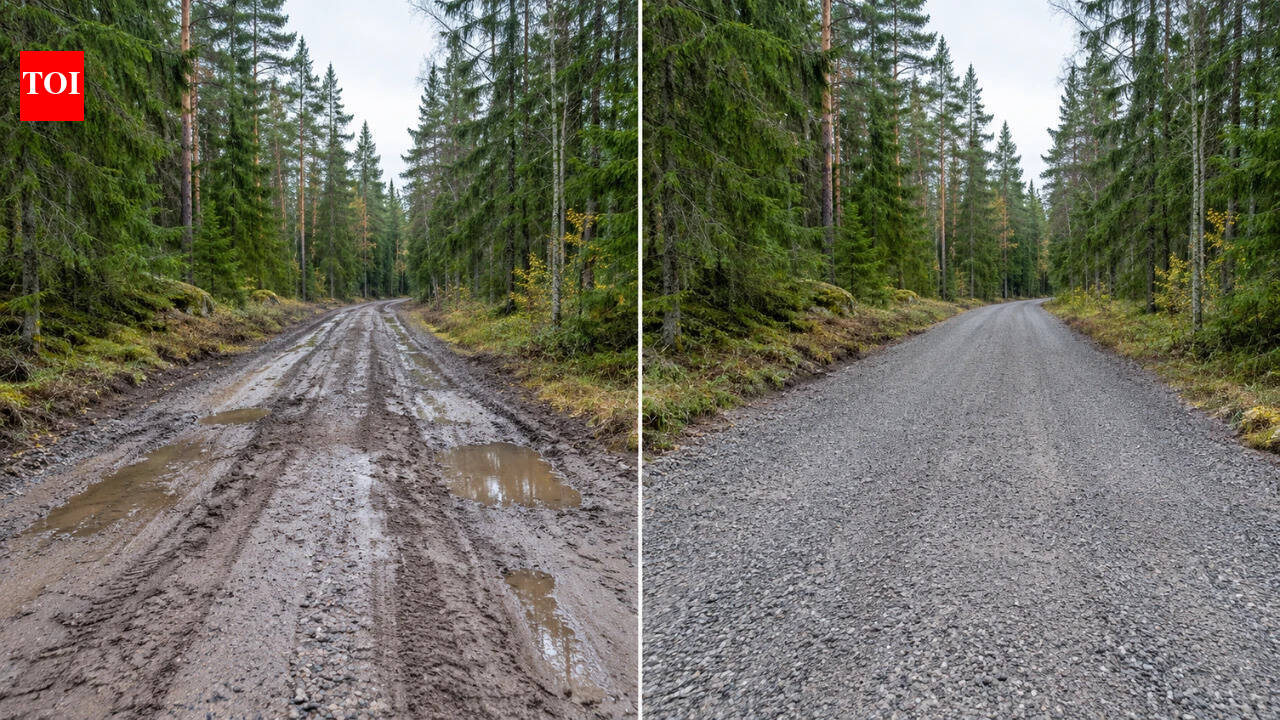
A representative image of a forest road without and with geocell reinforcement. In Sweden’s field tests, the geocell sections had 52% to 64% more bearing capacity than the comparison section. Image Credits: ChatGPT
Anyone who has ever driven on a muddy back road after a heavy rain probably knows how quickly a wheel can sink. Forest roads in Sweden face this problem all the time, and the trucks that are allowed on these roads have only become heavier. A February 2025 article from VTI, the Swedish National Road and Transport Research Institute, said tests near Grums found a good fix for the problem. Engineers buried geocell grids under two sections of a forest road. Those sections had 52% to 64% greater load-bearing capacity than the thicker comparison section without geocells.Why Sweden's forest roads are under pressure Most of the forest roads in Sweden were built to older standards. They were built neither for the present-day trucks nor the weather. VTI explains that the maximum legal gross weight of a loaded truck went up from 64 to 74 tonnes. Moreover, climate change has brought heavier rains in short intervals. Roads are damaged and vehicles end up getting trapped. The results are reported by the project named “Solutions for faster development of forest roads. ” VTI led the project, which Vinnova funded. It is said to be one of the biggest research projects conducted by the Swedish forest industry. There were 11 partners in this research project, among whom were some big names in the forest industry. Five options for road reinforcement were tested; geocells were one of them.
Geocell grids being filled with gravel on a test road, where a lightweight deflectometer measures how the ground responds (representative image). Image Credits: ChatGPT
How the geocell worked VTI describes a geocell as a grid placed in the road and filled with gravel. The cells keep the stones in place and help the road carry weight. The trial was conducted by the forestry company Stora Enso. According to a 2026 paper, ‘Performance evaluation of geocell-reinforced gravel road on waterlogged ground,’ published in European Transport Studies, three full-scale test sections were built on waterlogged ground. Two of them used geocells, one filled with crushed rock, and one filled with local material. The third was a normal road, without geocells. It was nearly twice as thick, so it was difficult to beat.What the measurements showed A lightweight deflectometer was used in this case. It is a machine that drops a weight on the surface of the road and monitors how the ground responds. Vehicles were driven over the sections first. After that, the two geocell sections showed 52% to 64% greater bearing capacity than the comparison section, the paper reports. VTI adds that this even held though the soil had a relatively high moisture content. Dina Kuttah, the project manager and senior researcher at VTI, said the results were much clearer and more positive than she had expected.
Join conversation
Share your thoughts in the comments
Be respectful · TOI community guidelines
Moreover, she did not expect some of the solutions to prove so cost-effective. Overall, most of the solutions worked well, but VTI described geocells as giving the biggest improvement. However, it's also worth noting that the comparison involved a single, thicker reference section. The institute also rated them as the most economical choice for strength per metre of road gained.Cost, local stone and some cautions A strong road is only useful to people if they can afford to build it. Costs have been reviewed in a VTI report, ‘Lösningar för snabbare utveckling av skogsbilvägar i Sverige.’ It found Stora Enso’s two geocell roads to be the most cost-effective in the project. The reference section had lower bearing capacity and higher construction cost. The report also says this was the first time in Sweden's forest industry that a gravel road was built on waterlogged soil. Local fill, the researchers note, performed as well as or even better than imported crushed rock. It could cut transport costs and even reduce damage done to nature. A little caution is still needed. One co-author works for Stora Enso, the company that ran the trial. The tests were also just on three sections in Sweden, so other soils and climates could give different results.