
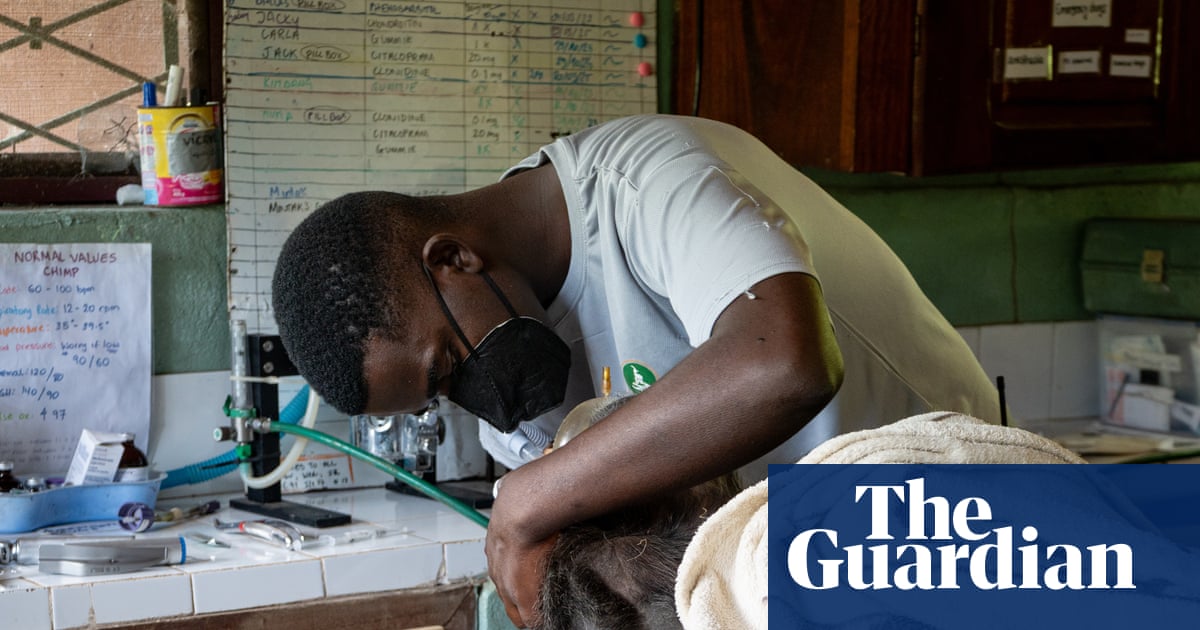
Sheri Speede runs the Sanaga-Yong sanctuary in Cameroon, which she started in 1999 to protect chimpanzees from poaching and trafficking. She cares for 75 primates, including Jacky, who arrived in August 1999. Many apes face threats from bushmeat hunters, but this haven provides a safe home for these rescued animals.
Poaching, trafficking, insurgencies and traditional medicine all threaten the central African primates, but a rehabilitation centre offers a haven in Cameroon
Every morning in central Cameroon, the primatologist Sheri Speede wakes to a daunting task. At the Sanaga-Yong sanctuary, which she founded in 1999, there are 75 chimpanzees to feed four times a day and monitor for physical or behavioural issues.
Of those, more than 30 need to be given routine birth-control medications, four are babies requiring round-the-clock care, and two are rowdy teenagers currently being integrated into new social groups.
A chimpanzee might wake up on the wrong side of the bed and decide to pick a fight, hatch a plan to rise in the group hierarchy, or refuse to take its medication. On any given day, Speede is therapist, meal-prepper, veterinarian and site manager all in one.
Originally a veterinarian in the US, Speede visited Cameroon in the late 1990s and, in 1997, met Jacky, a chimpanzee that had been kept in a small cage outside a hotel in Limbe for nearly 30 years. Known around town as the "mad chimpanzee", Jacky had little prospect of release or rehabilitation. In August 1999, Speede brought Jacky to her newly founded sanctuary, where he became one of Sanaga-Yong's first three residents.
Jacky is still there, estimated to be in his 60s. He and Speede have lived side-by-side for a quarter of a century - longer than many people live with their own children.
The problem, though, as it has been for decades, is that chimpanzees and other great apes are hunted as some of the most prized bushmeat species in the world. The practice is deeply rooted in traditional remedies, with a reported 36 conditions claimed to be healed by 22 chimpanzee parts. Female chimp reproductive organs are said to cure infertility in women; crushed bones, to heal fractures; sleeping on their skins, to offer protection during childbirth.
Poaching is often a two-for-one transaction. When mothers and mature adults are killed for meat, their infants are sold to wealthy clients who want a chimpanzee as a pet, or to the private zoo trade. Compounding this is the near-absence of government enforcement against wildlife trafficking.
In addition, the decades-long armed conflict in Cameroon has harmed biodiversity conservation in the country. Between the anglophone crisis - an ongoing armed conflict between the Cameroonian government in the south-west and separatist groups in the north-west - and the Boko Haram insurgency, many of the country's conservationists and forests are being badly affected. Every time the government launches a counterattack on separatist groups in the north-west, civilian villages are burned and hundreds of people flee the violence, seeking shelter in the forests - forests that were once the natural habitat of endangered great apes.
Armed groups also often take up temporary residence in the shelter and secrecy of Cameroon's dense forests. There, they set traps for bushmeat and carve out farms in previously protected areas. As armed groups regularly control the movement of people and goods in the area, regardless of what side of the conflict they are on, their presence greatly restricts the ability of conservationists to continue their work.
Cameroon is home to the Nigeria-Cameroon chimpanzee, of which conservation groups estimate somewhere between 3,500 and 9,000 remain in the wild. Classified as endangered by the International Union for Conservation of Nature, and one of humanity's closest living relatives, the subspecies continues to decline as the bushmeat trade goes largely unpoliced by the Cameroonian government. Killing chimpanzees has been illegal in the country since 1994, but enforcement effectively began only in 2006, pushed by the Last Great Ape organisation (Laga). The NGO says it has recorded more than a hundred great ape confiscations - dead and alive - annually since then. An estimated five to 10 chimpanzees are lost for every one recovered.
That gap between law and enforcement has not closed. Paul Biya has led Cameroon's government since 1982, making him one of the longest-serving non-royal heads of state, and under his administration the burden of humanitarian and conservation work has fallen largely to international organisations rather than the state.
Cameroon's safeguarded chimpanzee population is mostly at three wildlife centres - Ape Action Africa, Sanaga-Yong Chimpanzee Rescue and Limbe Wildlife Centre. Together they house well over 200 rescued chimpanzees, with no plan or space to release them, for lack of enforcement to safeguard them and appropriate forested habitat. For this reason female chimpanzees at Sanaga-Yong are given birth control medication.
As the fight continues for chimpanzee conservation and stricter anti-poaching laws in Cameroon, Sanaga-Yong stands as a stronghold. The sanctuary has earned wide recognition for some of the best chimpanzee care in the world. It runs on a model that benefits the surrounding community, with all of its caregivers hired locally. In recent years it has taken on two Cameroonian veterinarians, Mael Firina and Christian Atonfack, who joined the team upon graduation from veterinary school. While many sanctuaries rotate through international staff, the goal here is to train both vets under Speede and visiting international veterinarians so that the sanctuary's future veterinary care rests in Cameroonian hands.
That localisation of talent is increasingly the model for conservation. When the work of protecting a place is put in the hands of the people who live there, the odds of it lasting go up considerably.
"Conservation led by Indigenous peoples and local communities, based on their own knowledge and tenure systems, is far more likely to deliver positive outcomes for nature," says Neil Dawson, a global development researcher at the University of East Anglia who has studied the role of Indigenous people and local communities in conservation. "In fact, conservation very often fails because it excludes and undervalues local knowledge and this often infringes on rights and cultural diversity along the way."