
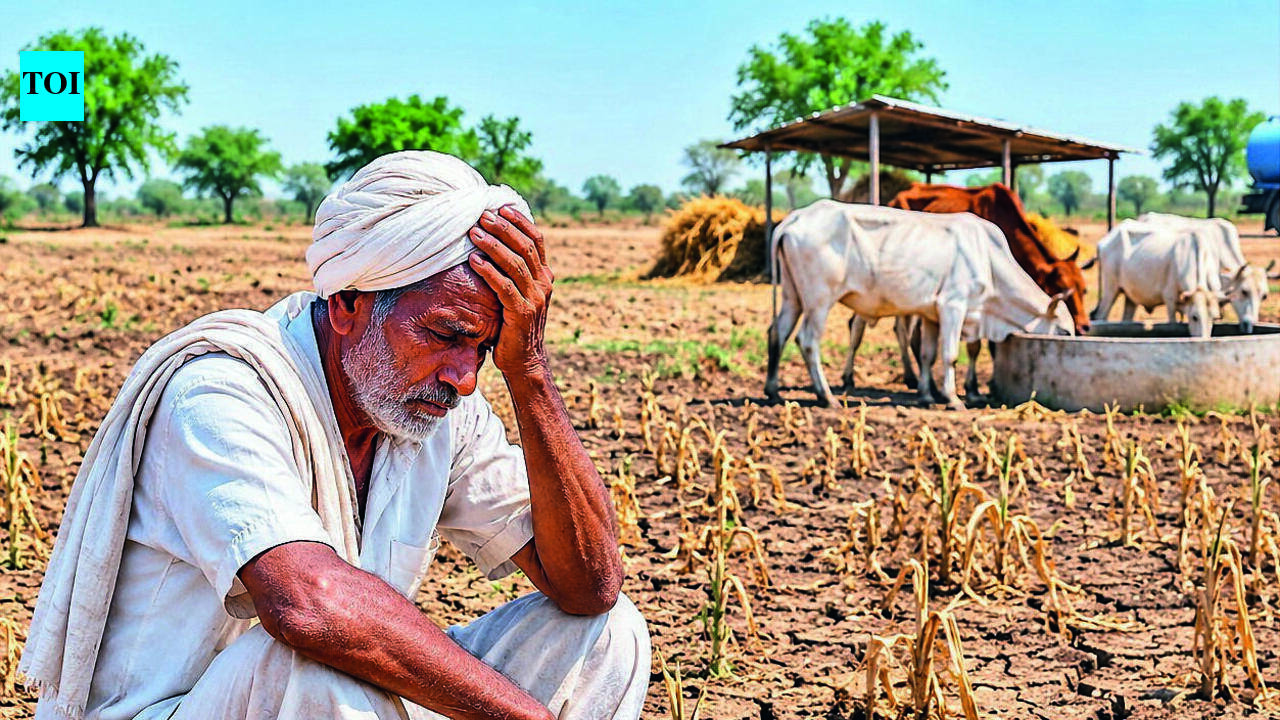
The Groundwater Surveys and Development Agency added 1,200 observation wells across Maharashtra to monitor drought in 310 tehsils. GSDA commissioner Ravindra Khebudkar said on Friday, "These additional observation wells have been added after decades." This expansion helps officials use local data to plan better water management for many villages.
Pune: With drought affecting 310 tehsils across Maharashtra, Groundwater Surveys and Development Agency (GSDA) has expanded its groundwater monitoring network by adding 1,200 observation wells across the state.The move, aimed at strengthening scientific assessment of groundwater availability, is expected to help authorities formulate micro-level water management strategies and take timely corrective measures in vulnerable areas.The larger objective is to move towards decentralised water management, where interventions are planned according to the actual groundwater conditions of individual revenue circles and villages instead of adopting a uniform approach across entire districts.With the addition of these wells, the number of observation wells monitored by the agency will increase from 3,817 to over 5,000. The expansion will provide officials with a wider geographical spread of groundwater data, helping them identify areas witnessing a rapid depletion of groundwater and prioritise water conservation interventions.GSDA commissioner Ravindra Khebudkar said on Friday, "These additional observation wells have been added after decades.
Our endeavour has been to have at least one observation well in every revenue circle, which usually covers five to six villages. Now, our officials will be able to take readings from these wells every month."
Officials said the expanded network would help generate more detailed information about groundwater availability at the village and revenue circle levels, rather than relying largely on broader regional assessments. The data will be particularly important during the ongoing drought, when several regions are witnessing declining water availability and increasing dependence on groundwater for drinking water and agriculture."If we observe a sharp decline in the water level of a particular well, we inform the respective district administration to initiate soil and water conservation works in that area. If these measures are implemented effectively, they can help the local population tide over the situation," Khebudkar said.Groundwater experts point out that a wider observation network is crucial because groundwater availability is not uniform, even within the same taluka or district. Geological formations, rainfall patterns, aquifer characteristics, groundwater extraction and recharge potential vary from one location to another. Consequently, a district-level average may not necessarily reflect the actual groundwater situation in individual villages."Therefore, we have instances of having good water in some wells despite having arid conditions across that particular area. It is only because of varied geological formations. It is difficult to point out those conditions," added the officials.Central Ground Water Board (CGWB) also emphasises that groundwater levels are influenced by local hydrogeological conditions, recharge and extraction. Its scientific guidelines underline the importance of a sufficiently distributed network of observation wells to understand groundwater behaviour and assess the effectiveness of artificial recharge structures.Experts say regular readings from a larger network can help authorities distinguish between areas facing temporary seasonal depletion and those experiencing sustained groundwater stress."This can help district administrations identify locations requiring urgent drinking water arrangements, regulate excessive groundwater extraction and prioritise watershed development, nala bunding, check dams and other recharge interventions," said Keerthi Pujar, the district collector of Dharashiv district from Marathwada region.The observation wells are selected after considering several scientific and geographical parameters, including their water-bearing capacity, location, accessibility and the presence of natural springs. Officials examine whether a well adequately represents the groundwater conditions of its surrounding geographical area. The objective is to ensure that readings provide a reliable picture of the groundwater table in that particular region, said officials from GSDA."The selection of strategically located wells is important because groundwater levels can fluctuate considerably over short distances, particularly in Maharashtra's hard-rock regions. A well selected without considering the underlying geological formation may not provide representative information about the groundwater conditions of the surrounding villages," said Pradeep Purandare, retired associate professor at Water and Land Management Institute.Officials said the monthly readings from the expanded network would allow geologists to study changes in groundwater levels over time and identify vulnerable pockets before the situation deteriorates further. The information can also help assess whether existing soil and water conservation measures are improving groundwater recharge.
The expansion assumes significance as the state faces an increasingly challenging water situation. Officials believe that scientific monitoring, combined with timely implementation of conservation measures, will be essential to strengthen long-term groundwater management.