
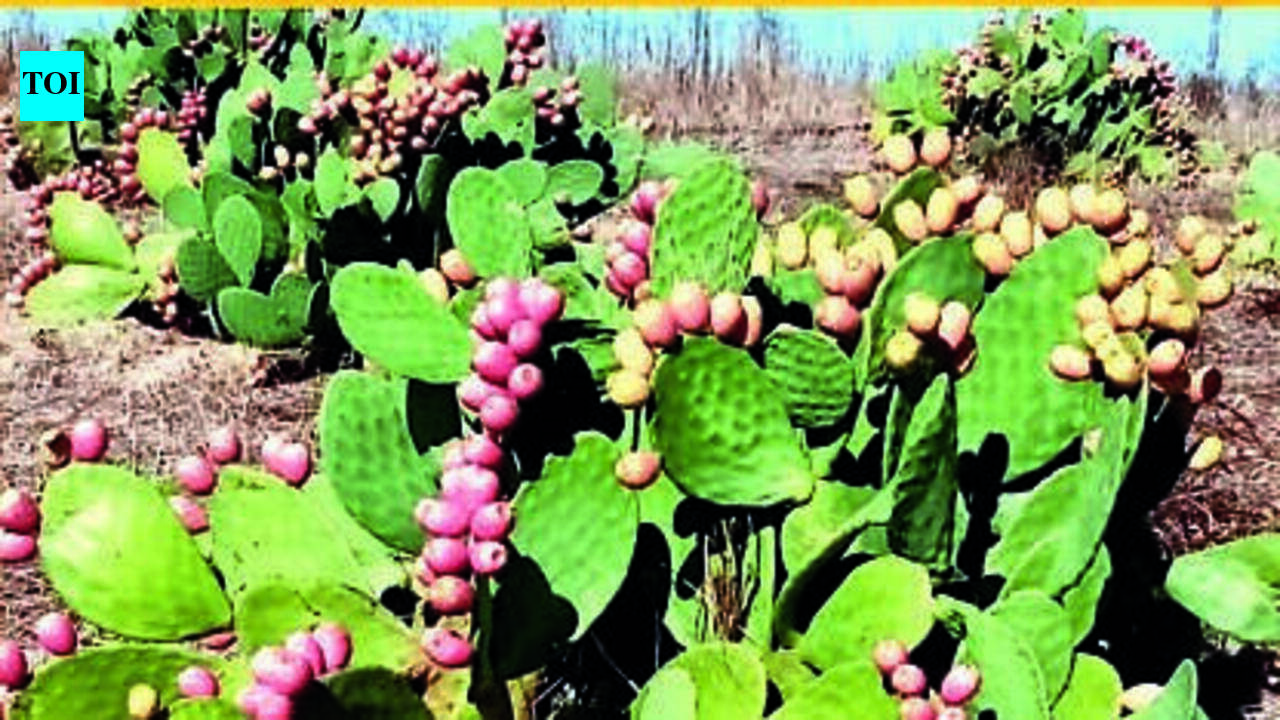
Agriculture scientists in Marathwada are pitching spineless cactus as a drought-time alternative for livestock. Indra Mani said, “The hardy plant can survive with little water and continue producing fleshy, moisture-rich pads.” With 53.6 lakh animals needing fodder, this plant could help farmers when traditional green feed gets hard to grow.
Spineless cactus
Chhatrapati Sambhajinagar: In drought-scorched Marathwada, the cactus could do more than survive. It could help livestock survive too. Agriculture scientists are pitching spineless fodder cactus as a drought-time alternative for cattle, buffaloes, sheep and goats. Indra Mani, Vice-Chancellor of Vasantrao Naik Marathwada Agricultural University, Parbhani, said, “The hardy plant can survive with little water and continue producing fleshy, moisture-rich pads even when conventional green fodder becomes difficult to grow. ” For drought-prone Marathwada, that resilience could be crucial. Parts of the region are already staring at an early fodder crunch after a poor monsoon. Official estimates indicate stocks in some areas could begin running out from Dec. The region has 53.6 lakh livestock animals and needs around 20,125 tonnes of fodder every day. Its animals include 6.5 lakh calves, 26.5 lakh large animals and 20.6 lakh sheep and goats. What makes cactus particularly suited to a dry region is the way the plant manages water. Unlike many conventional fodder crops, cactus is biologically adapted to conserve moisture. Its thick, fleshy pads act as water reservoirs. For livestock, that moisture has an obvious advantage. During drought, animals face a double stress: less fodder and less water. Succulent cactus fodder can help supplement both. Cactus, however, is not being proposed as a complete substitute for conventional feed. Its real promise lies in being a drought reserve that can supplement other fodder when grass and crop residues begin disappearing. BJP MP Dr Ajeet Gopchade has urged state govt to promote its cultivation across Marathwada. In a letter to the chief secretary, he has proposed using the crop not only to strengthen fodder security but also to generate additional income for farmers. “The cactus can be included in efforts to restore rainfed and degraded land because it survives in low-rainfall conditions,” Gopchade said. “Apart from fodder security, it also has potential for biogas and bio-fertiliser production,” he added. The MP has suggested linking cactus cultivation with the watershed development component of the Pradhan Mantri Krishi Sinchayee Yojana, which covers plantation work on rainfed and degraded land. He has also proposed involving the National Dairy Development Board in developing a policy for using cactus as cattle feed. By the end of Sept, the administration had estimated Marathwada’s fodder availability at 44.8 lakh tonnes. That includes kharif and rabi crop residue and grass available on bunds, fallow land and in forest areas. However, prolonged dry weather can rapidly dwindle the stock. That is where cactus could help. The idea is not new. Countries battling chronic drought have long turned to cactus as livestock feed. Mexico has a long history of cactus use under arid conditions, while northeast Brazil grows select cultivars like Orelha de Elefante Mexicana over 6 lakh hectares. Research from Brazil has also found that cactus intercropped with sorghum can yield high quantities of fodder. Studies in the United States have similarly explored prickly pear as emergency forage for livestock since the 1900s. Modern research at Texas A&M and University of California has reported fresh biomass yields of over 150 tonnes per hectare. In India, research institutions have begun promoting thornless varieties. ICAR-IGFRI, Jhansi, reported encouraging survival rates and fodder yields from field trials, while ICAR-CAZRI, Jodhpur, has identified 62 thornless accessions suitable for arid regions. BAIF, Pune, which maintains a large collection of cactus varieties, has also recorded promising biomass yields from select accessions. For Marathwada, experts have suggested introducing spineless cactus on farm boundaries and degraded lands. It can also be intercropped with grasses or integrated into dryland orchards with crops such as custard apple, aonla and ber. They have urged Vasantrao Naik Marathwada Agricultural University to conduct multi-location trials across the region before recommending a formal cultivation package to farmers. Mani said, “Cactus can also be grown collectively on suitable land and along farm boundaries.” Vasantrao Naik Marathwada Agricultural University also plans to work on cactus cultivation with interested agencies and industries. “Private industries and agencies can help create commercial value for cactus cultivation and make it popular among farmers,” Mani said. “For cactus to become commercially viable, farmers need greater awareness, quality planting material, proper cultivation practices and better marketing,” Gopchade said. For Marathwada, though, its most compelling promise lies elsewhere. As drought strips the countryside of green, cacti could stay standing, holding both fodder and moisture for the animals that need them most.