
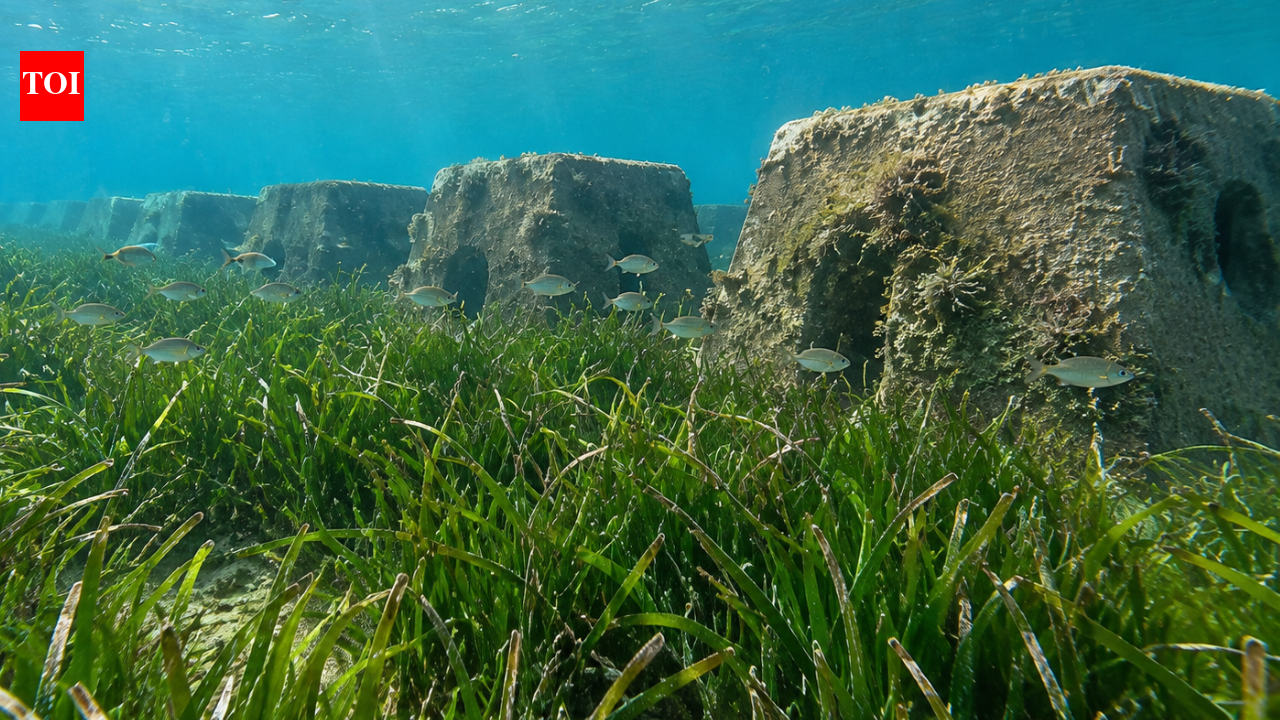
In 1992, Spain placed 358 concrete anti-trawling reefs off Alicante to protect 540 hectares of seagrass. Trawling nets often uproot thousands of shoots, causing lasting damage to these slow-growing plants. Eight years later, researchers observed partial meadow recovery, though the plants grew much slower than those in healthy, undisturbed areas.
Some damage can be done in hours, yet take almost a century to undo. Seagrass meadows show how. Trawling involves dragging a heavy net along the seabed to catch fish. Repeated trawling can uproot 100,000 to 360,000 seagrass shoots every hour, according to a
technical report commissioned by the European Commission on Posidonia beds. Illegal trawling off Alicante in southeast Spain had already damaged local seagrass meadows. So, in 1992, Spain placed 358 concrete anti-trawling reefs on the seabed to protect 540 hectares of seagrass. Eight years later, researchers saw partial meadow recovery.A slow-growing meadow under threat The plant from the story is Posidonia oceanica, which is a seagrass that grows only in the Mediterranean Sea. Its leaves grow up to a metre long during the summer season. Its meadow hosts many different kinds of animals and algae. The report's authors, Elena Díaz-Almela and Carlos M. Duarte, refer to the plant as a nursery ground for several commercially important species. However, this plant only grows one to six centimetres in length per year, so losses become very difficult to reverse. Their review of 39 studies at 135 locations found that 46% of the Mediterranean meadows had lost some range, density or cover.
Some 20% had regressed significantly since the 1970s.
What Spain did off AlicanteDíaz-Almela and Duarte call this one of the first uses of artificial reefs to protect a Posidonia meadow. The work began in 1992 in El Campello and Villajoyosa, in Alicante. Illegal otter trawling, a form of bottom trawling, damaged 40% of the seagrass beds at depths of 14 to 28 metres. In total, it covered 290 hectares along more than seven kilometres of shoreline. The reefs were heavy concrete structures. Any trawling gear that runs over them gets caught and breaks up. The 358 reefs, arranged in rows that were 300 meters long, protected 540 hectares of meadow from trawling. The work was accompanied by a follow-up research programme to see what happened next.Recovery came, but slowly Eight years later, researchers discovered partial recovery of the meadow due to rhizome growth. Rhizomes are underground stems that help the spreading of the plant. However, there is a catch. The Commission report adds that rhizome growth in the meadows impacted by trawling was five times slower than in the healthy meadows at the same depth. There was also four times less light, as the seabed sediment had changed. In 2005, José M.
González-Correa and colleagues published '
Recovery of deep Posidonia oceanica meadows degraded by trawling,' which investigated a similar area. It was affected by illegal trawling and protected by reefs. The researchers compared two areas that were affected by trawling and two that were left untouched. Growth was positive in both cases but lower in the affected meadows. The authors conclude that recovery is possible if the cause of the damage is eliminated. They say that extremely slow growth can make the process last almost a century. Why reefs are not a magic fixThe report is careful about what the reefs can deliver. The trawlers are often too big for the reefs built so far. They can be two to five times more powerful than officially declared engine ratings suggest. Illegal trawlers can then move the reefs and continue fishing in the meadows. Many reef projects do not have monitoring, and so it is difficult to say how they are doing, the authors note. At Cap Couronne in France, reefs and daily surveillance prevented trawling within the meadow. But some of it went to a nearby unprotected patch. Both the Commission report and the González-Correa team suggest one lesson: the best way to protect a seagrass meadow is probably to avoid losing it in the first place.