
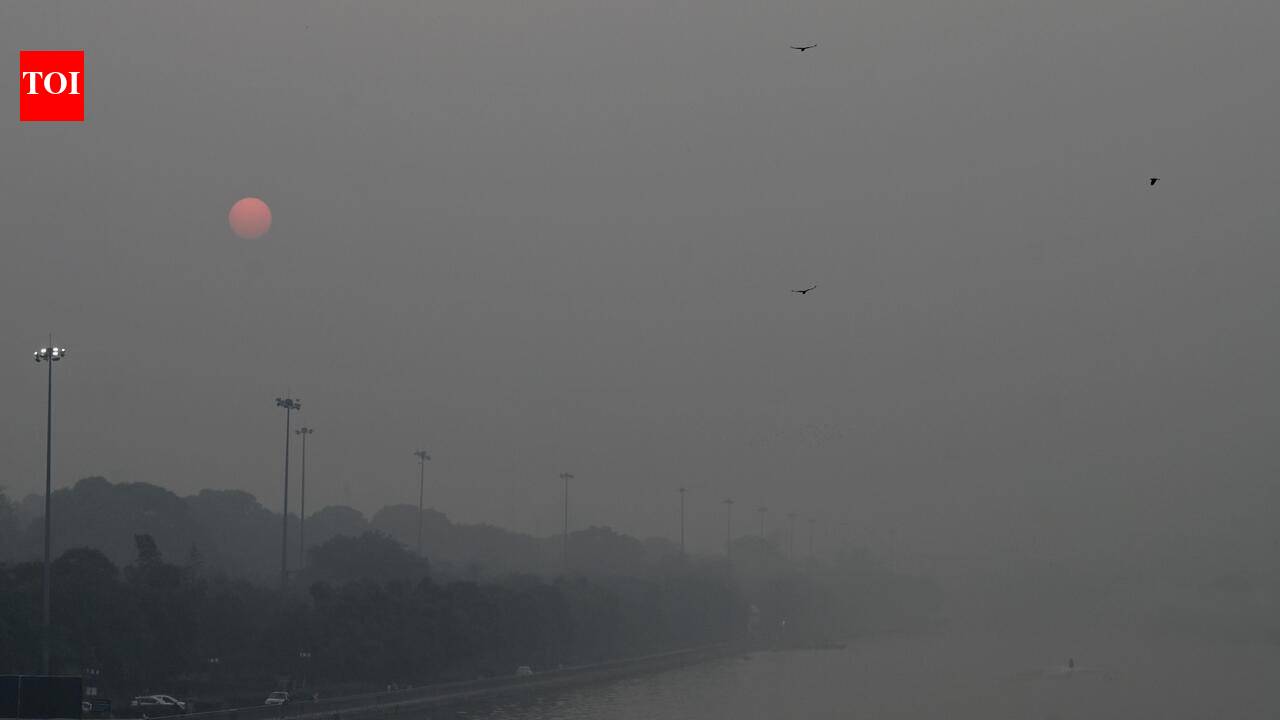
Lucknow recorded an AQI of 232 on Saturday, leaving the city under a thick blanket of smog. Experts said that stagnant air and low wind speed trapped pollutants near the ground. While civic agencies sprinkled water on roads, they noted that such temporary measures cannot replace long-term emission control efforts.
Lucknow: For hours on Saturday morning, the city skyline remained hidden behind a thick grey blanket of smog, with buildings, flyovers and distant landmarks barely visible.Even as water was sprinkled from tankers on the roads, the smog continued to hang over the city, highlighting the limitations of temporary dust-control measures in tackling the larger air pollution crisis.Lucknow recorded AQI of 232 on Saturday, placing it in the 'poor' category, as stagnant weather conditions prevented pollutants from dispersing.Unlike usual winter fog, the haze was a combination of suspended pollutants and atmospheric moisture, with unfavourable meteorological conditions trapping polluted air close to the ground.Explaining the phenomenon, Narendra Kumar of the environmental science department, School of Earth and Environmental Science, Babasaheb Bhimrao Ambedkar University, said that stagnant air, low wind speed and temperature inversion play a crucial role in worsening winter pollution. During temperature inversion, a layer of warmer air sits above cooler air near the surface, restricting vertical movement and trapping pollutants at breathing level, he added.weather experts cautioned against interpreting improved afternoon visibility as cleaner air.Alfred J Lawrence, senior faculty in the chemistry department at Isabella Thoburn College, said rising temperatures during the day generally lower relative humidity and deepen the atmospheric mixing layer, allowing pollutants to disperse.
Evaporation of fog droplets also improves visibility. However, fine particulate matter, particularly PM2.5, can continue to remain suspended even when the sky appears clearer.Lawrence explained that the ventilation coefficient, which combines wind speed and the height of the atmospheric mixing layer, determines how effectively pollutants disperse.
A low ventilation coefficient indicates poor atmospheric conditions for pollution dispersion.Meanwhile, water sprinkling, one of the most visible measures adopted by civic agencies, offers only temporary relief.On Saturday, repeated sprinkling rounds were conducted around Kendriya Vidyalaya, Aliganj, near a CPCB air-quality monitoring station.While sprinkling helps suppress road dust, it has little impact on PM2.5 generated by vehicle exhaust, fuel combustion and industrial emissions.Narendra Kumar said tackling the problem requires sustained source-level interventions, including controlling vehicular emissions, construction dust, open waste burning and industrial pollution.
Experts stressed that sprinkling roads cannot substitute for long-term emission control, particularly when winter weather continues to trap pollutants over the city.