
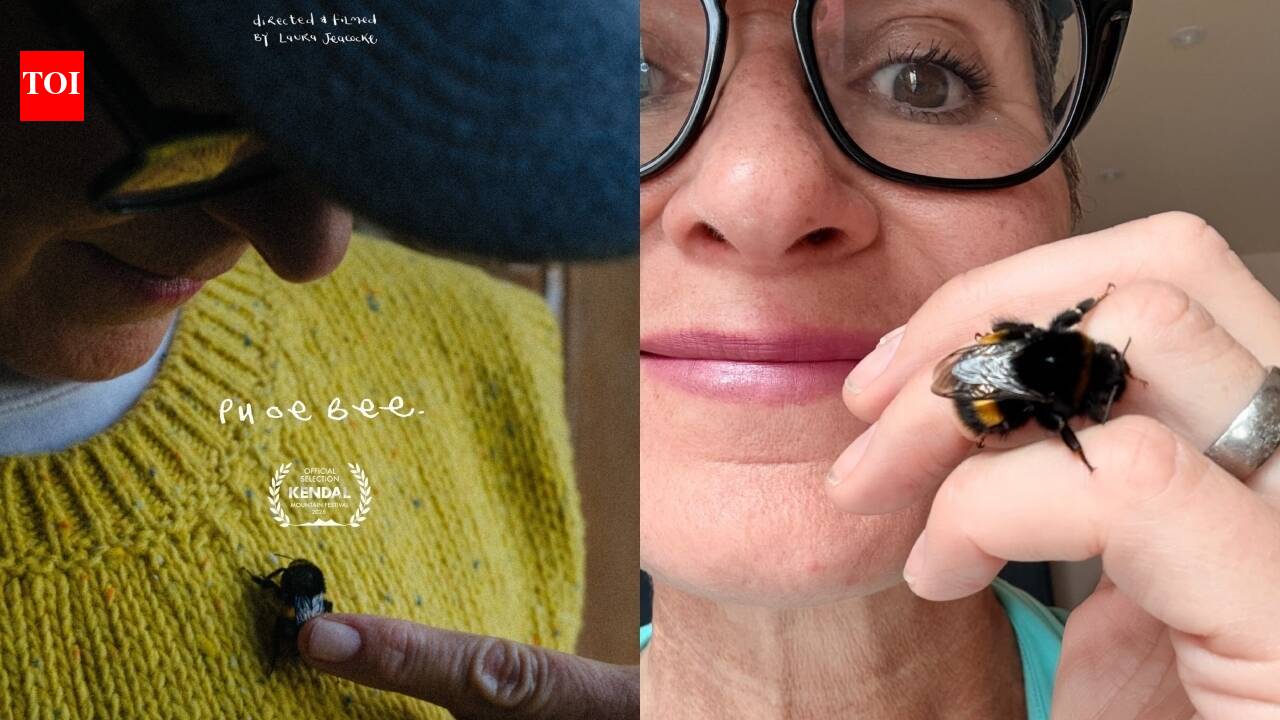
Gilly McArthur rescued an injured queen bumblebee named Phoebee from a roadside. She made a flower bed for the bee, expecting her to die. Instead, Phoebee survived and became an internet sensation. "I couldn't leave her by the roadside," McArthur said. On 24 October, they celebrated 100 days together.
We hear rescue stories every day. A dog pulled from a flooded ditch. A cat coaxed out from behind a fridge. But how often have you heard about a bumblebee with a broken wing?
Gilly McArthur found one lying in the sun beside a road. She took it home, made it a bed of flowers and expected it wouldn't last the day. Instead, the bumblebee now climbs McArthur's arm, works her way around the back of her neck and disappears into her hair. The woman named the queen bee 'Phoebee', and strangers from around the world are obsessed with her."I couldn't leave her by the roadside. So I brought her home and made her a bed of flowers. I thought she'd be dead in a day or so," McArthur told The Guardian, describing the extraordinary rescue. Contrary to McArthur's fears, Phoebee survived and also became an internet celebrity.
An unexpected travel partner
McArthur was due to leave on a week-long sailing trip shortly after the rescue. She couldn't leave the bee behind, so she brought Phoebee along. The woman posted about their voyage together on Instagram. "Phoebee is now at sea. It's been nearly a month since I found her struggling on a hot concrete pavement in my town, unable to fly because one of her wings had been lost; well, it's now a postcard from us on the West Coast of Scotland.
When I picked her I hadn't expected her to last this long!" she wrote on Instagram in August.
The next morning, McArthur woke to messages from around the world. People wrote about bumblebees they had rescued, butterflies they had nursed and small creatures they had tried to save. The stories kept flooding in.McArthur is moved by the response but still a little puzzled by it. "I think it might be because the world is in such a polycrisis at the moment, and everyone is wanting to pull back to something authentic and kind," she told the newspaper. "Perhaps Phoebee reminds people of a time when bumblebees were more prolific, in a world that isn't on fire: lots of the messages said the videos helped them feel more grounded in a world where the algorithms are usually so grounded in clickbait and violence."
100 days of Phoebee
On 24 October, McArthur posted a collage video of Phoebee, celebrating 100 days since the rescue. She also shared how the experience had been 'weird' yet eventful. "Sure, it's a bit weird, but in this world that we seem to be racing through and destroying at great speed, these small interactions of wonder, and truly observing something tiny and perfectly designed for life, can pack a lot of punch."
McArthur also spoke about her familiarity with bumblebees. "I've a bit of history with bumblebees, rescuing them on swims, popping them onto my head for an easy swim back to shore, so it probably wasn't too surprising that in the end, one would find me, or me it, for this sort of slice of life. Too much to say in a post about this and the wider observations that the bee is teaching me, so I'd better keep writing and see where it lands!" she wrote on Instagram.
Over these days, McArthur also observed some of Phoebee's unique traits. "She's fascinating: she spends a lot of time cleaning herself like a cat. And I could watch her putting her long tongue out and getting the nectar out of the flowers for hours."Britain has 24 species of bumblebee and more than 240 species of solitary bee. Most bumblebees live for only a year. Newly mated queens are the exception, hibernating in autumn and emerging in spring to start colonies of their own. Phoebee has not mated, so her future is uncertain.Andy Benson, of the Bumblebee Conservation Trust, is equally bemused by Phoebee. In his view, Phoebee had some natural advantages. She is a buff-tailed bumblebee, one of the biggest and fluffiest of the British species, and she is a queen, which he described as "the biggest and fluffiest of them all". He praised McArthur's compassion. "A third of British wild bees and hoverflies are in decline and a quarter of European species are at risk of extinction because of the loss of their natural habitat, climate change and bee-killing pesticides," he says.The stakes are practical as well as ecological. Pollinators help produce roughly one in three mouthfuls of food, and crops that rely on them, including apples, beans, squashes and almonds, are worth far more than those that do not.Benson suggests giving such bees a home, not in your home, but in your garden. Plant a few flowers in a garden, a balcony box or a patch of earth, and hundreds of bees can find something to eat. Nobody needs to bring one home.