
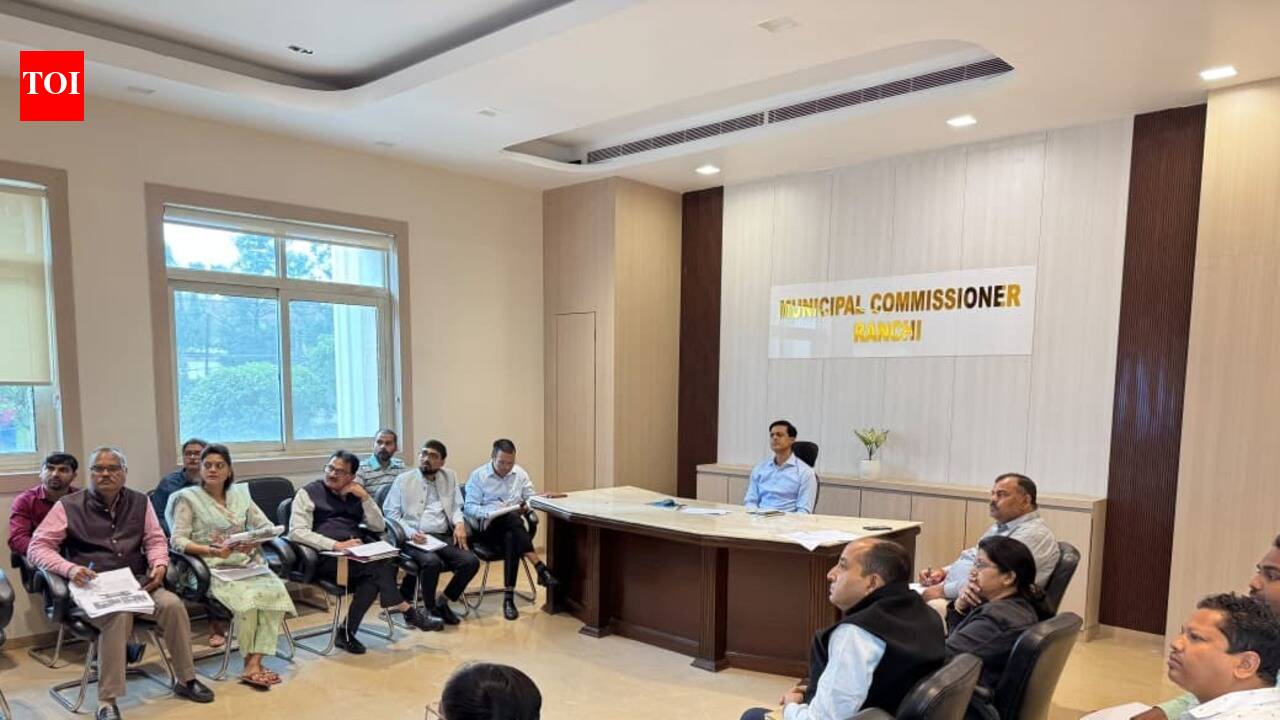
The Ranchi Municipal Corporation seeks a detailed report on air pollution and its health impacts within city limits. During Friday’s meeting, commissioner Sushant Gaurav said, “Necessary steps are being taken for improving air quality.” Officials will now identify pollution hotspots and create a five-year plan to ensure cleaner air.
Attachment
Attachment
Attachment
Attachment
Attachment
Ranchi: The Ranchi Municipal Corporation’s health wing has been instructed to prepare and submit a detailed report regarding illnesses and health impacts caused by air pollution within corporation limits. The direction was issued at the 12th meeting of the city level implementation committee, focused on understanding the current air pollution scenario, improving air quality, and controlling emissions, chaired by municipal commissioner Sushant Gaurav on Friday. To evaluate the ground situation, officials from the Jharkhand State Pollution Control Board (JSPCB) were requested to identify and submit a report on the five most polluted and five least polluted sites within the RMC area based on scientific data. Information was also sought regarding the specific times of day when PM10 levels reach their peak and minimum concentration. Instructions were also issued to formulate a scientific route plan for ambient air quality monitoring across various city zones and set up a dedicated team for its effective execution. The municipal commissioner directed the preparation of a five-year saturation plan for the city under the National Clean Air Programme (NCAP) for submission to the Union ministry of environment, forest and climate change. The framework will incorporate components such as paver block installation, road repair, tree plantation, modernised crematoria, and waste management. A plan will serve as a multi-year strategy to ensure anti-pollution infrastructure and mitigative actions achieve 100% coverage across all major emission sectors. Under this approach, urban local bodies (ULBs) and state pollution control boards (SPCBs) systematically scale their resources to cover entire urban areas rather than implementing isolated or piecemeal activities. To curb dust pollution, covering all under-construction buildings and construction sites with green shading nets was made mandatory. The horticulture wing was directed to identify suitable locations for maximum tree plantation and formulate an action plan to expand the city's green cover. Additionally, directions were issued to organise awareness activities in schools, colleges, and public spaces. Gaurav said, “Necessary steps are being taken for improving air quality in the city by prioritising pollution source control, green cover expansion, scientific monitoring, and public participation. The corporation's goal is not limited to pollution control alone, but extends to ensuring a clean, healthy, and safe environment for present and future generations.”