
Pune saw a sharp rise in air and noise pollution during Diwali this year. Peak PM2.5 levels hit 1,000 µg/m³ at 2am on Monday, far above the 60 µg/m³ norm. Many residents flouted rules, leading activists to call for a complete ban as noise levels also rose across the city.
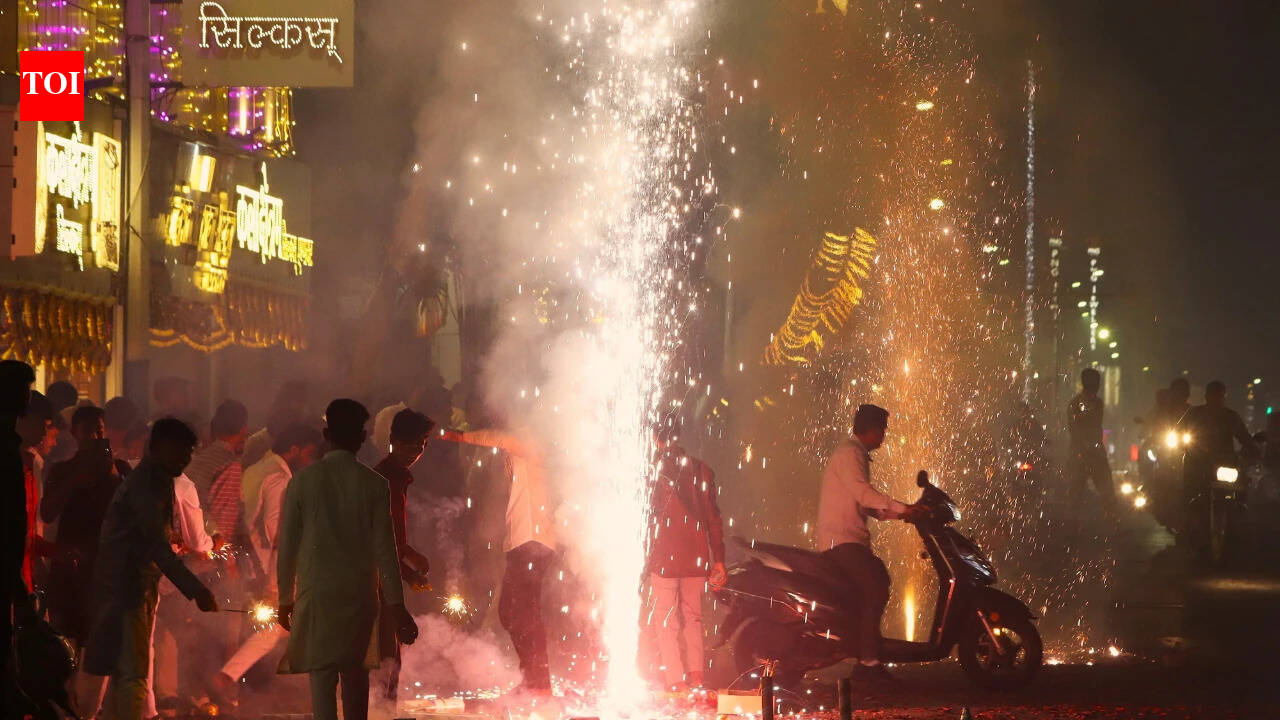
Pune experienced a notable rise in air pollution levels during the recent Diwali celebrations (Representative image)
PUNE: Diwali festivities this year brought a sharp spike in both air and noise pollution for thousands of hapless residents, while many others openly flouted norms. Pune’s peak PM2.5 concentration touched around 1,000 µg/m³ at 2am on Monday, compared with approximately 600 µg/m³ during the festival last year. It was much higher than Central Pollution Control Board (CPCB)’s National Ambient Air Quality Standards of 60 µg/m³.
Noise range recorded at different parts of city (Photo credit: Ashish Gupta)
Similarly, night-time equivalent noise level (Leq) readings rose at seven monitored locations, as per a Maharashtra Pollution Control Board (MPCB) comparison of Laxmi Pujan in 2025 and 2026. Laxmi Road recorded a 2.02% increase in night-time Leq, followed by Sarasbaug (1.49%), Shaniwarwada (1.32%), Khadki Bazaar (1.18%) and Shivajinagar (Sakhar Sankul) (0.27%). Leq, or equivalent noise level, is the average noise level recorded over a specified period. It takes into account variations in sound levels during that time, rather than relying on a single reading. However, it does not show how loud individual firecracker bursts were at their peak. In the aftermath of firecracker norms being blatantly violated across the city for Diwali on Sunday, several residents and activists have called for a complete ban on the activity, citing that implementation of existing norms is not being carried out effectively.