
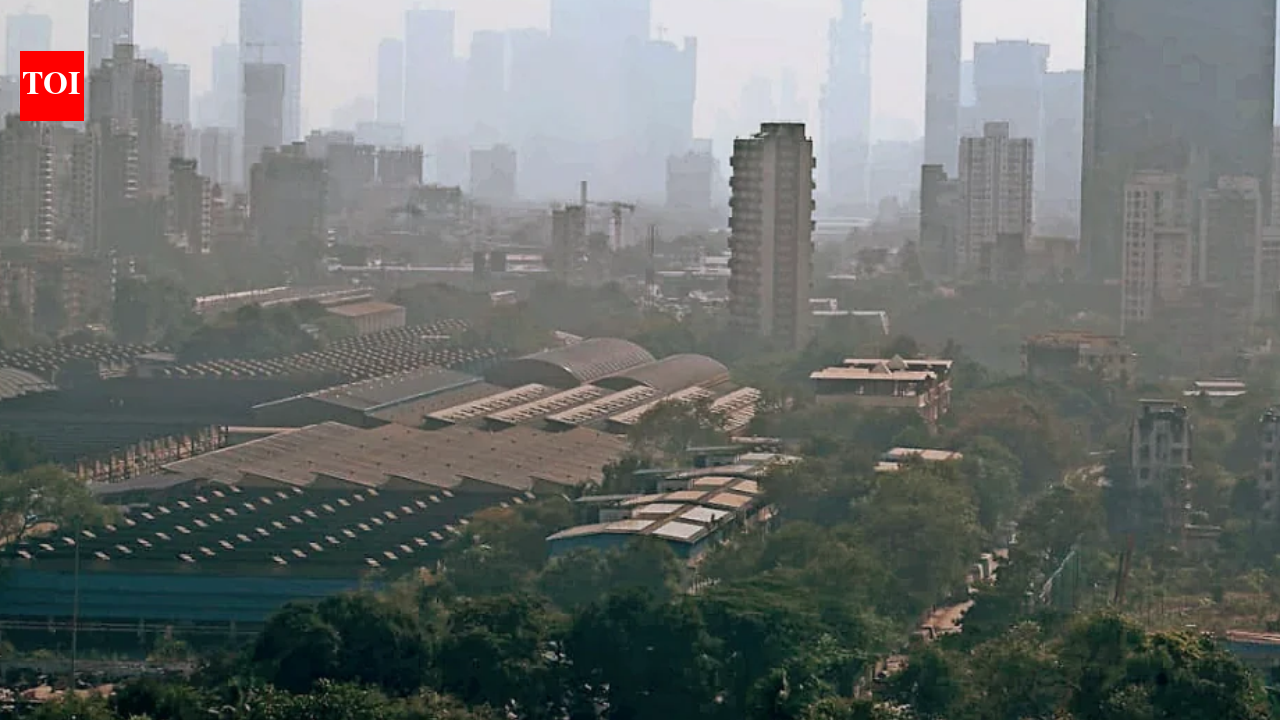
PM10 dust levels exceeded the national limit at 13 of 14 Mumbai air stations in 2025-26, the BMC reported. Chembur and BKC recorded the highest concentrations at 125 micrograms per cubic metre. Deputy municipal commissioner Avinash Kate said, "Washing the wheels of vehicles involved in construction work is mandatory."
MUMBAI: Dust from roads and construction sites could be contributing to elevated particulate pollution across Mumbai, with 13 of 14 air quality monitoring stations recording annual average PM10 levels above the national limit in 2025-26. Chembur and BKC recorded the highest concentrations at 125 micrograms per cubic metre (g/m³) each, more than twice the prescribed limit of 60 g/m³, according to BMC's Environment Status Report 2025-26. Only Kandivali met the standard.
PM10 refers to particulate matter 10 micrometres or less in diameter that can be inhaled. Major sources include road dust, construction activity, vehicular emissions and dust resuspended from roads and open spaces.The data combine readings from nine SAFAR-Mumbai stations and five BMC-run continuous ambient air quality monitoring stations (CAQMS). India's annual PM10 standard, set by Central Pollution Control Board (CPCB), is 60 g/m³, four times WHO's recommended annual guideline of 15 g/m³. The WHO guideline is health-based, while India's standard is a national regulatory limit.Shivaji Nagar in Govandi recorded the highest PM10 level among BMC-run stations at 93 g/m³, 55% above the national standard.
Ghatkopar recorded 84 g/m³, followed by Sewri (75), Byculla (69) and Kandivli (59).
Avinash Kate, deputy municipal commissioner (environment and climate change), attributed Shivaji Nagar's high reading partly to roadwork dust and a bakery using wood instead of cleaner fuel. The bakery has since been shut, he said."Past studies have found that construction dust accounts for nearly 9% of PM10. With around 3,000 construction projects underway across Mumbai, its contribution to rising particulate levels cannot be ruled out. However, this is largely a post-monsoon concern, and air quality remains much more under control during the rest of the year," Kate said. "Washing the wheels of vehicles involved in construction work is mandatory."All nine SAFAR-Mumbai stations exceeded the annual PM10 standard. Chembur and BKC recorded the highest levels at 125 g/m³ each, followed by Malad (100), Colaba (95), Andheri (90), Borivli (87), Worli (79), Mazgaon (71) and Bhandup (64).Bhagwan Kesbhat, founder of Waatavaran Foundation, said BMC has issued 28 guidelines for construction sites, but questioned how strictly they are being followed. "Many times, construction sites put up green cloth only in the portion where construction work is ongoing and do not cover the entire site."
BKC recorded an annual average PM10 concentration of 125 g/m³, more than twice the national standard. Its PM2.5 level was also elevated at 48 g/m³, against the 40 g/m³ limit. Kesbhat attributed the readings to infrastructure projects, including bullet train and Metro 2B (DN Nagar to Mankhurd). "Unlike other cities like Delhi or Pune, Mumbai isn't landlocked and has the advantage of the sea. Therefore, we should attempt to match the WHO's prescribed standards, at least where possible," he said.