
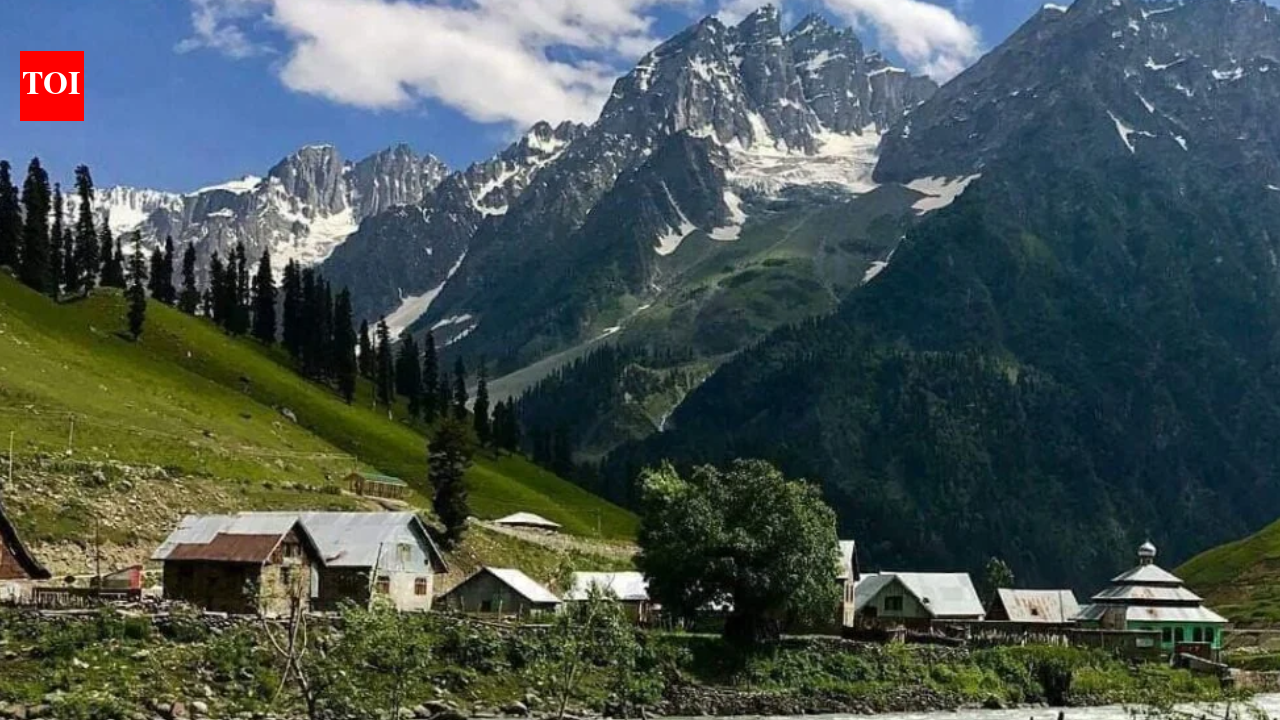
The Sher-e-Kashmir University of Agricultural Sciences and Technology of Kashmir submitted a draft mountain policy to the J&K government. "Our mountains are sending clear warnings," the document said. It proposes strict rules for construction, visitor caps at tourist sites, and better protection for glaciers to save fragile mountain ecosystems.
SRINAGAR: "Our mountains are sending clear warnings. If we continue with business as usual, the damage will become irreversible within a generation," says the draft Jammu and Kashmir Sustainable Mountain Development Policy (JK-SMDP) 2026, submitted by the Sher-e-Kashmir University of Agricultural Sciences and Technology of Kashmir (SKUAST-K) to the government.
The policy proposes a three-tier institutional framework to strengthen mountain governance. It calls for the establishment of a J&K Mountain Development Council to formulate policies and resolve interdepartmental conflicts; a J&K Mountain Development Authority to translate decisions into regulations, permits and monitoring mechanisms; and District Mountain Committees and Destination Management Committees to oversee the day-to-day management of individual sites.It proposes dividing mountains into four sensitivity zones, with clear rules on what can and cannot be built in each zone. It also calls for capping the number of visitors at major tourist and pilgrimage sites based on their carrying capacity, through online registration and digital governance mechanisms. The policy proposes stopping private vehicles at green gateways below fragile destinations and exploring ropeway transport systems for hilly areas.
It also calls for applying mountain-safe standards to every road, tunnel and hydropower project, covering slope stability, muck disposal, drainage and spring protection.
The policy identifies the conservation of natural resources and biodiversity, along with the stabilisation of natural ecosystems, as key objectives. It proposes bringing all major tourist and pilgrimage destinations under carrying-capacity management, restricting fossil-fuel vehicles in fragile destinations beyond designated green gateways, and prohibiting new construction in high-risk or ecologically sensitive zones while bringing existing establishments into compliance.It also calls for protecting glaciers, springs and wetlands as critical water infrastructure, reducing disaster-related deaths through early warning systems and safe infrastructure planning, and making mountain destinations free of visible waste and untreated sewage.The draft policy was submitted to the Jammu and Kashmir government earlier this month for consideration. If adopted, it will make J&K the first Himalayan state or Union Territory in India to introduce a legally backed mountain development policy."This is a conscious choice to act before the mountains force our hand," the policy document states. It further emphasises that "by enacting this policy, Jammu & Kashmir signals its determination to safeguard fragile ecosystems, empower mountain communities, and lead India's Himalayan states in pioneering a new era of resilient, regenerative, and inclusive mountain governance."It urges the J&K government to finalise the draft policy within six months, secure Cabinet approval within nine months and enact the enabling law within one year. It also requests the Government of India to support J&K as a national pilot for Himalayan mountain governance.The draft policy raises concerns about receding glaciers, overtourism, the accumulation of waste in high-altitude areas, unregulated construction on mountain slopes, and roads and tunnels cutting through fragile mountain terrain.
"Our water is melting away. Glaciers such as Kolahoi, Thajiwas and those feeding the Jhelum, Chenab, Tawi and Indus are retreating. They feed our rivers, springs, canals, drinking water and hydropower. When the glaciers go, summer flows fall and the Jhelum and Chenab economies face a question of survival," the document states.
"Tourism has crossed the limits of our fragile sites. India's growing prosperity has brought record numbers of domestic tourists and pilgrims; J&K recorded about 2.36 crore tourist visits in 2024. Thousands of vehicles now drive deep into Gulmarg, Pahalgam, Sonamarg, Doodhpathri, Katra, Mansar, Basoli, Patnitop and other destinations, as well as along yatra routes. Their exhaust and black carbon settle on snow and ice and speed up melting," the document states.