
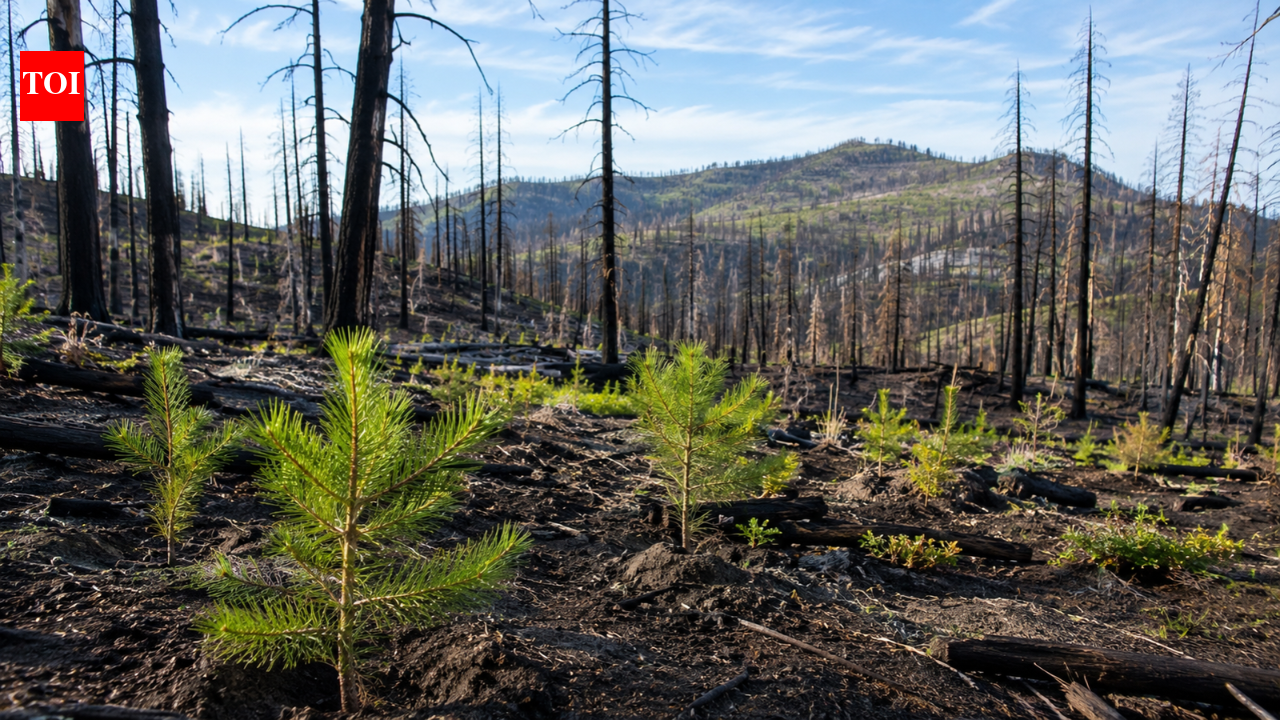
America planted trees across thousands of miles of wildfire-hit forests, and a study of 69,245 seedlings found that recovery was 25.7% faster in planted areas. Researchers analysed reforestation activities between 1987 and 2022. They said, "post-fire planting could establish new tree growth," though survival rates varied based on local weather conditions.
Tree planting across wildfire-damaged forests in the western United States has helped accelerate forest-cover recovery, according to a major study published in Forest Ecology and Management. Researchers analysed post-fire reforestation activities carried out between 1987 and 2022, examining 69,245 planted seedlings across 297 wildfire events and 6,706 planting areas in 10 states. They found that areas where trees were planted gained forest cover 25.7% faster than environmentally similar areas left unplanted within the same fires. The study also found that 79.5% of planted seedlings survived their first growing season. However, the researchers observed that recovery varied considerably depending on rainfall, temperature, drought, fire severity and the timing of planting.
How tree planting helped wildfire-damaged forests recover faster
The study, titled Green is the New Black: Outcomes of post-fire tree planting across the US Interior West, was led by Kyle C. Rodman and involved researchers from Northern Arizona University, the USDA Forest Service, Colorado State University, Washington State University and The Nature Conservancy.
The researchers combined satellite-derived forest-cover measurements from Landsat imagery with field-based records of planted seedling survival. They compared areas where trees had been planted with environmentally similar, unplanted areas within the boundaries of the same wildfires.The analysis found that planted areas recorded an average 25.7% higher rate of forest-cover gain than their unplanted counterparts. The average difference was equivalent to an additional 0.29 percentage points of forest cover per year.However, the advantage was not immediate. During the first five to 10 years after planting, average forest cover was slightly higher in unplanted comparison areas. Planted areas consistently recorded higher average forest cover after approximately 13 years.
Nearly 80% of planted seedlings survived their first growing season
One of the study's key findings concerned the early survival of trees planted in wildfire-affected landscapes.Researchers found that the average survival rate of planted seedlings was 79.5% after one growing season, with considerable variation between individual planting areas.The survival records showed that:Fewer than 1% of planting-unit records recorded complete seedling mortality after the first growing season.Around 14.1% of planting-unit records reported 100% seedling survival.Most recorded survival rates ranged between 16% and 100%, reflecting differences in local environmental conditions.The findings suggested that post-fire planting could establish new tree growth across damaged landscapes, although survival rates varied considerably according to the conditions experienced by individual seedlings.
Rainfall and temperature influenced how well trees survived
The researchers found that climate conditions played a major role in determining the success of reforestation efforts.Areas with colder and wetter conditions generally recorded higher rates of forest-cover recovery and seedling survival. In contrast, warmer and drier environments presented greater challenges for newly planted trees because of increased moisture stress.The study identified climatic water deficit, a measure of moisture stress experienced by plants, as the strongest predictor of early seedling survival.It also found that planting areas in cold, wet locations had average seedling survival rates approximately 20% to 30% higher than those in warm, dry regions.Post-planting weather also mattered. When seedlings experienced moderately wet to highly wet conditions after planting, their early survival increased by approximately 20% compared with drier conditions.
Planting season made a difference in forest recovery
The timing of tree planting also influenced how successfully seedlings established themselves after wildfires.Researchers found that spring and early-summer planting generally produced better results in colder, wetter regions. In these locations, planting between late April and mid-June was associated with stronger forest-cover gains.However, the pattern differed in warmer and drier areas, where late-summer and autumn planting produced better outcomes.The researchers explained that newly planted trees in dry regions face greater moisture stress during hotter periods. Planting later in the year can help reduce exposure to some of these conditions.The findings suggest that reforestation programmes need to account for regional climate patterns rather than follow the same planting schedule across every wildfire-damaged landscape.
Forests with surviving trees showed faster recovery
The severity of the original wildfire was another important factor influencing the results.Researchers found that forest-cover gains were generally fastest in areas that experienced low to moderate fire severity and retained more than 20% post-fire forest canopy cover in the surrounding landscape.Surviving trees can provide seeds for natural regeneration, allowing forests to gradually recolonise damaged areas without relying entirely on planted seedlings.Approximately 45% of the planting units were located in areas that had experienced low to moderate fire severity. The researchers noted that natural regeneration was more likely in these locations, even without additional intervention.By contrast, severely burned landscapes with few surviving trees may face greater difficulties recovering naturally because many forest species depend on nearby trees to supply seeds.
Only 63.7% of planting areas recovered faster than unplanted sites
Although the overall results favoured tree planting, the research also revealed considerable differences between individual restoration projects.Only 63.7% of the planting units recorded faster forest-cover increases than their environmentally matched, unplanted comparison areas.The researchers found that planting outcomes were influenced by several interacting factors, including local climate, rainfall following planting, fire severity, surrounding forest cover and the season in which seedlings were introduced.This variation highlights why planting trees alone cannot guarantee successful forest restoration. Selecting appropriate locations, species and planting periods is important, particularly in regions experiencing prolonged drought and rising temperatures.
Why restoring forests after wildfires has become important
Severe wildfires can destroy large sections of forest, leaving landscapes with limited natural regeneration potential.In western US forests, many conifer species depend on seeds from surviving trees to regenerate after fires. When large areas burn at high severity, surviving seed sources can become too distant to support natural recolonisation.The researchers noted that some heavily burned landscapes could take decades or even centuries to regain tree cover naturally.The study also highlighted the growing reforestation requirement on USDA Forest Service-managed lands. Wildfire-affected landscapes account for more than 80% of the agency's reforestation needs, while only around 6% of post-fire reforestation needs were met over the preceding decade, according to estimates cited in the research.The Infrastructure Investment and Jobs Act of 2021, which included updates to the REPLANT Act, sought to address the growing backlog by providing additional support for reforestation on federal lands.
What the findings mean for future reforestation efforts
The researchers concluded that post-fire tree planting can improve forest recovery across large landscapes, but its effectiveness depends on environmental and operational conditions.They recommended accounting for local moisture availability, planting seasons, drought exposure and the availability of suitable tree species when planning restoration projects.The findings also underline the importance of long-term monitoring to determine whether newly planted trees survive and contribute to forest recovery over several years.By combining satellite observations with field-based seedling records, the research provides a broader picture of how planting programmes perform across different wildfire-damaged landscapes. It also offers information that forest managers can use to identify locations where active reforestation is most likely to produce lasting results.