
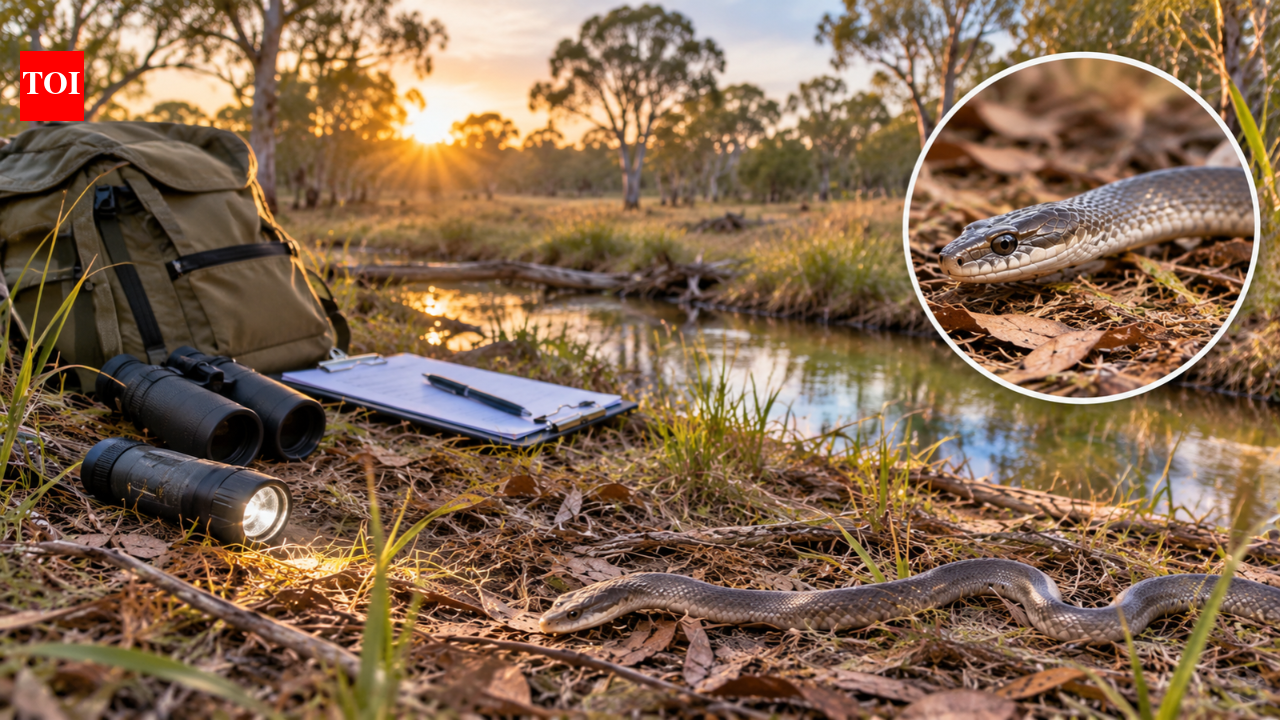
Researchers surveyed Australia's floodplains for 15 nights and recorded just 15 endangered grey snake sightings among 140. The study showed that four surveys may be needed for a 95% chance of detection. These findings highlight how snake behaviour makes it difficult for conservation teams to monitor threatened species accurately.
Australia's floodplains are home to snake species that can be difficult to locate, even during dedicated wildlife surveys. A recent investigation in the Murray-Darling Basin has highlighted the problem, with researchers recording 140 snake sightings over 15 consecutive nights of fieldwork. Just 15 of these involved the endangered grey snake, raising questions about how reliably its presence can be established through routine searches. The findings also point to a difficulty for conservation teams assessing development sites and habitats. When a threatened snake goes undetected, it can be mistaken for a species that is no longer present in an area, potentially affecting decisions about its protection.
Researchers record just 15 endangered grey snakes during 15 nights of surveys
The fieldwork covered 22 survey transects across floodplain habitats in the Murray-Darling Basin. Researchers focused on three snake species: the endangered grey snake (Hemiaspis damelii), De Vis' banded snake (Denisonia devisi) and the curl snake (Suta suta).Over 15 consecutive nights, the team recorded 140 snake observations. Only 15 were new records of the grey snake. The remaining observations included 94 De Vis' banded snakes, 19 curl snakes and 12 records involving six other snake species.
The number of sightings alone, however, did not tell the full story. The researchers also examined how likely each species was to be detected during a survey. Their findings showed that some snakes were considerably harder to record than others, even when the searches took place across the same landscape.
Why snake behaviour makes endangered species difficult to monitor
Snakes are often difficult to monitor because they spend much of their time out of sight. Their behaviour and use of surrounding habitats can make visual searches unreliable, particularly when survey teams have limited opportunities to encounter them.For threatened species, this creates a problem when conservation decisions depend on whether an animal has been recorded at a particular location. An unsuccessful search does not necessarily mean that the species is absent. It could simply mean that the snake was present but remained undetected.The investigation measured this difference among the three species. De Vis' banded snake had the highest estimated detection probability, at 0.842. The figure for the grey snake was 0.582, while the curl snake had the lowest probability, at 0.430.
How many surveys are needed to detect each snake
According to the study published in Australia Ecology, titled, 'Detection Probabilities for Three Nocturnal Floodplain Snakes: Implications for Monitoring the Endangered Grey Snake Hemiaspis damelii in the Murray-Darling Basin' reveals that the team also calculated how many survey visits would be needed to achieve a 95% chance of detecting each species, assuming it was present.De Vis' banded snake required an estimated two surveys to reach that level of confidence. The grey snake needed four, while the curl snake required six.The difference is significant when planning wildlife monitoring. A couple of visits may provide a reasonable chance of recording one species, but the same effort may not be sufficient for another. Applying identical survey schedules across different species could leave gaps in the information collected.For the endangered grey snake, four surveys were estimated to be necessary to reach the 95% detection target. A single visit that produced no sighting would therefore offer little certainty about whether the species occupied the area.
Why missed sightings could affect conservation planning
The research has particular relevance for biodiversity offset schemes, which are used when development projects affect natural habitats. Such arrangements involve measures intended to compensate for environmental losses through habitat protection, restoration or improvements elsewhere.Accurate wildlife surveys are important when assessing these sites. If an endangered snake is present but remains undetected, its occurrence may not be reflected in the environmental information used during planning.This could influence decisions about which areas require protection and how development-related impacts are assessed. The problem may be harder to address across large floodplain landscapes, where surveying every suitable habitat patch requires considerable time and effort.
The researchers suggest that survey programmes should account for differences in how easily individual species can be found. This would help avoid treating an absence of sightings as confirmation that a threatened animal does not live in the area.