
New oil plans for the Falkland Islands threaten local seals, whales, and penguins. The Sea Lion project, led by Navitas Petroleum, plans 23 wells to extract oil. Environmentalists worry about marine pollution. In August 2024, Falklands Conservation said the project used old data, failing to protect this rich global ecosystem.
While Argentina and the UK dispute sovereignty over the islands and its vast oil reserves, environmentalists fear for one of the Atlantic's richest ecosystems
From the air, the main Falkland Islands form two large, jagged shapes against the South Atlantic. East Falkland and West Falkland are surrounded by 778 smaller islands and islets east of Patagonia's southern tip.
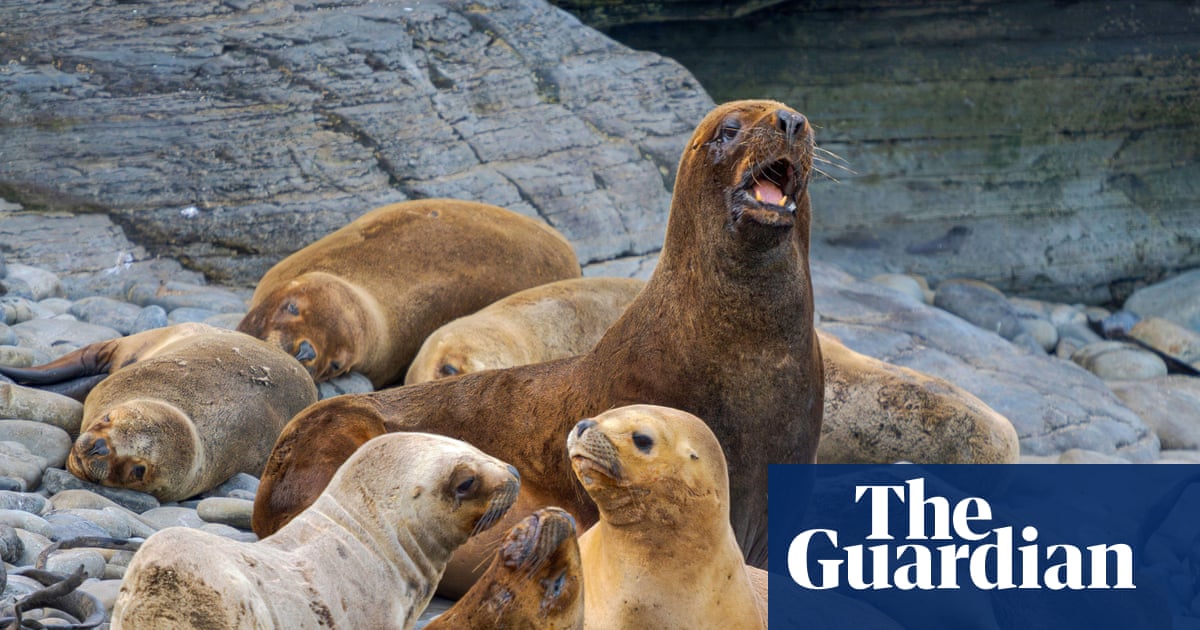
The archipelago, a British overseas territory claimed by Argentina, is home to large colonies of albatrosses and penguins. Its waters, with those of the Patagonian shelf, provide feeding grounds for sea lions, southern elephant seals and southern right whales.
"We are talking about an area of great importance for wildlife, not only regionally but globally," says Hernán Pérez Orsi, an oceans researcher, activist and energy coordinator at the Forum for the Conservation of the Patagonian Sea.
Yet new oil development plans licensed by the Falkland Islands government now threaten these waters: about 130 miles (210km) north of the islands lies the Sea Lion project, a major deepwater oil development that is likely to involve drilling wells and installing subsea infrastructure in the ocean.
Operated by Navitas Petroleum, with Rockhopper Exploration, the project plans 23 wells in its first two phases. Oil will be processed and stored onboard the Aoka Mizu, a production vessel with a planned capacity of up to 55,000 barrels a day.
The scale of Sea Lion and its potential effects on the environment concern the Argentine Association of Environmental Lawyers (AAdeAA). Noting that routine operations can cause marine pollution, Gonzalo Vergez, the organisation's legal coordinator, says: "It is generally said that offshore oil operations cause harm, even when nothing goes wrong."
Warnings have also come from the islands' residents. In August 2024, Falklands Conservation, a local environmental organisation, questioned some of Sea Lion's scientific data, used in its environmental impact statement.
Its report notes that birds from colonies hundreds or thousands of miles away, including albatrosses from South Georgia and New Zealand, visit Falklands' waters, and says the only broadly appropriate seabird data in the impact statement is more than 20 years old. According to Falklands Conservation, good practice in regions such as the North Sea would require data collected within the past five years.
Oil exploration off the Falkland Islands is a new frontier in the South Atlantic rush driven by countries across Latin America and the Caribbean since Brazil discovered its largest oil reserves yet in deep waters up to 300 miles offshore in the 2000s.
While the British government has not provided direct financial support for the Sea Lion project, it offers political, diplomatic and legal backing. London maintains that Falklands residents have the right to self-determination, including the authority to manage their natural resources.
Recently, Ellie Reeves, the attorney general for England and Wales, said the Falkland Islands would suffer "devastating consequences" if the territory was blocked from developing the offshore oilfield.
The Patagonian shelf, where the islands lie, is one of the world's most productive marine ecosystems, sustained by the cold, nutrient-rich waters of the Falkland current. A 2019 study led by the researcher Alastair Baylis estimates that the archipelago supports about three-quarters of the world's black-browed albatross population, half of the global slender-billed prion population and about a third of the world's southern rockhopper and gentoo penguin populations.
The researchers analysed 1,891 foraging trips by 686 animals from nine seabird and marine mammal species. They identified areas where several species' ranges overlapped, especially on the Patagonian shelf north of the Falkland Islands.
"Our findings highlight that the distribution of marine predators on the Patagonian shelf [is] not constrained by national jurisdictions," the researchers concluded.
Beyond the risk of a major accident, Sea Lion's potential environmental threats range from minor oil leaks to underwater noise, drilling waste, industrial lighting and vessel traffic.
An oil spill would pose another danger: crude oil can poison animals and coat the feathers and fur of seabirds and marine mammals, impairing their ability to regulate their body temperature. Falklands Conservation's report also questions the assessment of spill risks and the capacity to respond to an accident.
The project's progress has also prompted a response from the Argentinian government, not for environmental reasons but against the backdrop of the long-running sovereignty dispute with the UK. On 3 September, the Argentinian president, Javier Milei, signed a decree tightening controls on oil activities in the Falkland Islands without Argentinian authorisation.
Although his government promotes large-scale energy investment, the decree requires applicant companies and their affiliates to declare compliance with Argentinian legislation governing oil and gas activities in the islands.
The next day, the Argentinian presidency announced sanctions against 45 individuals and entities allegedly linked to those activities, including companies associated with Navitas Petroleum and Rockhopper Exploration, according to the Argentinian newspaper La Nación.
Environmental organisations, however, had been monitoring oil activity in these waters long before the government's response. AAdeAA, headed by Enrique Viale, began investigating oil development in the Argentine Sea in 2020 and had been examining information about Sea Lion since at least 2024.
As the project advanced, it intensified its work and, on 1 September, joined the La Plata Falkland Islands Ex-Combatants Centre (CECIM), an organisation of Argentinian veterans of the 1982 war, in filing a preventive legal action over potential environmental damage in an attempt to halt the development.
"Once this project is installed, there is no getting rid of it," Viale says.
The dispute also reached the Argentinian courts. On 16 September, the federal judge Mariel Borruto ordered Navitas and Rockhopper not to carry out any work until an environmental assessment had been conducted before the Argentinian authorities, or until the court ruled otherwise.
The injunction remained in force as of 29 October, although its enforcement is uncertain: the islands remain under British administration, beyond Argentina's effective control.
Beyond the sovereignty dispute and the court rulings, questions remain about the project's environmental impacts. Rockhopper declined to comment, directing inquiries to the project operator, Navitas.
Navitas stated that it would not comment on the allegations until the Hamburg-based International Tribunal for the Law of the Sea had ruled on a case brought by the Argentinian government against the UK, which claims that the Sea Lion project breaches Argentinian sovereignty and should be suspended. The court may hand down a decision on 28 November.
In its revised environmental impact statement from July 2025, Navitas acknowledged that some seabird survey data used was 24 years old, but argued it remained useful for identifying broad distribution patterns and had been supplemented by more recent research.
Although it acknowledged remaining data gaps, the company considers it impracticable for an operator to repeat surveys at this scale and has proposed collecting further data as the project develops.
The company also acknowledged potential impacts on marine wildlife even during routine operations. Its assessment rates the residual impacts and risks associated with artificial lighting, underwater noise, the discharge of drill cuttings and vessel collisions with cetaceans as "moderate", despite the proposed mitigation measures.
Navitas has proposed vessel speed restrictions and the use of specialist seabird and marine mammal observers, while acknowledging that visual monitoring cannot prevent collisions in darkness. It rates its confidence in the collision risk assessment as "uncertain".
In the event of an oil spill, the document also acknowledges the challenges of responding in the south Atlantic's difficult sea conditions: in one modelled scenario of a subsea well blowout, recovery equipment was projected to recover just 6.3% of the spilt oil, without reducing the estimated amount reaching the shoreline.
As the Sea Lion project moves towards oil production, environmental organisations warn about the consequences for one of the richest marine ecosystems in the south Atlantic.
For Vergez, the uncertainty provides all the more reason to act. "In the absence of scientific certainty," he says, "the principles of prevention and precaution apply: protection is necessary."