
Nagpur became Maharashtra’s most polluted city on Sunday as its air quality index touched 195. While other cities saw air quality improve after Diwali, Nagpur continues to struggle with high pollution. MPCB official Hema Deshpande said, "A lot of waste generated during the festival is being burnt in open."
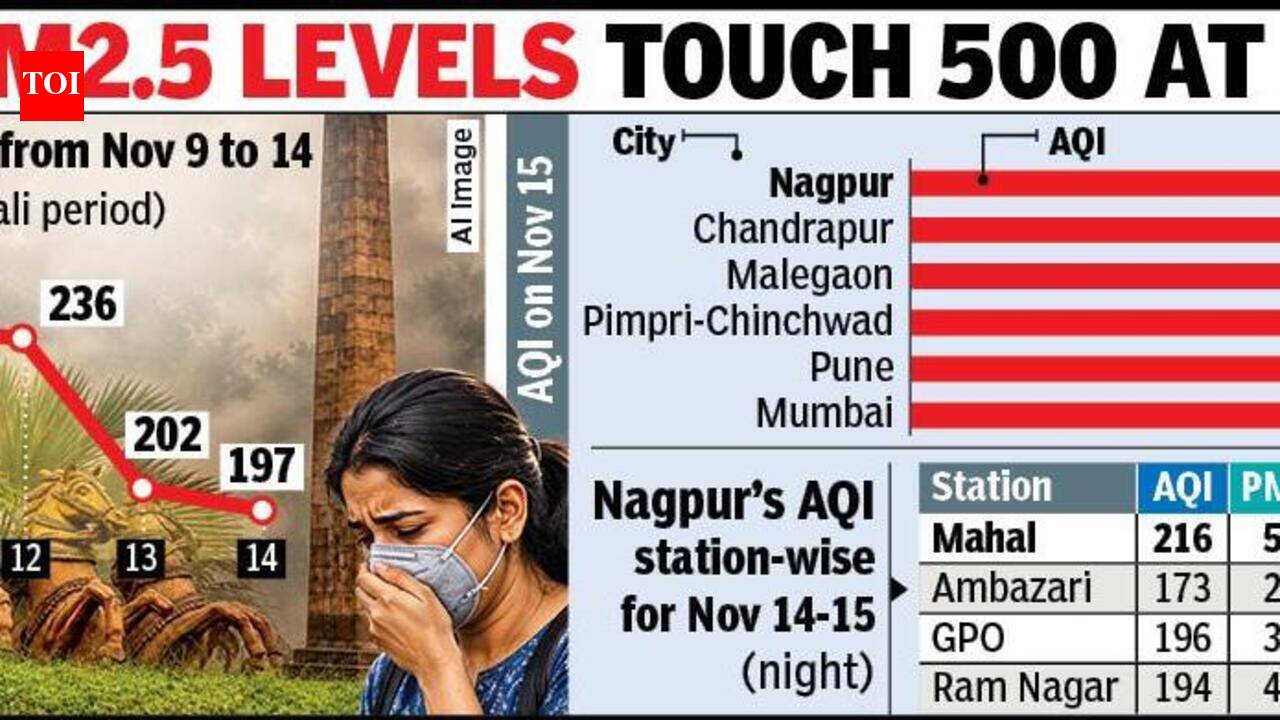
Nagpur: Nagpur emerged as Maharashtra's most polluted city on Sunday, with its air quality index (AQI) climbing to 195, overtaking Pimpri-Chinchwad, which had recorded higher pollution levels during the Diwali period. While air quality has started improving across most cities in the state following the festive celebrations, Nagpur continues to struggle with elevated pollution levels.The city's AQI stood at 262 on Diwali night (November 9). It improved marginally to 197 on Nov 14, before settling at 195 on Sunday. However, the improvement has been slower compared to other cities, pushing Nagpur to the top of the state's pollution chart.On Sunday, Chandrapur was the second most polluted city with an AQI of 177. Several cities which had recorded higher pollution levels than Nagpur during Diwali have since managed to bring down their AQI. These are Pimpri-Chinchwad at 164, Pune at 147, Nanded at 137 and Jalgaon at 140. Even Mumbai's AQI is at 138.Station-wise readings in Nagpur reveal the extent of the problem. During the night of Nov 14-15, Mahal recorded an AQI of 216, with both PM2.5 and PM10 levels touching an alarming 500. Ram Nagar registered an AQI of 194, with PM2.5 at 431, while GPO recorded an AQI of 196 and PM2.5 at 338. Ambazari, despite its green surroundings, reported an AQI of 173 and PM2.5 at 265.
The readings indicate that particulate pollution remains high across different parts of the city rather than being restricted to a single pocket.Chandrapur, too, has witnessed a sharp rise in pollution over the past few days, moving to the second position in the state's AQI rankings.
Noise pollution readings also suggest that firecracker bursting has not completely stopped. Residents continue to burst powerful crackers on roads and in narrow lanes during evening hours, adding to the city's pollution burden even after Diwali.MPCB regional officer Hema Deshpande said firecrackers bursting continued during the fifth-day celebrations of Diwali but other contributing factors are keeping the pollution levels high.
"A lot of waste generated during the festival is being burnt in open while the cold weather is also playing a role. Also, it needs to be assessed for how long the pollution levels are touching peak of 500 ug/M3. Accordingly, graded action plan as per National Clean Air Plan needs to be taken," she said.