
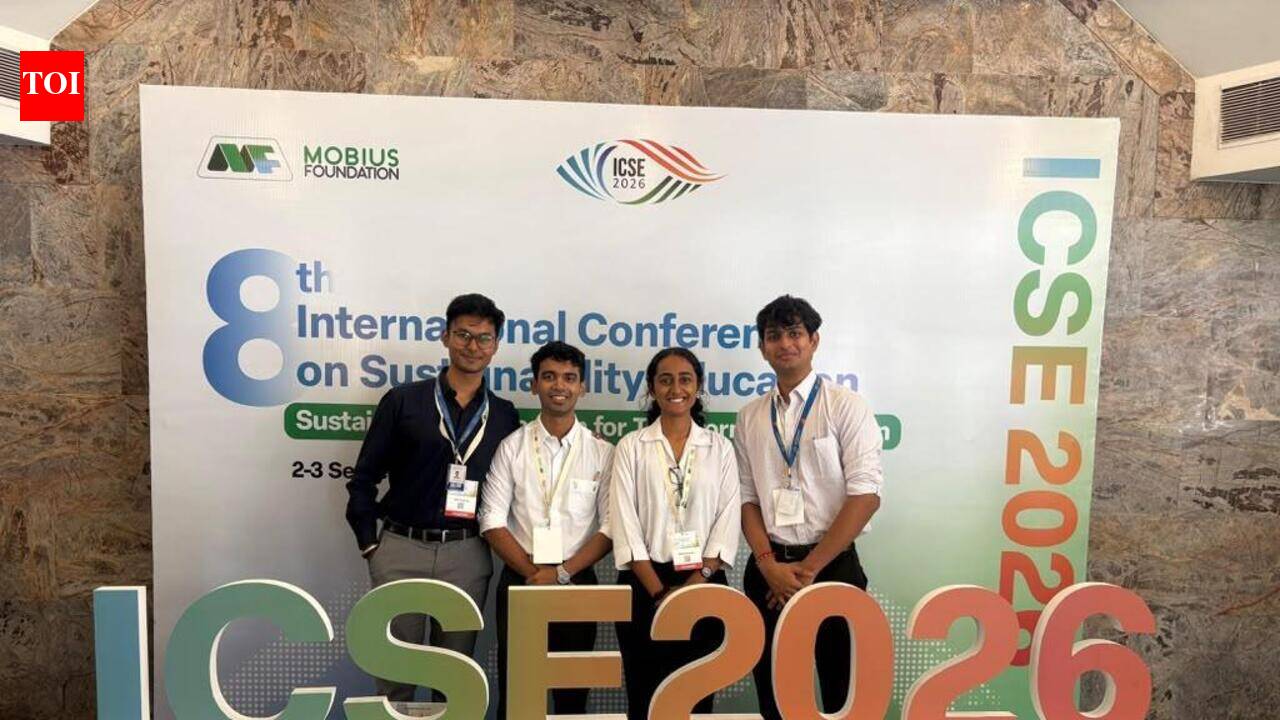
MIT-WPU students created an algae-based facade to lower building temperatures by 3°C. The team used local materials like recycled brick powder to support biological growth. Swayam Thorat said, "We tested it on two brick walls and found that the one with the coating maintained the temperature 3°C below."
Pune: Considering the challenge of increasing urban heat islands and increasing dependence on air conditioning, MIT-WPU students claimed to have found a way to cool building surfaces naturally by up to 3°C.They developed porous coatings using locally available materials that support the biological growth of algae, moss and cyanobacteria on building surfaces, effectively reducing temperatures inside these structures.Swayam Thorat, a final-year BTech student, said, "Global warming, increasing heat in cities, etc., have been playing on our minds when we came to know about the competition, Youth for Earth (Y4E) Campaign 2026. One of our faculty members, Sharbani Kaushik, has a background in biomaterials. All of us brainstormed and came up with this product. Actually finding the right algae to make the coating was the biggest challenge."The project, titled 'Bioreceptive Façade System for Passive Cooling in Indian Climates', won the second prize in the competition organised by the Mobius Foundation and The Climate Reality Project. The team was also recognised at the 8th International Conference on Sustainability Education (ICSE) 2026, held recently at the India Habitat Centre, New Delhi.
The group of students includes Swayam Thorat, Sahil Vaghole, Aditi Surwase and Anirjit D Kartha from the department of bioengineering and Manushree Bhagwate and Dhruv Deshmukh from the department of computer science engineering.As per the students, the porous coating was developed using locally available materials, including recycled brick powder, silica fume, expanded clay and kaolin. The students also worked on identifying heat-tolerant Indian algae and moss species, developing a carrageenan-based bio-gel for biological growth and assessing the coating's thermal performance and durability. "We tested it on two brick walls, one which had the coating and one which didn't have and found that the one with the coating maintained the temperature 2.8°C to 3°C below the non-coated one during June-July," said Swayam.In a comment shared with the media, Kaushik, programme director, department of bioengineering, School of Engineering and Technology, said, "Algae and cyanobacteria use sunlight and carbon dioxide to manufacture their own food, making them interesting candidates for sustainable building coatings. Our focus is to identify species and materials that can withstand Indian climatic conditions and explore how biological systems can help make buildings more climate-responsive."Sheetal Kulkarni, assistant professor, department of computer science and engineering technology, added that the students have also developed an app which continuously monitors the temperature, humidity and other parameters of the coating using sensors. "The team is working on the product and checking on durability and other parameters. It is also checking whether it can be used in all buildings to reduce the dependence on AC and other cooling equipment," said Kulkarni.
The team is now examining long-term durability, performance across different building orientations and potential alignment with India's National Building Code and GRIHA green building framework, said the official release.