
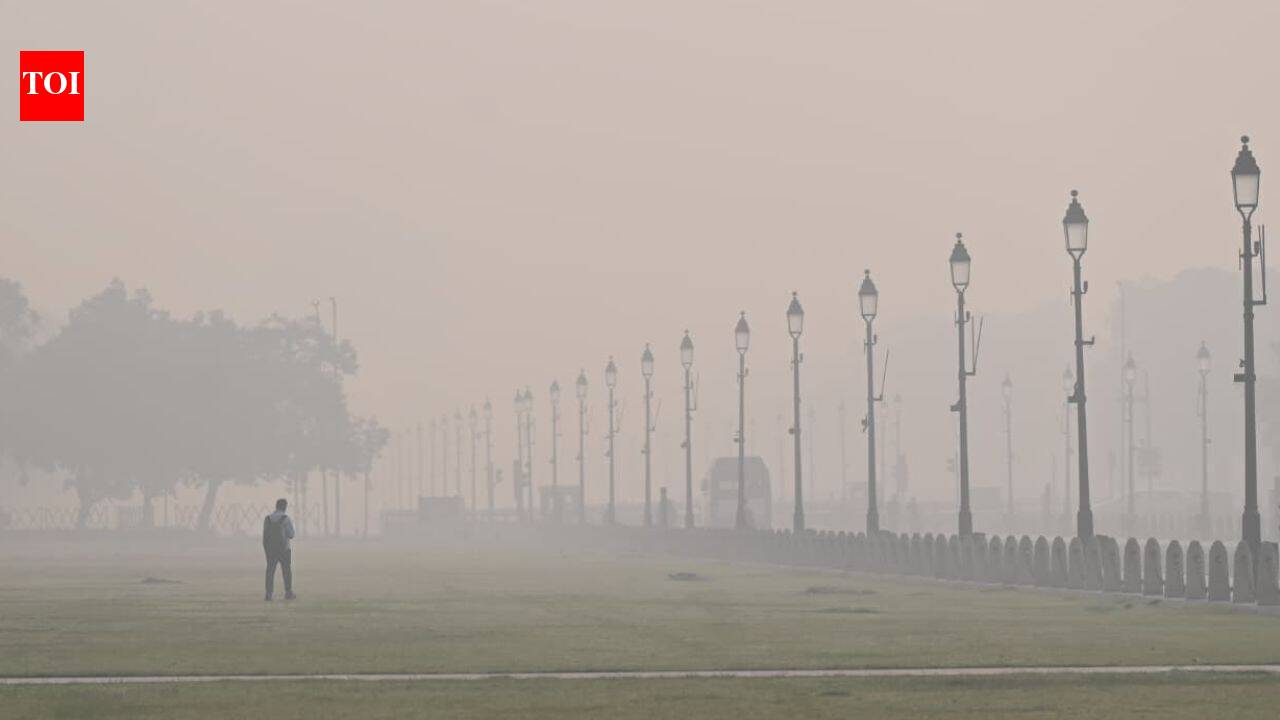
Delhi’s air quality data went missing for 35 stations on Diwali night as pollution levels peaked. The CPCB website stopped showing readings after PM2.5 levels hit high thresholds. Sunil Dahiya said, "Diwali night exposed a serious gap in how Delhi's air quality is reported." Conflicting figures caused further confusion Monday.
NEW DELHI: After the air quality station at Delhi University's North Campus hit peak PM2.5 levels of 999 micrograms per cubic metre (g/m³) at 11 pm on Diwali, the real-time hourly data went missing for six hours.
Central Pollution Control Board's (CPCB) website again started displaying data from 5 am Monday, when PM2.5 concentration dipped to 723 g/m³.Out of 60 continuous ambient air quality monitoring stations in Delhi, hourly data was initially unavailable for at least 35 stations, according to data released by CPCB. The mystery behind the missing data on Diwali night continues with most stations stopping releasing readings after hitting a PM2.5 threshold of 800 to 1,000 g/m³.Air quality index (AQI) is capped at 500 in India, but there is no upper limit for pollutants like PM2.5 and PM10.Interestingly, Delhi Pollution Control Committee (DPCC) updated its data. Jahangirpuri was shown to have three different peak readings of hourly PM2.5 concentrations, with one at 719 g/m³ at 1 am Monday. In the evening, DPCC changed this to 4,985 g/m³, which was said to have been recorded three times. Later Monday night, it again revised the hourly peak, showing it was 776 g/m³ at Diwali midnight.
Continuous ambient air quality monitoring stations in Delhi are run by DPCC, CPCB, India Meteorological Department (IMD) and Indian Institute of Tropical Meteorology, Pune. CPCB shares data of all stations and calculates AQI after compiling data of all these stations.According to the data available on CPCB's website, the highest hourly PM2.5 levels of 1,000 g/m³ were reported at Siri Fort on Diwali. According to CPCB data, no station breached this mark. In contrast, DPCC's data showed many stations surpassed it, with 11 locations recording hourly PM2.5 concentrations above 2,000 g/m³. Of these, four were above 3,000 g/m³. Hourly PM2.5 levels at Mundka touched 3,744 g/m³ at 2 am Monday, according to DPCC's data. However, CPCB did not share Mundka's PM2.5 readings from midnight to 4 am Monday.Delhi's AQI Monday was calculated using data of 47 out of 60 stations, except the defunct New Moti Bagh. Also, the city would have recorded a higher AQI if data had not been missing for several hours. It went missing last Diwali too.Sunil Dahiya, founder of Envirocatalyst, a think tank, said, "Diwali night exposed a serious gap in how Delhi's air quality is reported. From 10 pm onwards, monitors began disappearing from CPCB's data: 57 of 59 stations reported readings at 10 pm, but only 23 at 2 am."Dahiya said DPCC's own portal shows that hourly PM2.5 readings went missing from CPCB's website, but DPCC stations recorded PM levels above 1,000 g/m³. "Most were between 1,500 and 3,000, with Mundka reaching 3,744. CPCB's highest PM2.5 reading all night was exactly 1,000. Meanwhile, a near-zero reading of 0.1 from Sirifort was counted in the city average. The official numbers understate the quality of the air Delhi actually breathed," said Dahiya.Manoj Kumar, analyst, Centre for Research on Energy and Clean Air (CREA), said when monitoring stations do not report readings during severe pollution episodes, the available data may not capture the full extent of pollution. "This may affect the calculation of hourly and daily averages and influence the reported citywide AQI. This is particularly important during peak pollution hours, when even a few missing observations can affect how the overall air quality situation is assessed," said Kumar.A DPCC official said, "The entire data is now available on DPCC website. There was an issue earlier in display data due to a technical glitch. No station is switched off and all data was available in the log."
No response was received from CPCB in the matter.