
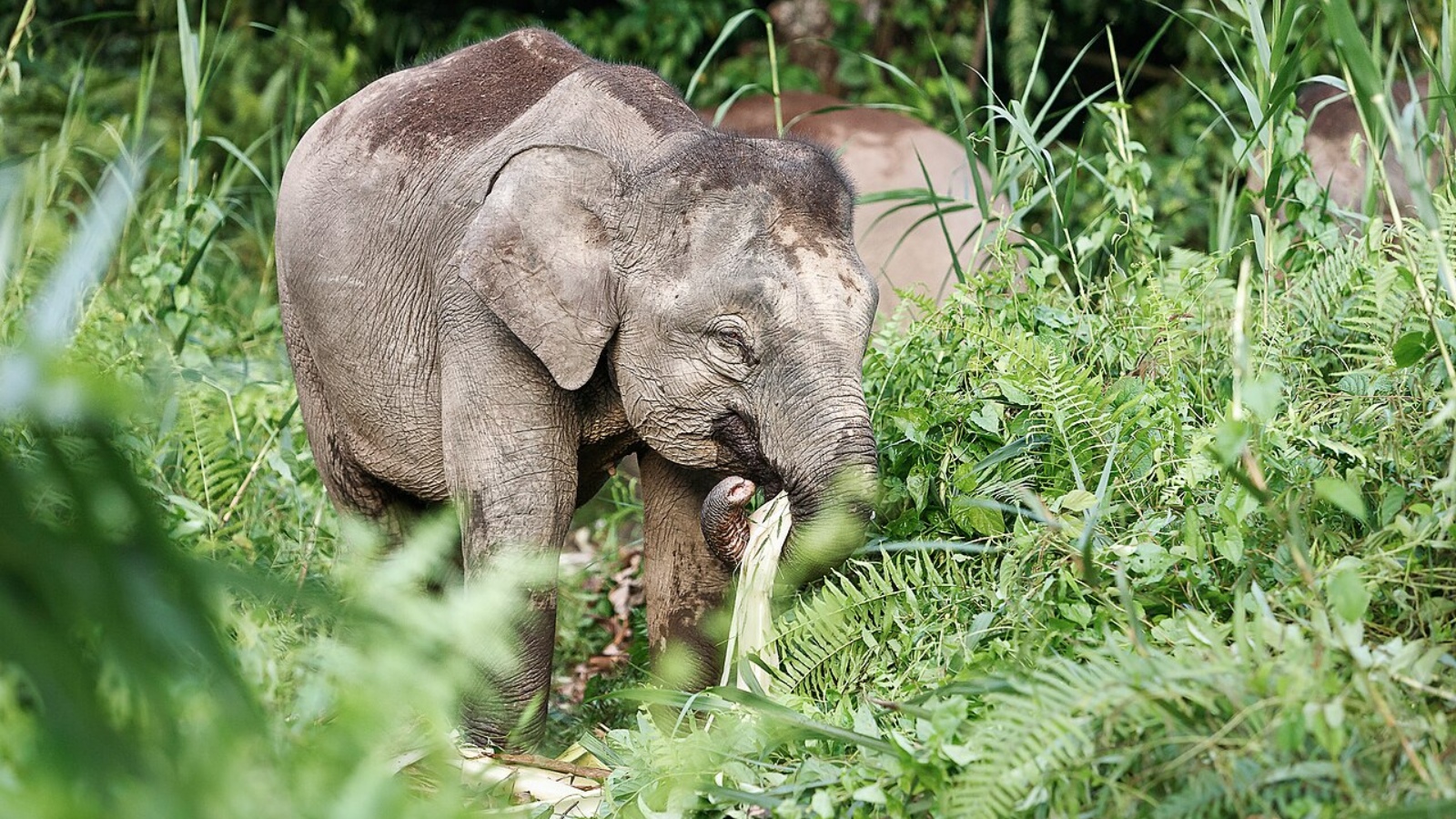
The Bornean elephant is the world’s smallest elephant subspecies, standing about 2.5-3 metres tall. In 2024, the International Union for Conservation of Nature assessed them as Endangered. These animals live in northeastern Borneo, but logging and plantations have lost many forest areas, leaving their populations fragmented and struggling to find space.
Thank you for your feedback.
Your feedback has been reported succesfully.
When you think of an elephant, you may picture one of the massive animals roaming Africa's grasslands or Asia's forests. But one elephant subspecies is notably smaller than its relatives.
The Bornean elephant, also known as the Borneo pygmy elephant, is recognised as the smallest living elephant. It is a subspecies of the Asian elephant, scientifically known as Elephas maximus borneensis. In 2024, the International Union for Conservation of Nature (IUCN) assessed the Bornean elephant as Endangered.
Despite its smaller stature, it remains the largest mammal found on the island of Borneo.
Where is the world's smallest elephant found?
Bornean elephants are found in northeastern Borneo, primarily in the Malaysian state of Sabah, with a smaller population in Indonesia's Kalimantan. Their present-day range is considerably smaller than their historical range.
They depend on forest landscapes that provide food, water and enough space to move. However, logging, agriculture, and plantations have lost or divided large areas of their habitat.
According to WWF, Sabah lost around 60 per cent of its elephant habitat over the last 40 years, leaving populations increasingly fragmented.
How small are Bornean elephants?
Bornean elephants can stand around 2.5-3 metres tall, making them considerably smaller than many mainland Asian elephants. WWF gives an adult height range of approximately 8.2-9.8 feet (2.5-3 metres).
Their relatively compact build is not their only distinctive feature. They also have:
* A long tail, which can sometimes reach the ground
* Relatively large ears
* A wider and rounder head
* A comparatively shorter trunk
* Straighter, shorter tusks in males that have them
These physical differences, along with genetic evidence, helped scientists confirm the Bornean elephant as a distinct subspecies.
Why are they called 'pygmy elephants'?
The term "pygmy elephant" refers to their relatively small size compared with other Asian elephants. However, these are not dwarf elephants or a separate species.
They are a distinct subspecies of the Asian elephant, Elephas maximus. The name Borneo pygmy elephant is therefore commonly used to distinguish them from other Asian elephant populations.
How did they become so small?
One possibility is the island effect, in which island populations can evolve differently from their mainland relatives. Researchers have also pointed to the elephants' genetic history as a possible factor.
Genetic evidence suggests that Bornean elephants became isolated from other Asian elephant populations around 300,000 years ago. However, exactly how their ancestors reached Borneo remains uncertain. They may have arrived when sea levels were lower, allowing animals to move between land areas, or their ancestors may have come from another island.
What do Bornean elephants eat?
Like other elephants, Bornean elephants are herbivores. They feed on vegetation, including grasses, leaves and other plant material.
Their need for large quantities of food and water means they need extensive areas to forage and move. This is one reason why habitat fragmentation can be particularly damaging to elephant populations.
Explore more captivating stories about pets and animals here, and make us your daily stop for the latest from the animal kingdom.