
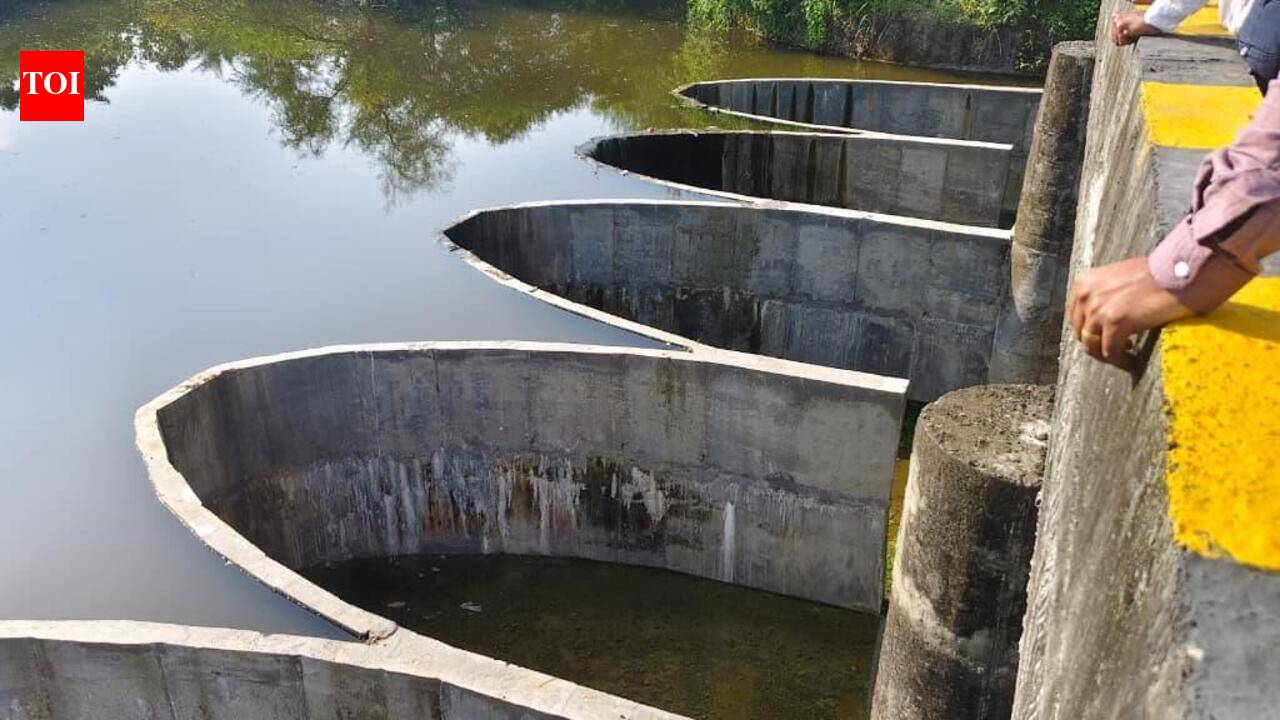
The Maharashtra government plans to build low-cost elliptical arch weirs under existing bridges to improve water conservation. These structures use less concrete and need little maintenance compared to traditional dams. "State govt is planning for the construction of such weirs that are low on cost and maintenance," said Haribhau Gite.
Nashik: Maharashtra govt plans to roll out low-cost elliptical arch weirs across the state to conserve water and soil, using existing bridges to create storage structures without affecting their foundations. Districts have been asked to survey suitable locations and submit proposals for the initiative.The move is aimed at creating water conservation structures that require less concrete and maintenance than conventional weirs, while making use of existing bridge foundations and piers."State govt is planning for the construction of such weirs that are low on cost and maintenance, and can be constructed under the existing bridges without affecting their foundation, thus achieving maximum of water and soil conservation," said Chhatrapati Sambhajinagar chief engineer (soil and water conservation) Haribhau Gite.Engineers across districts are also being trained in the new construction technique as govt prepares to implement the model statewide. An initial batch of engineers was trained at Visvesvaraya National Institute of Technology (VNIT), Nagpur, following which training was taken to other centres to build technical capacity across districts."Govt has now sought the proposals from all the districts while the engineers are also being trained over the construction idea.
Soon they will be carried out across the state," an engineer from the department said.
Unlike conventional linear check dams, elliptical arch structures can be constructed at bridge locations and are designed to divert water pressure through the arch, reducing the amount of concrete required.Conventional check dams generally have a top width of about one metre and a bottom width ranging from 2.5 metres to 3.5 metres. In elliptical arch structures, the thickness of the arch ranges from 150 cm to 200 cm, depending on its height and design.Officials said the design also addresses some of the maintenance problems associated with conventional weirs. Traditional weirs are about 3.5 metres high and have openings at regular intervals to drain excess water during heavy rain and prevent inundation of neighbouring farms. After the monsoon, these openings are blocked using needles, or rectangular plates, to retain water. These components, however, can wear out after five to six years and their rubber seals require replacement. The plates can also be stolen or, in some cases, remain uninstalled by farmers or gram panchayats, resulting in water being lost.Officials said elliptical arch weirs largely eliminate these problems.
"The arches need not be higher than two metres. No foundation is required except the base. The arch design deflects the pressure and the height is lower than the surroundings, meaning the water flow does not affect farms. These multiple advantages are coupled with no maintenance and low cost, making it the best way to conserve water," the engineer said.