
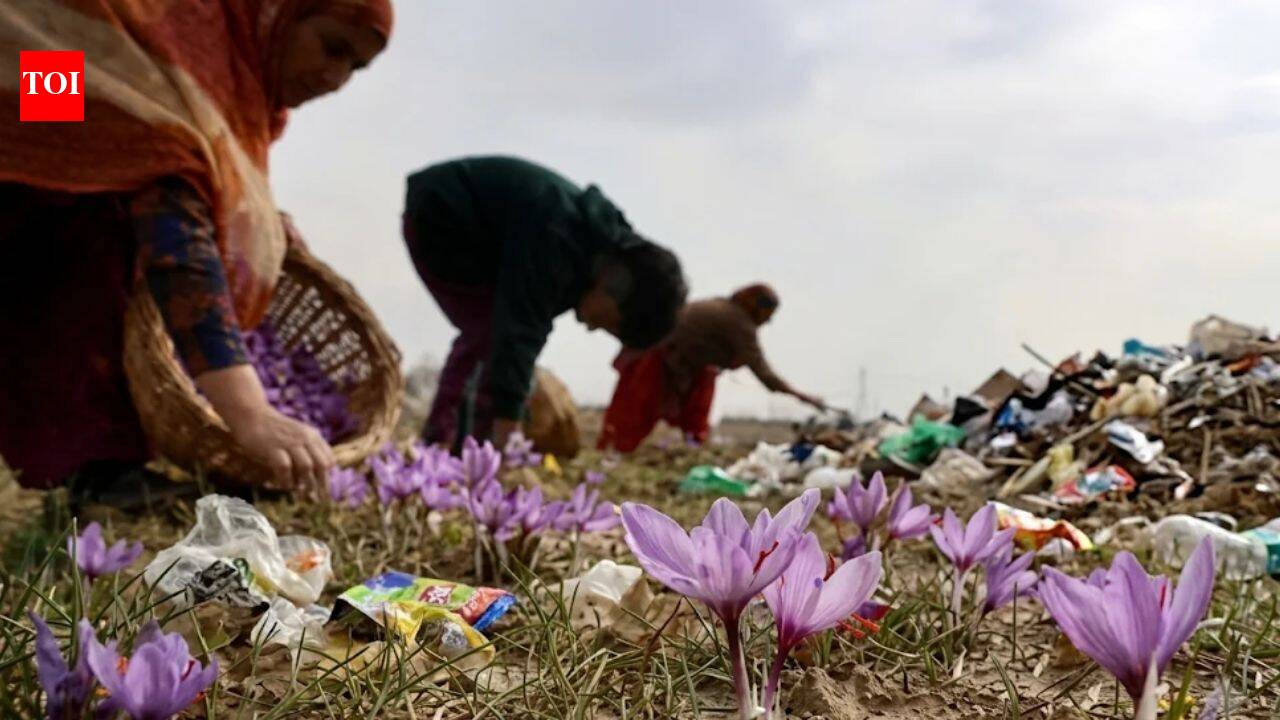
The National Green Tribunal ordered an expert committee to assess environmental damage in Pampore after waste dumping threatened local saffron fields. The panel will inspect the site and report back within eight weeks. "The committee will also ascertain the effect of dumping of the waste at the site," the order said.
National Green Tribunal (NGT) has directed the formation of an expert committee to assess environmental damage and inspect a dumping site in Pampore after an environmental activist petitioned the tribunal, alleging that unscientific disposal of municipal solid waste was threatening the area's vast saffron fields.The division bench of the NGT comprising chairperson Justice Prakash Shrivastava and Dr Afroz Ahmad directed formation of a joint committee comprising representatives of the Sher-e-Kashmir University of Agricultural Sciences and Technology of Kashmir (SKUAST-K), nominated by its Vice-Chancellor, the Regional Director of the Union Ministry of Environment, Forest and Climate Change and a nominee of the Member Secretary, Jammu and Kashmir Pollution Control Committee to visit the site, find out the extent of municipal and plastic waste which is dumped there , ascertain the status of necessary clearances from the competent authority and material recovery facility."The committee will also ascertain the effect of dumping of the waste at the site in question upon the crop of the surrounding areas. The committee will complete this exercise within a period of eight weeks and will submit the report immediately thereafter," the order said.Saffron, locally known as kesar, is believed to have originated in southern Europe. It is widely cultivated in countries like Iran, Spain and Turkey.
In India, it is primarily grown in the Pampore area of Kashmir.
In his application before the NGT, environmental activist Raja Muzaffar Bhat had alleged that the Municipal Committee, Pampore, was illegally dumping municipal solid waste and plastic waste at its solid waste management facility including the Material Recovery Facility (MRF), at Patlibagh-Galander.Bhat had said untreated waste at the site was generating leachate seeping into underground water sources and flowing through channels into the Jhelum River, located less than one km away. He also said the dumping site was located in a notified saffron-growing area protected under Section 3(1) of the Saffron Act, 2007, and alleged that saffron fields surrounding the site were being damaged.He also said the waste had attracted rodents and porcupines, which damage saffron corms and crops. Bhat also submitted a report by the Divisional Officer of the Pollution Control Committee, Pulwama which had pointed towards heaps of unsegregated and untreated legacy waste, comprising biodegradable domestic waste and non-biodegradable materials, including single-use plastic items and packaging materials, on the MRF premises. "Apart from this site, the tragedy is that they are also using saffron fields for dumping municipal solid," Bhat told the TOI.
Saffron cultivation has declined over the years, posing serious challenges for farmers. The area under cultivation shrank from 5,707 hectares in the early 2000s to 3,715 hectares by 2010, while productivity also fell sharply. However, the government said after the introduction of the "Economic Revival of J&K Saffron Sector" project under the mission in 2010-2011, the decline in cultivated area was halted. The area under saffron cultivation has remained steady at about 3,715 hectares since 2010-11, the figure disputed by the growers. Saffron Mission was launched in 2010-11 with an outlay of 400.11 crore rupees to halt the decline in saffron cultivation and improve productivity.