
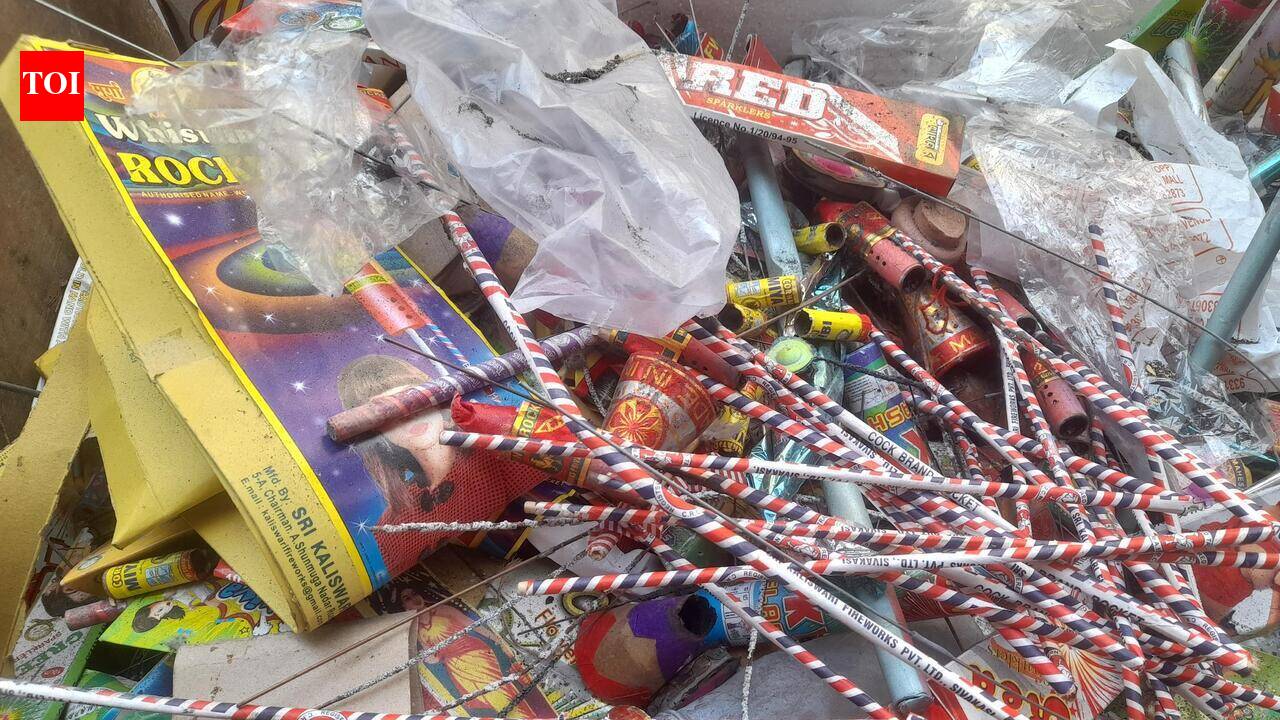
Kolkata’s Kali Puja-Diwali celebrations on Sunday night sparked 434 police complaints and 84 reports to the WBPCB due to illegal firecracker noise. Police arrested 205 people for violations as silence zones hit over 80 dB. ENT specialist Dulal Bose said, "Sudden firecracker blasts can cause acute acoustic stress, and aggravate existing health conditions."
Kolkata: Kolkata's Kali Puja-Diwali celebrations descended into an unprecedented noise frenzy on Sunday night, with banned high-decibel firecrackers exploding across the city well beyond the permitted two-hour window, triggering record complaints to the police and pollution watchdog.West Bengal Pollution Control Board received 84 noise-related complaints by 1 am, while Kolkata Police's control room recorded a staggering 434 complaints, exposing the scale of violations that left the elderly, patients, children and animals on the receiving end of the acoustic assault. Police also received 11 complaints about loudspeakers.The scale of enforcement also reflected the intensity of violations. Cops rounded up 371 people for bursting illegal firecrackers, of whom 205 were placed under arrest. Another 387 people were arrested for disorderly conduct. The figures were the highest since 2019. Last year, only 183 people were booked for bursting illegal firecrackers.By contrast, the quantity of banned crackers seized fell sharply this year -- 238.6 kg against 853 kg last year -- raising questions about the effectiveness of preventive enforcement.
Police sources fear unused stocks of illegal crackers could fuel further violations during Chhath and Jagaddhatri Puja.
On Sunday evening, automated noise-monitoring stations recorded a dramatic escalation from 8 pm, with Tangra registering 86.2 decibels (dB) at 10 pm against the area's permissible night-time limit of 45 dB. The Calcutta University campus in Ballygunge, a designated silence zone, recorded 81.1 dB, more than double its permissible 40 dB limit. Even at 3 am, Ballygunge remained alarmingly noisy at 71.5 dB. Jadavpur University, another silence zone, recorded 80.3 dB at 10 pm.Monday evening was not any better, with the decibel rising steadily post 8 pm. The worst-affected spots -- Ballygunge, Jadavpur, Dhakuria, Taltala, Posta and New Alipore -- remained unchanged from the previous night. At 9 pm, Jadavpur had touched 75.6 dB. Till 9 pm on Monday, 11 people were arrested for cracker violations while 67 were nabbed for disorderly conduct."An ambient reading of 80 dB represents 10,000 times the sound intensity of the 40 dB silence-zone standard," said a former PCB scientist. "Sudden firecracker blasts can cause acute acoustic stress, and aggravate existing health conditions. They frighten and sometimes kill pets and wildlife," said ENT specialist Dulal Bose.Aruna Saha, a Behala resident whose elderly father with a heart ailment had a tough night, said, "We pleaded with the youths to stop bursting crackers after 12 am. But my request fell on deaf ears."Environmental watchdog Sabuj Mancha, whose teams moved around with noise-measuring devices, reported widespread violations in both north and south Kolkata. Whenever we called cops, they appeared proactive, but nothing changed on the ground," said Naba Dutta of Sabuj Mancha.
On immersion days, five PCB teams and 151 cop teams are expected to patrol streets, with 22 police station areas identified as extremely problematic and another 12 as moderately problematic.