
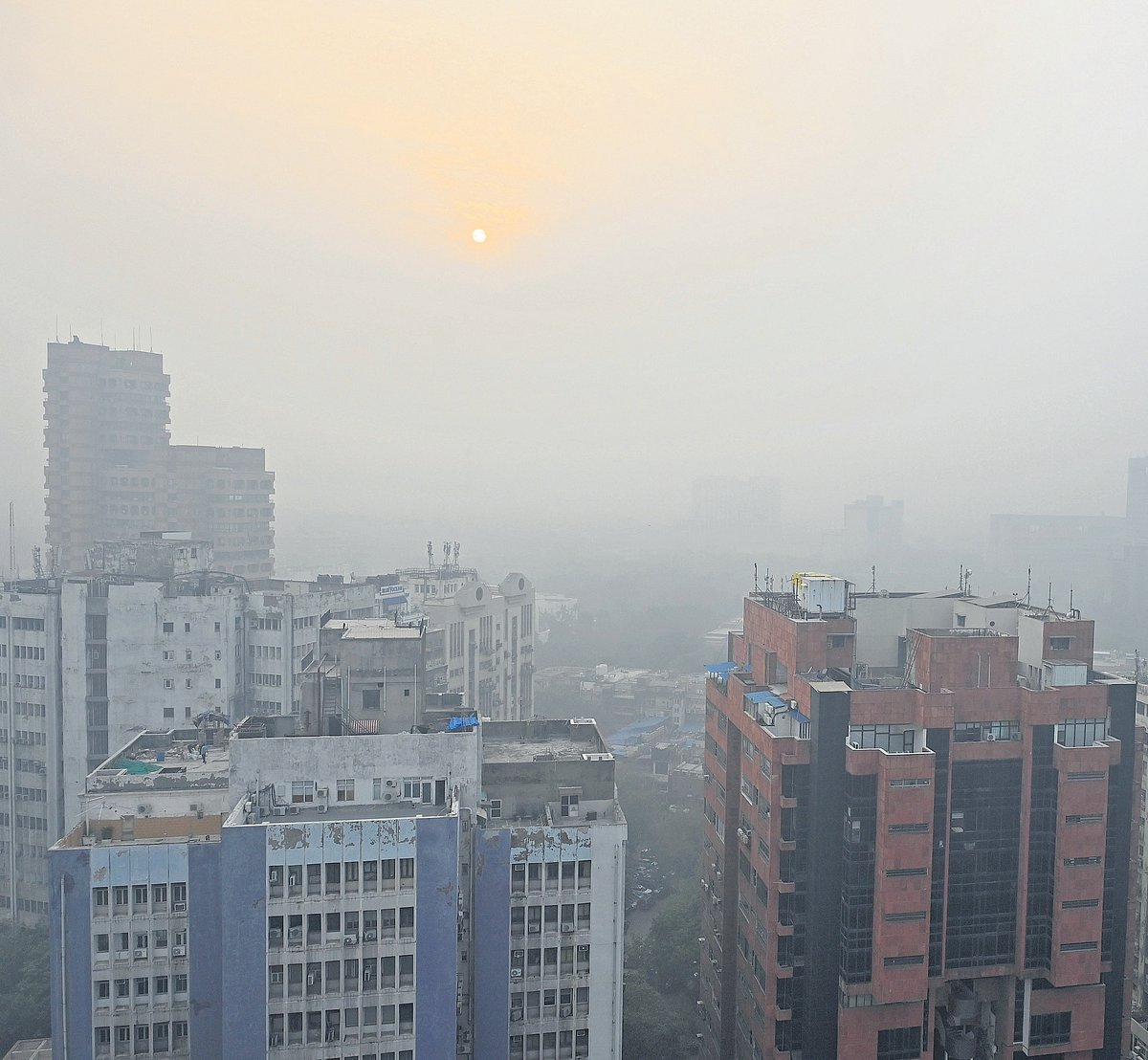
Delhi’s air quality cycle between poor and severe levels continues despite new dust-control measures. While authorities deployed hundreds of machines, the Graded Response Action Plan curbs hit daily-wage workers the hardest. Many migrant labourers face an uncertain livelihood as construction bans cause an immediate loss of wages every single year.
AQI in the ‘poor’ category, slipping into ‘very poor’, then ‘severe’ and back to ‘very poor’ — the cycle continues, raising fresh questions about the effectiveness of the city’s pollution-control measures. For the past two months, Delhi has been undertaking dust-control measures, deploying hundreds of sprinkling machines, mechanical sweepers and anti-smog guns. Yet, concerns persist over the effectiveness of its pollution-control strategy, gaps in monitoring and enforcement, and the disproportionate burden of GRAP restrictions on daily-wage workers, who often bear the brunt of curbs on construction and other economic activities.
The Supreme Court questioned the unchecked movement of vehicles, the High Court scrutinised the protection of green spaces, and the civic bodies have expanded pollution-mitigation infrastructure, yet the lived reality of those breathing the toxic air tells a different story.
The story has been retold multiple times over the years with little change. This year is no different. There is a city choking under a blanket of smog despite stricter restrictions, official interventions, and judicial responses while its citizens ask if the measures are addressing the problem or merely responding to it. However, the story forgets the ones most affected--thousands of migrant workers--dependent on construction and other labour-intensive activities who face an uncertain livelihood whenever restrictions under the Graded Response Action Plan (GRAP) are intensified.
For them, a ban on construction work can mean an immediate loss of daily wages, often without any alternative source of income. The contrast between the pollution-control machinery and the economic vulnerability of those most exposed to polluted air puts forth a larger question: Is Delhi’s pollution response addressing the problem at its source, or is it largely revolving around seasonal interventions and restrictions that often leave the most vulnerable paying the price?
Growing fleet of machines
A study by the Delhi-based environmental think tank ‘Centre for Science and Environment (CSE)’ revealed that vehicular emissions are the top contributor to Delhi’s winter pollution. Hence, the dust generated from the roads also remains a significant contributor to the city’s deteriorating air quality. The MCD, which maintains a substantial share of the capital’s road network, has been focused on addressing all gaps in the existing cleaning infrastructure to reduce the dust pollution.
It has deployed 207 water-sprinkling machines, including 40 anti-smog guns, of which only 28 are currently operational. Twelve additional anti-smog guns were inducted into the fleet last month.
According to MCD officials, it currently operates 64 mechanical road sweepers, each covering an average of 53-54 km over nearly 12 hours daily to remove accumulated dust and silt before vehicular movement makes these particles airborne.
To expand coverage, the corporation is procuring around 70 additional mechanical sweepers from Switzerland and Italy, particularly designed for roads less than 60 feet wide. An MCD official said the machines were expected to arrive within two to three months but have been delayed due to the Gulf War.
Meanwhile, the NDMC operates 11 large and four small mechanical sweepers, four ride-on scrubbers and 20 litter pickers. It plans to add four large and four medium-sized sweepers and four leaf pickers. NDMC Vice-Chairperson Kuljeet Singh Chahal said officials had been directed to prioritise night-time cleaning to clear accumulated dust before peak traffic hours. The collected silt is transported to the Okhla processing plant for scientific disposal. However, sustained results will depend on cleaning frequency and effective coverage across roads.
Beyond mechanical sweeping, the NDMC is increasingly turning to water-based interventions to keep road dust from becoming airborne. Its existing fleet includes 13 pressure-jetting machines and 18 water tankers, 10 equipped with sprinklers. With capacities ranging from 5,000 to 10,000 litres, the tankers cover 20-25 km daily, making two to three trips. The council plans to increase its pressure-jetting fleet to 20.
The effort extends to overhead misting systems, with installations planned on 1,200 electric poles covering 26.69 km of roads in 2026-27. Six locations are already operational—Man Singh Road, Shahjahan Road, Bhagwan Das Road, Tilak Marg, Subramania Bharati Marg and Dr Zakir Hussain Marg. Six more are expected to be covered within a week, while 12 additional roads are targeted for November 2026 and Sher Shah Suri Marg for December.
Responsible for maintaining 416 km of roads across 42.7 sq km, the council is building an extensive network of mechanised cleaning and dust-suppression systems.
Judicial scrutiny
The Supreme Court while hearing a suo motu case examining the regulatory framework governing air pollution, has termed vehicular emissions a major contributor.
It called for immediate, medium-term and long-term measures to improve air quality and directed Delhi and three neighbouring states Uttar Pradesh, Haryana and Rajasthan to provide details of the steps being taken to keep over-age and non-compliant vehicles off the region’s roads.
The bench also flagged the problem of bumper-to-bumper movement across the capital and NCR towns. “We keep talking and sometimes make statements and suggestions, but the point is that AQI is already touching 400,” the Chief Justice had said. It drew attention to the large number of vehicles plying on roads connecting Delhi with neighbouring cities, including Ghaziabad, Greater Noida, Gurugram and Faridabad.
“Take a look at any road and the kind of vehicles moving on it. That is the major problem,” the CJI had said. However, the remarks somehow ruled out the fact that confining the restrictions to Delhi’s administrative boundaries would hardly solve the crisis.
The bench also highlighted the disproportionate exposure of economically weaker sections, observing that daily-wage workers remained vulnerable to pollution while working outdoors, with the festive season often offering a crucial earning opportunity. On stubble burning, the court stressed educating farmers about machine-based alternatives.
The Centre outlined measures targeting five pollution sources and cited stubble burning’s 14% contribution on November 5. The matter was listed for November 16 for further orders. The Delhi High Court has also been examining air pollution through a suo motu case initiated in 2015, alongside concerns over the protection of the capital’s green cover.
In a March order, it questioned the seriousness of the Delhi Police, DDA and Forest Department in safeguarding notified forest areas. Its scrutiny has also extended to vehicle-entry restrictions.
In a separate ruling, Justice Amit Mahajan exempted advocates and judicial staff residing in the NCR from the ban on non-BS-VI outside-registered vehicles. The exemption highlights the practical challenges of enforcing restrictions in a region where thousands commute daily across state boundaries.
When curbs mean loss of earnings
“I have no alternative source of income,” said Ramphal Kumar, a native of Khagaria district in Bihar who is involved in the construction industry. The consequences of the pollution-control measures have affected Kumar and hundreds like him who depend on daily wages to meet ends.
For them the imposition of restrictions on construction activities means losing the opportunity to earn the daily bread. “We have come here from Bihar to work as labourers. If our work stops, what will we do?” Kumar said.
He feels that anti-pollution measures disproportionately affect poor workers. “If the government wants to reduce pollution, it should also put curbs on vehicles first,” he said. For daily-wage workers, the impact of GRAP restrictions extends well beyond a temporary halt in construction activity.
With no financial stability, fixed income, even a few days without work can disrupt budgets, making it difficult to pay rent, buy essentials or send money to families back in the native villages. The uncertainty over when restrictions will be lifted also leaves many hesitant to travel back to the capital in search of employment.
For Suresh Kumar, a painter, the situation has been relatively different. Since his work does not fall under the activities prohibited by GRAP, he continues to earn his livelihood. However, several daily-wage workers from his native village in Moradabad, Uttar Pradesh remain uncertain about their livelihood. Kumar said several of them had been calling him, asking him to inform them as soon as the curbs were lifted or eased so they could return and resume work. “They are waiting for the situation to improve. Many of them do not want to spend money travelling back to Delhi without knowing whether they will get work,” he said.
Their predicament reflects the uneven impact of pollution-control measures. While some informal workers continue to earn, others are left without income, despite having little control over the sources of pollution. Exposed to toxic air while working outdoors, they are also among the first to lose their livelihoods when restrictions tighten.
The absence of a comprehensive livelihood-support mechanism during prolonged GRAP curbs further deepens their vulnerability, raising questions about whether the cost of cleaner air is being disproportionately borne by those least equipped to afford it.
Political slugfest
The city’s air pollution recurs every year, and so do political parties shifting blame, with AAP in Punjab and BJP in Delhi debating its cause and culprit. While the BJP blames stubble-burning incidents in Punjab, AAP alleges AQI data manipulation, and point finger towards vehicular emission and industry pollution.
Delhi Environment Minister Manjinder Singh Sirsa questioned Punjab’s handling of farm fires despite substantial progress in paddy harvesting. He argued that the official figures data the state’s public claims about controlling farm fires.
Recalling a November 4, 2022, press conference, Sirsa pointed out that Punjab Chief Minister Bhagwant Mann had then accepted responsibility for tackling stubble burning, while Arvind Kejriwal had promised a reduction in farm fires the following year. BJP also questioned a reported spike in incidents around Diwali. Citing satellite data, it claimed Punjab recorded 100-125 farm fires on November 5, 6 and 7, before the figure rose to nearly 1,200 on the evening of November 8.
The renewed exchange has brought the annual dispute over farm fires back into focus.
Tale of different readings
The air-quality data has been interpreted differently by two different agencies—the Central Pollution Control Board (CPCB) and Swiss air-quality technology company IQAir—bringing the question of its reliability under scrutiny. While CPCB’s AQI readings remained below 500, IQAir reported significantly higher figures, 1,000 and even 1,500.
The reliability was also under question, as more than 20 monitoring stations on Diwali night were not reporting data between midnight and 2 am during peak smog hours, according to an analysis by the Centre for Research on Energy and Clean Air (CREA).
Gufran Beig, founder and project director of the Union government’s System of Air Quality and Weather Forecasting and Research (SAFAR), explained why CPCB readings remained below 500 while IQAir recorded substantially higher values.
Beig said that India’s National Air Quality Index (AQI) has an upper limit of 500. “Once pollution levels cross the threshold for the severe category, the index remains capped rather than reflecting further increases in pollutant concentrations,” he said. He cautioned against directly comparing these readings with IQAir’s figures of 1,500 and 1,700 and said that the platform does not follow India’s AQI methodology and that such numbers do not represent the country’s prescribed index.
“Indian AQI will never go above 500,” he said, adding that the cap should not be mistaken for stabilising pollution levels. Concentrations can continue rising even when the reported AQI remains unchanged, limiting the public’s understanding of the severity of extreme pollution episodes. The distinction also raises questions about how effectively existing monitoring systems communicate deteriorating air quality.
Beig also pointed to delays in categorisation and response during the November 11 pollution episode. He said, “The AQI had entered the severe-plus range earlier in the day, but the formal declaration came only by evening. Such delays could affect the timely activation of GRAP restrictions, which are linked to prescribed AQI thresholds.”
Response that falls short
The enforcement measures affect every section of the society differently, exposing the economic inequalities underlying the pollution crisis. While GRAP restrictions mean loss of employment for a daily wage worker, higher exposure to health hazards for gig workers, it means inconvenience, additional expenses or changes in commuting arrangements for the affluent. The consequences hence are not distributed equally.
While civic bodies are investing in machines to clean roads and suppress dust, the effectiveness of these interventions ultimately depends on the scale of pollution generated across the city and the consistency with which measures are implemented. Citizens argue that the measures need to be accompanied by effective action against vehicular emissions, industrial pollution, construction violations and open crop-residue burning.
One of the city-based doctors Dr Maqsoof said, “As the capital adds more machines to its pollution-control arsenal and courts continue to demand answers, the larger test for the government will be whether these measures translate into sustained improvements in air quality without making those who are already the most vulnerable bear an even greater share of the cost.”
The SC’s emphasis on a coordinated approach involving Delhi-NCR also highlights the limitations of treating air pollution as a problem confined to the capital’s municipal boundaries. Delhi’s air does not stop at its borders, nor do the vehicles, industrial emissions and other sources contributing to its pollution. There is also a need to ensure that the monitoring system is capable of communicating the true extent of pollution, particularly when readings touch the upper limit of the AQI scale. The discrepancy between CPCB and IQAir readings underline the importance of reliable and timely information.
The annual winter pollution battle cannot be won through a seasonal deployment of machines, temporary restrictions and political exchanges alone. The gaps between the reality and the restrictions needs to be filled for the city to breathe healthy. Otherwise, the battle will be half won every year.