
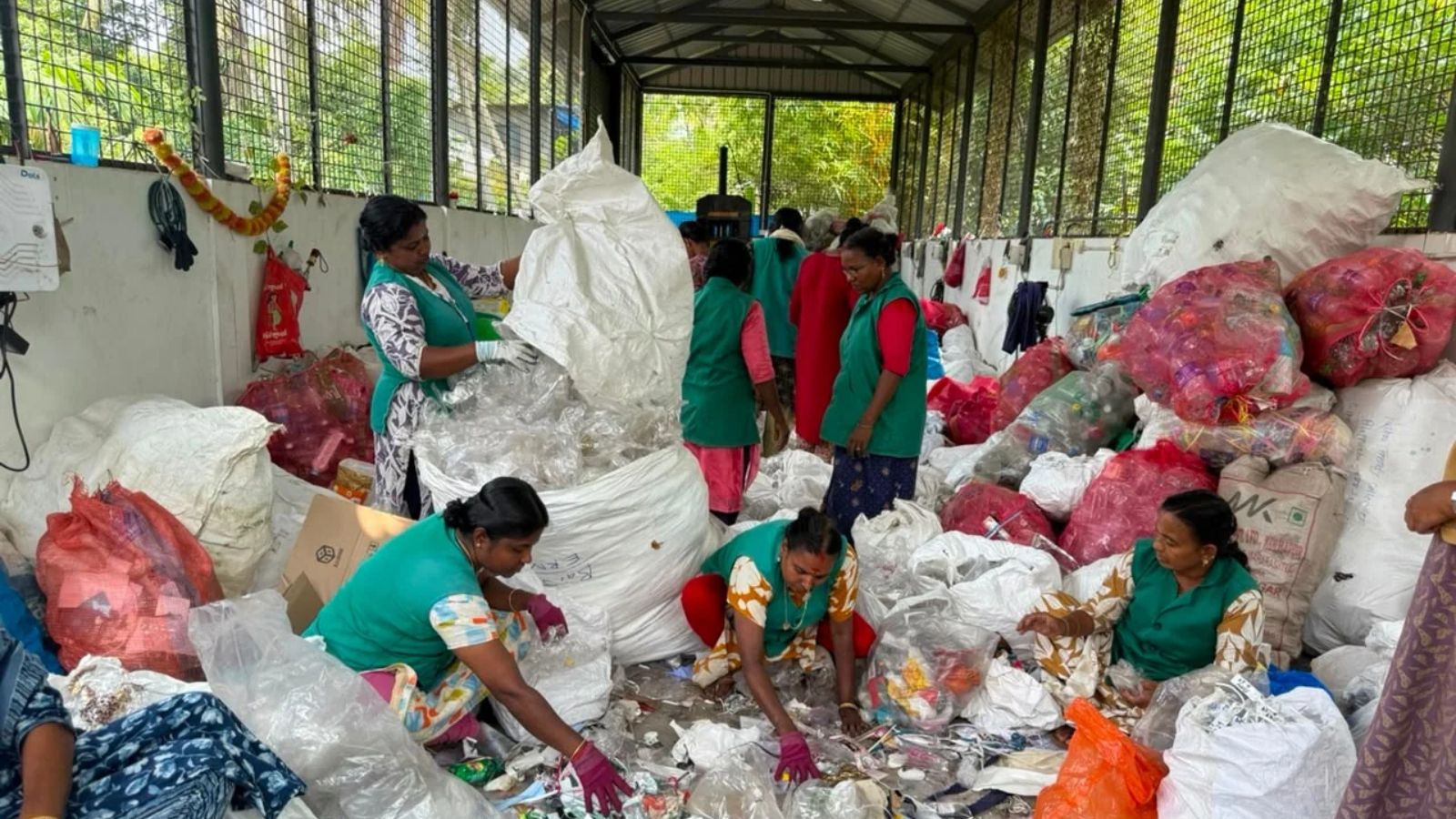
Keralam uses a decentralised waste-management network to collect and sort trash through the Haritha Karma Sena. Women work in 1,110 facilities across the state to handle non-biodegradable waste. Menaka, who joined in 2017, said, "Today, even kids know that we are from Haritha Karma Sena," highlighting their local impact.
Through a decentralised waste-management network, the state has put women of the Haritha Karma Sena at the forefront of collecting and sorting waste -- but low earnings and difficult working conditions remain a challenge.
In one corner of the scenic village of Arookutty, on the backwaters of Vembanad Lake, Menaka sits in a pink salwar kameez, a green overcoat and a mesh covering her hair, holding a plastic milk packet. Around her, other women in identical uniforms sit amid a sea of plastic items - empty cold drink and mineral water bottles, used plastic straws, polythene bags and discarded plastic fasteners - covering every inch of a 1,700-square-foot tin shed.
It's high noon, and the women are in the middle of a busy workday. They sift through the plastic methodically - empty bottles go into one bag, polythene bags into another, and plastic straws into a third - carefully filing away the remnants of everyday human life for another, more sustainable use.
This is the Material Collection Facility (MCF) in Arookutty, a village at the northern tip of the scenic Karappuram peninsula. The facility is one of 1,110 such facilities in Keralam and is part of the Haritha Keralam Mission (Green Kerala Mission), the state government's flagship initiative to make Keralam garbage-free through decentralised waste management.
"Today, even kids know that we are from Haritha Karma Sena, and when we enter the houses, they immediately bring the sacks full of plastic," says Menaka, 65, who joined the mission in 2017, telling The Indian Express.
What is Haritha Keralam Mission
Launched on December 8, 2016, by then Chief Minister Pinarayi Vijayan, the Haritha Keralam Mission was Keralam's response to its growing waste problem. The flagship initiative focuses on environmental protection, sanitation, water conservation and agricultural development and, along with the Suchitwa Mission - the state's technical nodal agency for waste management and sanitation - aims to move Keralam towards becoming a zero-waste state.
For Keralam, programmes such as the Haritha Karma Sena (HKS) are significant. According to Ameer Shah, programme officer and capacity-building expert at the closely linked Suchitwa Mission, the state generates an average of 10,044 tonnes of solid waste daily, 30% of which is non-biodegradable.
Former Keralam Chief Secretary Sarada Muraleedharan, who has worked closely with programmes such as Kudumbashree, says HKS was aimed at standardising waste management in a rapidly urbanising state.
"Laws and rules regarding solid waste management in urban and rural areas came up in the 1600s, and there were bio-waste management rules at the state level, like keeping the streets clean. However, there was no standardised pattern for waste management. Keralam urbanised faster, and there were a lot of problems to deal with. Burning plastic was one of the key issues. It was done in homesteads, houses and institutions. Plastic was not even collected at that time," she says.
To address this, the state set up the Haritha Karma Sena, or the Green Task Force. Largely comprising women workers from Kudumbashree, the state's flagship poverty eradication and women's empowerment programme, HKS is the frontline workforce of the initiative. For 15 days each month, women like Menaka and her co-workers go door to door across the state, collecting and segregating non-biodegradable waste, ranging from plastic and paper to e-waste such as discarded bulbs.
The collected waste is then sent to the Thiruvananthapuram-based Clean Kerala Company, a state government undertaking that provides forward linkages for the processing and disposal of non-biodegradable waste. Recyclable material is converted into higher-value granules, which are used as raw material to manufacture plastic furniture, pots and decor items, while non-recyclable combustible waste is converted into alternative fuel for cement factories.
According to the Haritha Keralam Mission website, Keralam has 36,000 Haritha Karma Sena workers. The programme is primarily funded through collection fees from households and institutions, with additional support from local self-government bodies and Clean Kerala Company.
"We began with Kochi, Trivandrum and Calicut, with Haritha Sena workers collecting waste from households," Muraleedharan says. "We needed a workforce, and the Local Self Government Department did not have enough people. People were reluctant to pay the local government, but they were okay to pay a local service provider, and hence Kudumbashree was brought in through government policy. It also turned out to be an income-generating opportunity for poor and vulnerable women."
Alongside this, the state tightened monitoring and regulation. Vulnerable points and illegal dumpsites were mapped and closely tracked. Fines were imposed on offenders, while those who helped identify them were offered incentives.
Initially, however, the measures did not receive the expected response from the public. "We could not ask them not to litter when there was no system or infrastructure in place. But between 2019 and 2021, fines worth Rs 2 to 3 lakh were collected, and about 15 lakh notices were sent to offenders. CCTVs were installed to monitor, the police force was roped in, and awareness posts were shared rampantly," Muraleedharan says.
The footsoldiers of HKS
For workers like Menaka, the work involves visiting households in Arookutty panchayat to collect non-biodegradable waste, which they bring to the facility for segregation and sorting. Of the 1,01,52,082 households in the state, waste is collected from 47,94,502; of the 97,790 institutions, waste is collected from 51,838, according to the government's 2021 Solid Waste Management Report. Of the 15 days they work each month, the first week is spent collecting waste and the second segregating it.
For their efforts, the women collect Rs 50 from each household and Rs 100 from each institution.
Back at the local facility, plastic bags are stacked inside a grilled mesh - waste the women painstakingly collected days earlier. As she hauls a plastic bag, Menaka talks about her workday. At 9.30 am, after finishing her household chores and seeing her son off to work, she posts her photograph on the official WhatsApp group, signalling that she is ready to start. The next eight-odd hours are hectic: she and 24 co-workers cover 5,436 houses and 350 institutions in the panchayat to collect waste.
At the HKM's Perumbalam facility, some 6 km away, Geetha, the unit's secretary, talks about her initial struggles. "When we approached people, they used to curtly say, 'Ningalk veetil ulla plasticum tharanam, pinne njangal paisayum tharanam (Hey, you want us to give plastic away, and you need money from us as well). We also didn't have a building structure and washroom facilities initially," she says.
Then there are the flip sides to the work, the most prominent being variable incomes. "Out of the meagre Rs 5,000-6,000 per person per month that we make, we have to pay for the extra bags that we need for collections and the rickshaws we sometimes need to hire to get the trash bags to the facility," Geetha says.
Then there are the health hazards. "Apart from that, a lot of heat is emitted from plastic, and it has caused us health problems like skin allergies and respiratory issues even though we work wearing masks and gloves. There were times when we got bitten by pet dogs and attacked by wasps. As many as four people have left our group owing to the poor income and other issues," Geetha says.
Safeera M I, Village Extension Officer in Arookutty, says HKS members are provided with medical insurance in case of health emergencies.
But despite the low pay, HKS has meant one thing for women like Menaka - a steady income. Before joining HKS in 2017, Menaka worked as a prawn peeler. But the long hours of standing began to take a toll on her, she says, as she hauls a waste bag at the facility.
"We used to earn Rs 400 to Rs 500 a day. Here the income is less. But I still join them every day since it gives a stable income," she says. At Perumbalam, Geetha adds: "Even though it's less, our income has increased from the initial Rs 1,000-Rs 2,000 a month to Rs 5,000-6,000. We hope it'll increase further. Even though we found it tough initially, we come here every day without fail for a good cause, and we believe in it."