
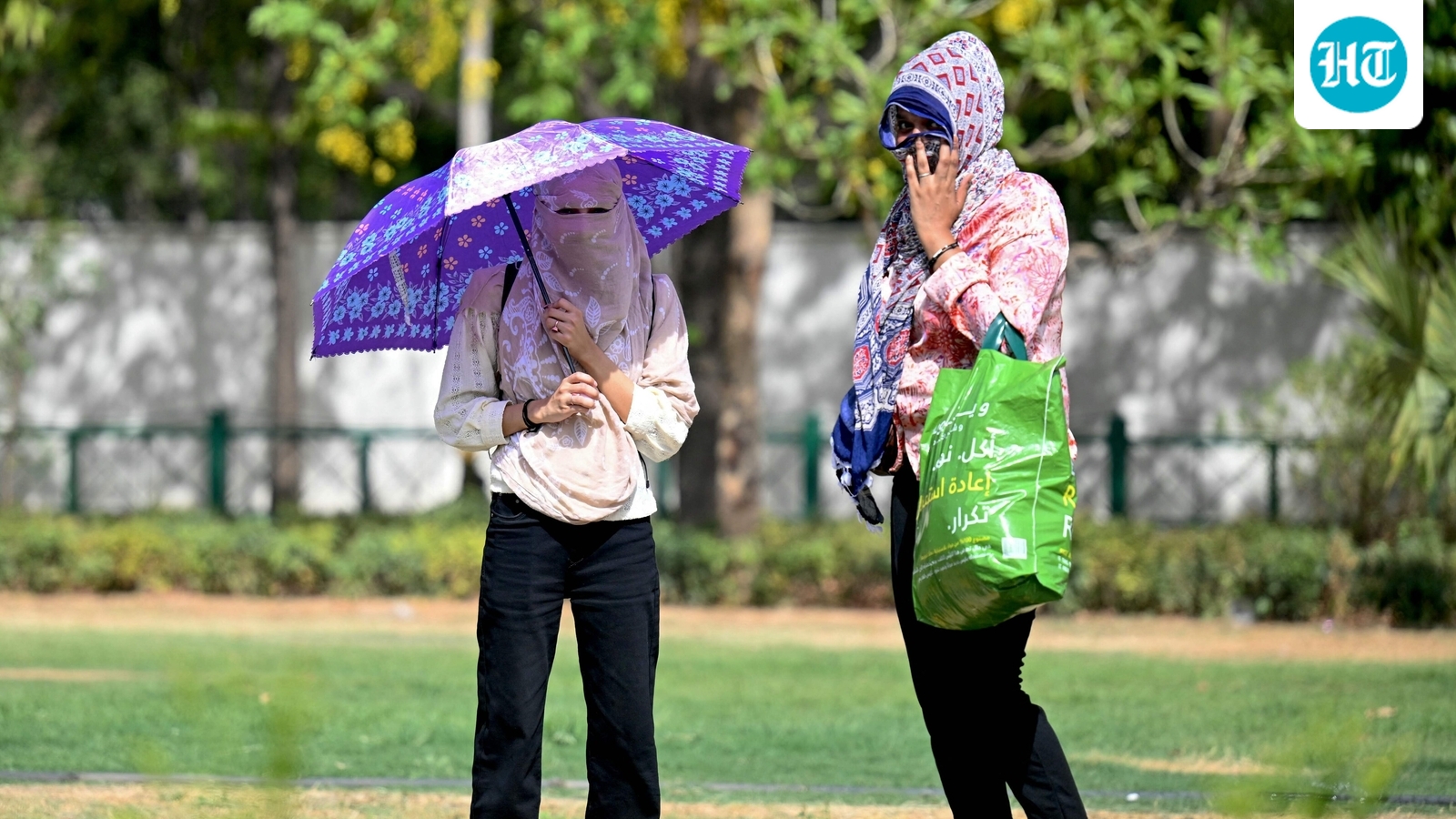
The 10th Lancet Countdown report showed that climate change harms health faster than the world responds. In 2025, heat cost Indian workers $174 billion in earnings, which is 4.2% of GDP. Researchers said, "Climate change should be formally recognised and addressed as a global health emergency" to protect many lives.
Climate change should be formally recognised and addressed as a global health emergency, say the researchers behind the Lancet Countdown on Health and Climate Change, who found in their 10th annual report that its harm to health is growing faster than the world's response.
For India, the cost is steep. Heat alone cost Indian workers an estimated $174 billion in potential earnings in 2025. That is 4.2% of GDP, more than four times the share for the world as a whole.
The researchers want the World Health Organization (WHO) to create a new instrument that would formally recognise climate change as a global health emergency. They also want health put at the centre of every climate decision, from emissions targets to climate funding.
The Lancet Countdown is run by 146 researchers, led by University College London (UCL) and working with WHO. Its 10th report was published in The Lancet on Wednesday. The group says many of the health harms it tracks grew faster in the decade after the Paris Agreement took effect, in 2016, than in the decade before.
Heat was linked to a record 710,000 deaths in 2023, more than the deaths from malaria or from HIV. The authors put 71.5% of those deaths down to climate change. Investment in clean energy reached a record $2.1 trillion worldwide in 2025, yet fossil fuels still supply more than 80% of its energy.
The India data sheet released with the report puts more numbers on the damage. Deaths linked to air pollution in India were valued at $517 billion in 2023, or 13.5% of GDP. Fossil fuels drive climate change, and they also cause more than a third of India's deaths from outdoor air pollution. Even so, India's net subsidies on fossil fuels came to $62.3 billion in 2024. That is about half of national health expenditure.
The Lancet Countdown was set up in 2016, the year the Paris Agreement entered into force. It tracks, every year, how climate change harms health and how climate action can protect it.
This year the researchers follow 54 measures, from heat deaths to fuel subsidies. For the first time, they estimate how many heat deaths climate change caused. To do so, they compare estimated deaths with the deaths expected at the temperatures the world would have had without human-caused warming. The report is published ahead of Cop31, the next UN climate summit.
The researchers record some progress. Action since 2016 has lowered projected end-of-century warming from 3.0-3.5°C to 2.6-3.4°C. "However, progress has been too slow, too small, and isn't reaching those who need it most," said Marina Romanello, the Lancet Countdown's executive director, who is based at UCL.
Heat cost India's workers an estimated 193 billion potential work hours a year on average over 2016-2025, according to the data sheet. That is 75% more than in the 1990s.
Hours lost per worker rose only 8.5%, which points to a bigger workforce out in the heat as a driver of the increase. Farm work accounted for about two-thirds of the hours lost. Worldwide, a farm worker lost an estimated 6% of hours worked to heat in 2025, twice the loss for a worker in any other sector.
Those hours were worth $174 billion in potential earnings in 2025. India's loss, at 4.2% of GDP, compares with 0.91% for the world and 3.9% for South-East Asia, the hardest-hit region. Among countries at a similar stage of development, a group the report describes as dominated by India, heat losses averaged 3.7% of GDP. Agriculture accounted for 54% of India's loss.
Worldwide, average annual income losses from heat rose by $306 billion, to $963 billion, between the decade before Paris and the decade after. India accounted for 12.4% of that rise, behind China and the US.
People in India faced an average of 10.6 heatwave days in 2016-2025, the data sheet says. Half of them, 5.3 days, were directly attributable to climate change. Hot nights cost Indians an estimated 64 hours of sleep a year in 2021-2025.
People over 65 are the age group most vulnerable to heat. In India, heat deaths in this age group were valued at $33.8 billion a year in 2021-2025, up 205% on 2000-2004. That is equal to more than 1.9 million average annual incomes in India.
Air pollution is a separate harm from the same source. Burning coal, oil and gas heats the planet. It also fills the air with fine particles less than 2.5 micrometres across, known as PM2.5.
Man-made PM2.5 was linked to more than 2.2 million deaths in India in 2023, up 22% on 2016. Burning fossil fuels contributed 38% of those deaths, and coal accounted for two-thirds of the fossil-fuel share. The report values the deaths at about $517 billion, or 13.5% of GDP. For countries at a similar stage of development, the average was 11.1%.
Heat also makes this pollution deadlier. A study of 10 Indian cities cited in the report, covering about 3.6 million deaths, found that PM2.5 was about five times as deadly when temperatures rose from the 75th to the 99th percentile, from a warm day to one of the year's hottest.
Deaths from household air pollution, caused by burning polluting fuels at home, are falling. They dropped from 783,000 in 2016 to about 617,000 in 2023. Electricity still provides only 19% of the energy Indian households use, against 29% worldwide. It provides 0.1% of the energy used in road transport, against 0.5% worldwide.
Worldwide, air pollution from fossil fuels killed an estimated 2.78 million people in 2023, almost the same number as in 2016. In 75 of the 140 countries studied, these deaths fell, and together those countries avoided about 323,000 deaths a year.
"A decade on, we have proof that health-centred climate action works," said Anthony Costello, co-chair of the Lancet Countdown. "But the pace and scale of emissions reduction remains entirely out of step with the pace and scale of the harm."
The researchers build these figures in different ways, so they cannot be added together.
The $174 billion combines International Labour Organization wage data with the working hours lost to heat. It stands for the earnings workers could have made.
The $33.8 billion covers only people over 65. It multiplies the years of life they lost to heat by a money value put on each year of life. The $517 billion values the years of life lost to air pollution in a similar way.
The two death figures are valuations of lives cut short, and should not be read as money spent. The figures also cover different years, and the shares of GDP are a guide to scale.
The researchers compare what each country spends on fossil fuel subsidies with what it raises from carbon pricing, which charges for emissions. The gap between the two is the net subsidy.
In 2024, India's net subsidies came to $62.3 billion, according to the data sheet. That is about 49% of national health expenditure, and $39 billion more than in 2016. Of the 87 countries analysed, only Russia, Iran, China and India passed $50 billion.
Together, the 87 countries paid out a net $808 billion in 2024, double the $403 billion of 2016. Since 2016, they have paid $6.2 trillion in all. Ten of them spent more on these subsidies than on health; India was not among them.
The US is left out of the analysis, as it stopped reporting its fossil fuel subsidies in 2025. The researchers expect the spike in energy prices in early 2026, which followed the US-Israel war with Iran, to have pushed subsidies higher still.
The authors' first recommendation reads: "Recognise, prepare for, and respond to the health emergencies of climate change through established World Health Organisation (WHO) and broader United Nations (UN) mechanisms, and develop a new WHO instrument to formally recognise and address climate change as a global health emergency."
Some of these mechanisms already exist. The authors name WHO's Emergency Response Framework and the UN's inter-agency emergency instruments. They also name the International Health Regulations, rules agreed in 2005 that "provide an international legal framework to support prevention and response to health emergencies".
The authors want these used to grade climate-related emergencies and to coordinate the response. A new instrument, they write, would enable "sustained anticipatory and preventative action, cross-sectoral and coordinated emergency management, and sustained resource mobilisation". The report does not set out how it would differ in law from the declarations WHO can already make.
In 2025, 131 of WHO's 194 member states reported high or very high capacity to manage health emergencies under the regulations, four fewer than in 2024. Only 56 member states have a national plan to adapt their health services to climate change, up from 14 in 2015.
Money is short too. The 48 developing countries that have costed their health adaptation needs put them at $3.3 billion a year. In 2024, $1.1 billion was committed to them. The authors want the money given as grants and loans on very soft terms, so that countries can act "without exacerbating debt burdens through additional borrowing and interest repayments".
"This report is a stark warning that climate change is a health emergency. What's missing is not evidence, but the political will to act on it," said Helen Clark, a former New Zealand prime minister who chairs the Lancet Countdown's board.