
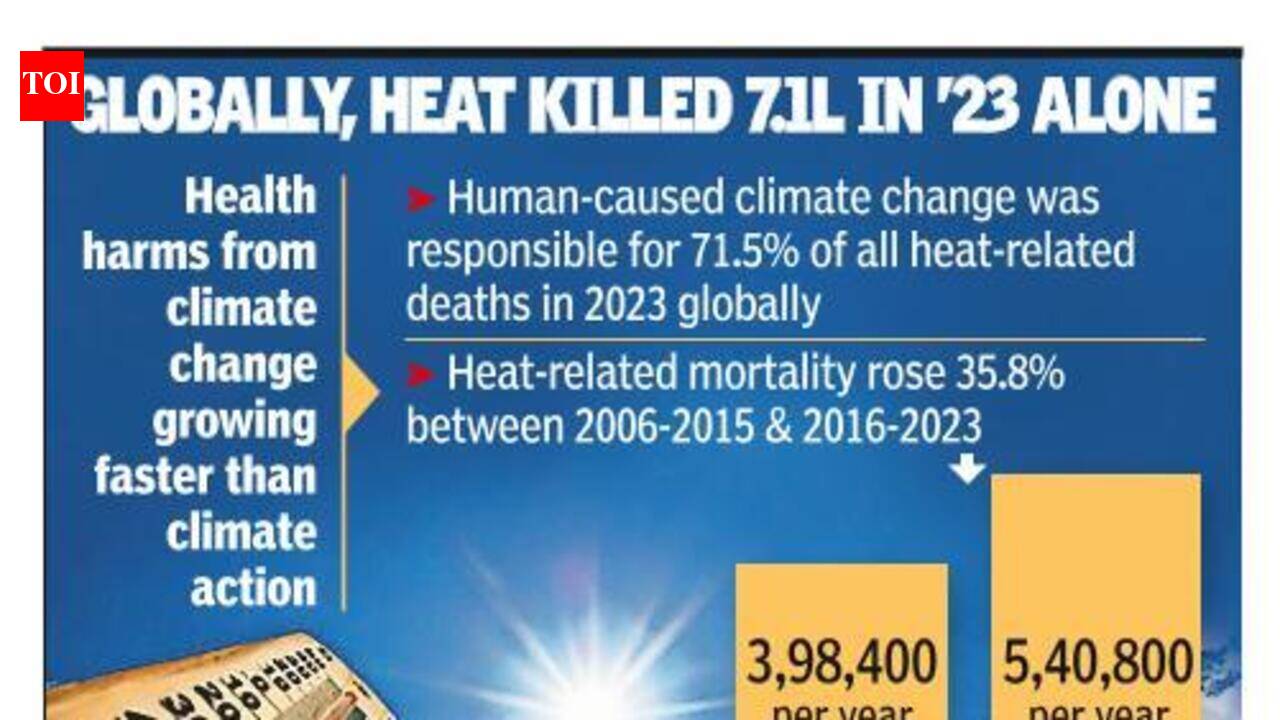
The 10th Lancet Countdown on Health and Climate Change Report released on Wednesday says climate change poses growing health risks to Indians. Heat stress and sleep loss rose significantly between 2016 and 2025. Mosquito-borne diseases like dengue and malaria also spread faster as conditions became more favourable for their transmission.
Mumbai: From prolonged heat stress and sleep loss to rising "climatic suitability" for dengue and malaria transmission, climate change is posing a growing range of health risks to Indians, according to the '10th Lancet Countdown on Health and Climate Change Report' released on Wednesday. The report found that the health harms of climate change worldwide grew faster in 2016-2025, the decade after the Paris Agreement, than in the preceding 10 years. This happened because efforts to tackle the crisis failed to keep pace, it said. Globally, annual average heat-related deaths rose by nearly 36% after the Paris agreement came into force, with heat linked to 7.1 lakh deaths in 2023 alone. Extreme drought affected nearly 52% of the world's land for at least one month in 2025, said the authors, calling for climate change to be recognised as a global health emergency. The report listed worsening heat effects in India: half of the heatwave days Indians were exposed to between 2016 and 2025 were attributable to climate change. Indians also faced over 2,600 hours a year when temperatures posed a "moderate" or "higher" risk of heat stress during outdoor activities such as brisk walking - over 200 hours more than the average in the 1990s. Indians lost an estimated 64 hours of sleep annually between 2021 and 2025 due to high night-time temperatures; this is about three hours more each year than in 1986-2005. The risks extend beyond heat-related illness. The report found that the transmission potential of two types of mosquitoes that spread dengue, Aedes albopictus and Aedes aegypti, had increased. Conditions favourable to malaria transmission have also expanded. Compared with 1981-1990, the number of environmentally suitable months increased by 19% for Plasmodium falciparum and 18% for Plasmodium vivax in 2016-2025. The findings are particularly relevant to Mumbai, where civic health officials have reported greater malaria activity this year. Coastal warming poses another health concern. The length of India's coastline environmentally suitable for transmission of Vibrio bacteria, which can cause gastroenteritis and wound infections, increased by 27% compared with 1982-1991, reaching around 2,740km in 2025. Bhagwan Kesbhat of the Waatavaran Climate Environment & Sustainability Foundation said the health consequences of climate change were no longer confined to agriculture and livestock. "At a parishad we recently organised in Marathwada, a local panchayat member said more women were suffering miscarriages due to heat-related health complications than ever before," he said. "We are still talking about climate change when we should be speaking about 'climate boiling'," said Kesbhat. Despite progress on some fronts, the report said global efforts remained inadequate. Clean-energy investment reached a record $2.1 trillion in 2025, while cleaner air prevented 3.23 lakh deaths annually in 77 nations where fossil-fuel-related pollution declined since 2016. Yet fossil fuels supply over 80% of the world's energy.