
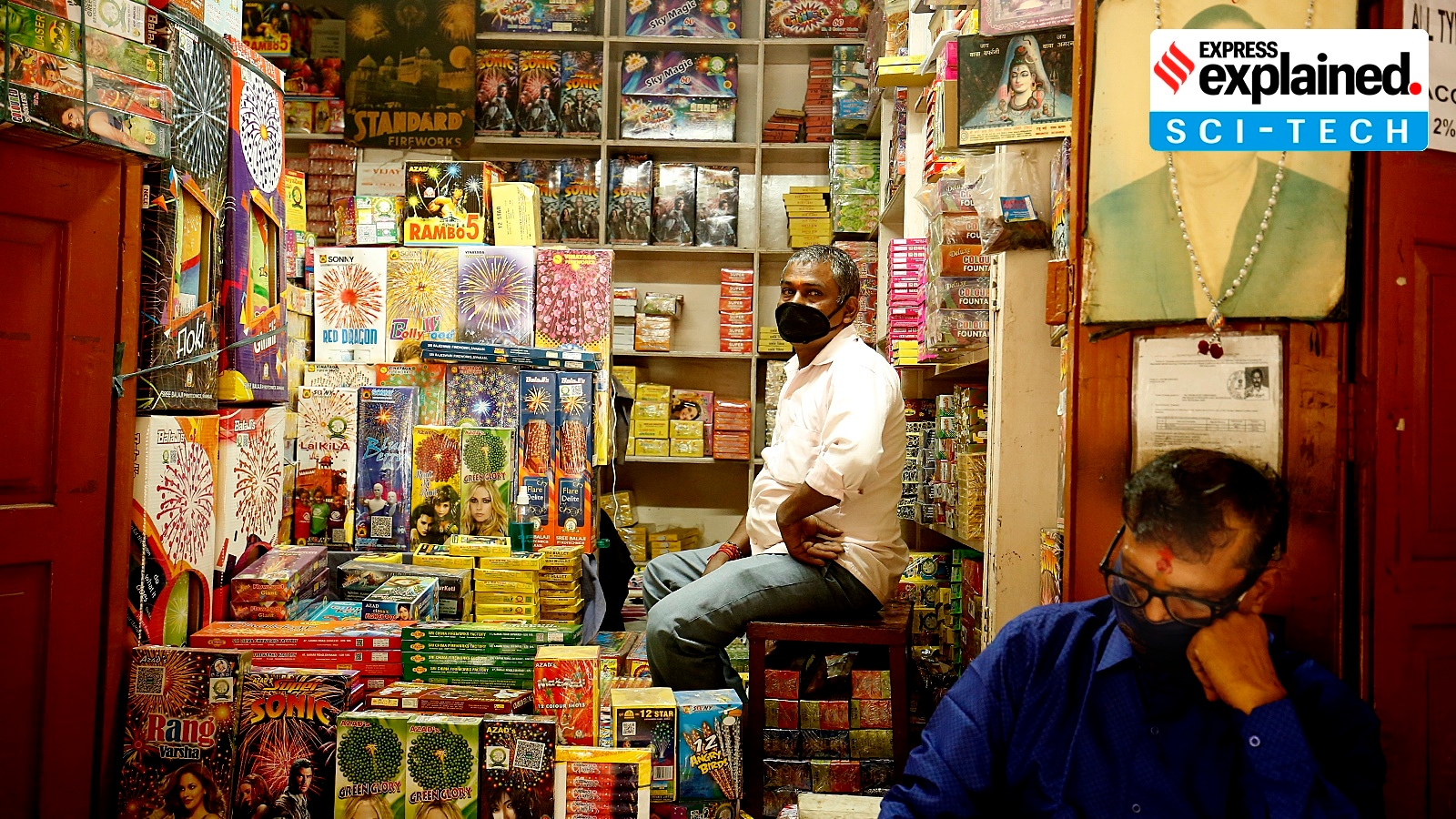
The Chandigarh administration allowed only certified green crackers for the upcoming Diwali festival. Developed by CSIR-NEERI, these crackers use modified chemicals to lower emissions. Professor Sonu Goel warned, "Even a lower-emission product contributes to pollution when used in large quantities." Buyers must check PESO licences and scan QR codes carefully.
Green crackers can reduce certain emissions, but they are not pollution-free. An expert explains their benefits, limitations and the associated health risks.
As Diwali approaches, the administration of the Union Territory of Chandigarh has allowed the bursting of only certified "green" crackers during the festival. This is in line with a larger push towards such crackers -- ahead of last year's Diwali, for instance, the Supreme Court had permitted government-approved "green crackers" on a "test case basis" in the Delhi-National Capital Region (NCR).
Green crackers -- developed by scientists at the Council of Scientific and Industrial Research-National Environmental Engineering Research Institute (CSIR-NEERI) -- have long been promoted as a less-polluting alternative to conventional firecrackers.
But how clean are they really? Professor Sonu Goel, from the Department of Community Medicine and Public Health of Chandigarh's renowned Postgraduate Institute of Medical Education and Research, speaks to Hina Rohtaki about their benefits, limitations and the associated health risks.
What are green crackers?
Green crackers are low-emission firecrackers developed through modified chemical formulations and reduced or substituted raw materials.
Developed by CSIR-NEERI, Nagpur, these crackers are designed to reduce particulate matter and certain gaseous emissions.
The recognised categories include SWAS (Safe Water Releaser), STAR (Safe Thermite Cracker) and SAFAL (Safe Minimal Aluminium).
According to Goel, their formulations may involve smaller shells, reduced use of raw materials, elimination of ash-producing components and substitution of certain ingredients. They also exclude barium nitrate, which the Supreme Court has refused to permit in firecrackers even in reduced quantities.
How can you identify genuine green crackers?
Packaging labels such as "eco-friendly", "green" or "pollution-free" are not sufficient proof of certification.
"Consumers should buy only from licensed vendors and check the manufacturer's name, registration details and the required Petroleum and Explosives Safety Organisation (PESO) licence. They should also scan the product-specific QR code and verify that the information matches the manufacturer and product," Goel said.
Are green crackers a long-term solution?
According to Goel, green crackers primarily act as an interim measure to reduce harm rather than a complete solution.
"Even a lower-emission product contributes to pollution when used in large quantities," he added.
In Chandigarh, restrictions on conventional crackers, joined firecrackers or laris, online sales and bursting hours can help limit exposure. Their effectiveness, however, will depend on public compliance, enforcement and the availability of genuine certified products.
"As I said, they are not entirely pollution-free. We need to minimise our usage. The objective should not stop at replacing conventional crackers with green ones. It should be to progressively reduce the overall environmental and public-health burden of firecracker use while enabling safer, more responsible celebrations," Goel explained.
To what extent can green crackers reduce pollution?
According to NEERI's criteria, green crackers must reduce particulate matter by at least 30% compared with the conventional composition for the corresponding category. Alternatively, they must achieve a reduction of at least 20% in particulate matter along with at least 10% in gaseous emissions, including sulphur dioxide and nitrogen dioxide.
Improved formulations announced in 2025 were reported to emit 30-50% fewer pollutants than conventional crackers. A 2023 study by NEERI scientists also found that barium levels in PM10 and PM2.5 were 30-60 per cent lower in the tested green crackers, depending on the product.
However, these reductions do not automatically translate into an equivalent improvement in a city's air quality.
"The evidence indicates that green crackers can reduce emissions, but the extent varies with the product, formulation and pollutant measured," Goel said.
Are green crackers pollution-free?
"No. They reduce emissions. They should not be described as pollution-free or completely harmless," the professor said. "Combustion continues to release airborne particles and gases even when a cracker's chemical composition has been modified. The size and chemical composition of the particles also matter, not just their overall quantity."
Goel quoted a 2022 study where examining ultrafine particles during Diwali in Delhi found that green crackers could emit more particles of smaller diameters than traditional crackers. This does not establish that all green crackers are more harmful, but it highlighted why emissions need to be assessed beyond their total mass.
"There is also a difference between reducing the amount of a pollutant and eliminating exposure to it. A lower-emission product still releases pollutants, particularly when many are burst at once," he said.
What are the health risks from crackers?
Fine particulate matter, particularly PM2.5, can penetrate deep into the lungs and contribute to respiratory and cardiovascular problems. Children, older adults and people with asthma, chronic obstructive pulmonary disease or heart disease are particularly vulnerable.
"Firecrackers produce sudden, loud noise that can disturb sleep and distress infants, older adults and hospital patients. Their remains may contain chemical residues and metals that settle on the ground or enter drains. Accidents can also cause burns and fires. People with respiratory or cardiac conditions should minimise outdoor exposure during intense bursting and follow air-quality advisories. So irrespective of whether they are green, we must minimise the usage," he stated.