
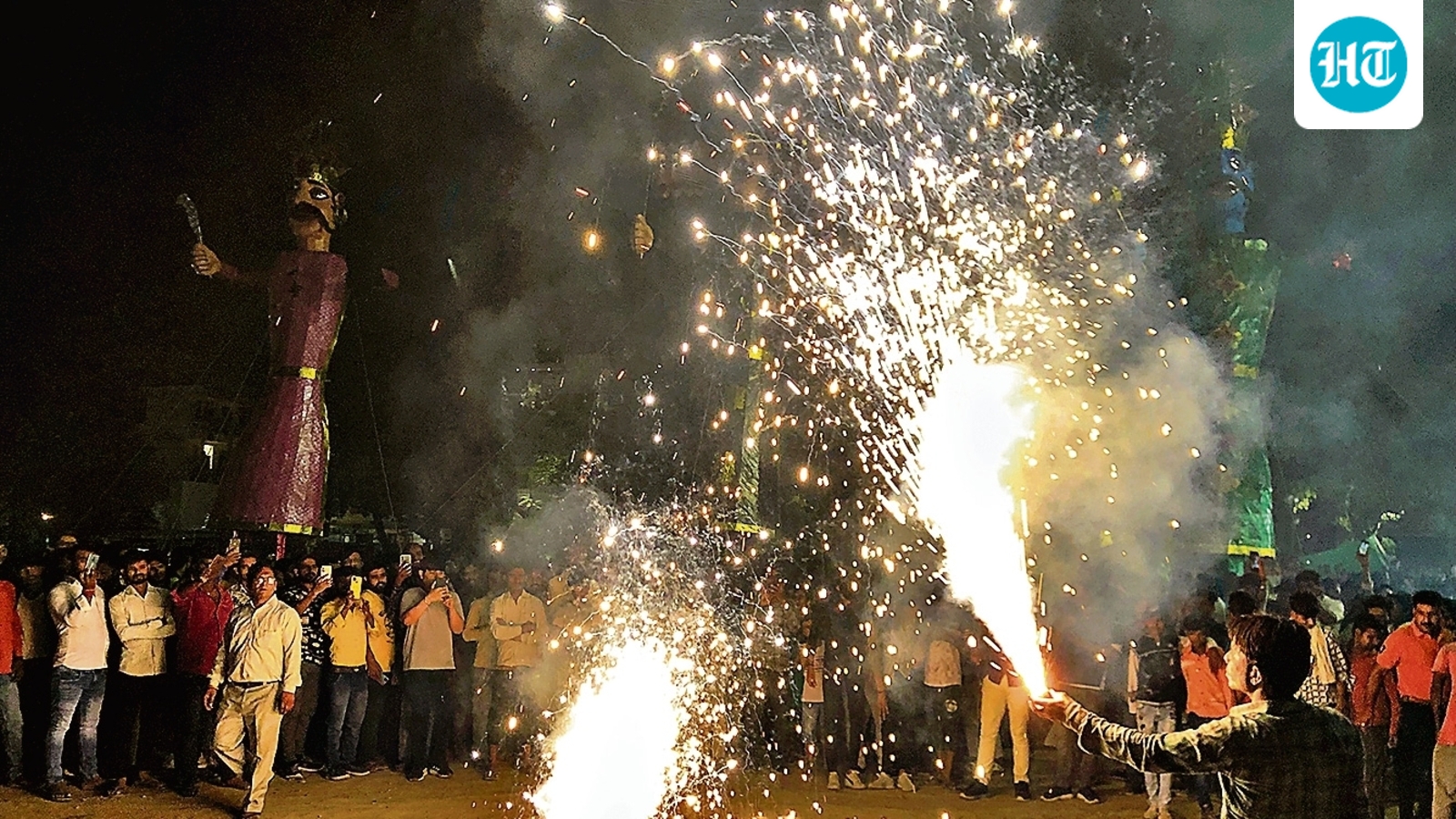
The Supreme Court on Monday called for a "practical and pragmatic" approach to regulating firecrackers ahead of the festive season. Green crackers use modified chemicals to reduce harmful emissions compared to conventional ones. The court will hear the matter again on October 15 to decide on their use in Delhi-NCR.
The Supreme Court on Monday called for a "practical and pragmatic" approach to regulating firecrackers ahead of the festive season. The bench, hearing its suo motu case on air pollution in Delhi-NCR, will take up the matter again on October 15.
The hearings have drawn attention back to green firecrackers, which are designed to produce fewer emissions than conventional ones. The court first permitted them in 2018, when it restricted conventional fireworks, though Delhi-NCR has seen blanket bans in multiple years since.
Conventional fireworks get their bang, colour and burn from a mix of fuel, oxidisers (chemicals that supply oxygen so the mix burns fast and hot) and metal salts. Green crackers alter this mix. Formulations developed with the involvement of the Council of Scientific and Industrial Research's National Environmental Engineering Research Institute (CSIR-NEERI) modify the chemicals used and, in some cases, reduce the quantity of substances associated with harmful emissions. Compliant products carry a green logo and a QR code meant to identify them as genuine.
The Supreme Court's 2018 restrictions included a ban on firecrackers containing barium and barium salts. According to submissions before the court, barium salts, particularly barium nitrate, act as oxidisers that make fireworks burn more intensely, and they are also used to produce green colour.
The Centre had earlier told the court that the environment ministry, after consulting experts from CSIR-NEERI, the Petroleum and Explosives Safety Organisation (PESO), which licenses fireworks manufacturers, and the Central Pollution Control Board (CPCB), recommended allowing redesigned laris.
Laris, or series crackers, are strings of small crackers that explode one after another, and they were among the fireworks restricted in 2018. The court accepted the recommendation on September 30, subject to limits on the number and size of shells and the interval between bursts. It has not yet ruled on whether the approval extends to Delhi-NCR.
In earlier proceedings, the Centre said controlled laboratory tests by CSIR-NEERI had found a 45% to 60% reduction in emissions of PM10, airborne particles smaller than 10 micrometres across. The tests covered certain new-generation green firecrackers that use reduced quantities of barium salts or nitrates alongside other oxidisers.
CSIR-NEERI and the CPCB proposed outdoor tests in Delhi, Bhopal, Kolkata and Chennai to assess how these formulations affect ambient air quality, it had said.
On September 2, the court gave CSIR-NEERI two weeks to carry out the outdoor study. The Centre has sought time until October 15 to submit the results.
The reductions in emissions, as told to the court, were measured in laboratory conditions. Dipankar Saha, a former head of the CPCB's air laboratory who was involved in developing green crackers in 2018, told HT last year that the technology reduces emissions but cannot eliminate them.
"Anything that involves combustion cannot be truly green, but it has lesser harmful chemicals, including barium or aluminium," he said.
CPCB data shows Delhi's 24-hour average air quality index (AQI) on Diwali day was 281 in 2018, 337 in 2019, 414 in 2020, 382 in 2021, 312 in 2022, 218 in 2023, 328 in 2024 and 345 in 2025. The AQI runs from 0 to 500; readings between 301 and 400 are classed "very poor" and those above 400 "severe".
Green crackers were permitted under court directions in 2018 and 2019, although violations were reported and conventional fireworks were also burst. HT reported major pollution spikes after Diwali in both years. The Delhi government had banned all firecrackers from 2020 to 2024.
Weather conditions also affect how quickly pollutants disperse. In 2023, favourable weather helped keep the Diwali AQI at 218, although particulate levels surged after firecrackers were burst. In 2024, several monitoring stations recorded sharp night-time spikes in PM2.5, the finer particles that can travel deep into the lungs and enter the bloodstream.
In 2025, the Supreme Court permitted certified green crackers in Delhi-NCR. Delhi's AQI on Diwali was 345, and most of the city's 38 monitoring stations were in the red zone, indicating very poor to severe air quality.
HT's analysis of Diwali pollution in 2025 found that the year saw Delhi's highest Diwali PM2.5 levels in five years, despite favourable weather. Average PM2.5 across eight stations with consistent historical data peaked at 785.6 micrograms per cubic metre, compared with 772.9 in 2021. Hourly averages reached 1,763 at Nehru Nagar and 1,710 at Anand Vihar.
India's national standard for 24-hour PM2.5 exposure is 60 micrograms per cubic metre.
HT reported last year that Delhi lacked a dedicated facility to test whether crackers sold in the market were genuinely "green". There were also concerns over irregularities in QR codes and packaging. The Commission for Air Quality Management (CAQM) told the court that licensed producers had sold QR codes meant to identify genuine green firecrackers to unregistered manufacturers.
At the October 12 hearing, senior advocate Aparajita Singh, speaking as amicus curiae (an independent lawyer appointed to advise the bench), told the court that restrictions allowing firecrackers to be burst only during limited hours had proved ineffective because of poor implementation. She argued that police could not be deployed on every street to ensure compliance, and suggested referring the matter to CAQM.
Yes. Experts have warned that lower emissions per cracker do not necessarily translate into safe air quality when large quantities of fireworks are burst within a short period.
In an HT report published on October 1, Jinitha Varghese, programme manager at the think tank Envirocatalysts, warned that allowing millions of green crackers to be burst within a two-hour window could push Delhi-NCR's AQI beyond hazardous thresholds.
"Green firecrackers are not zero-emission; they are simply slightly less polluting," Varghese said, pointing to the region's already high pollution burden.
The concern is that even if each cracker releases fewer pollutants than a conventional one, the combined emissions from large-scale bursting can still add significantly to the pollution load. The concentration of emissions over a short period, along with weather conditions that limit their dispersion, can worsen air quality.
Dipankar Saha has also said that green crackers cannot be completely free of emissions because they involve combustion. The experience of Diwali 2025, when Delhi recorded sharp PM2.5 spikes despite the permission being limited to certified green crackers, illustrates why reduced emissions should not be confused with pollution-free celebrations.