
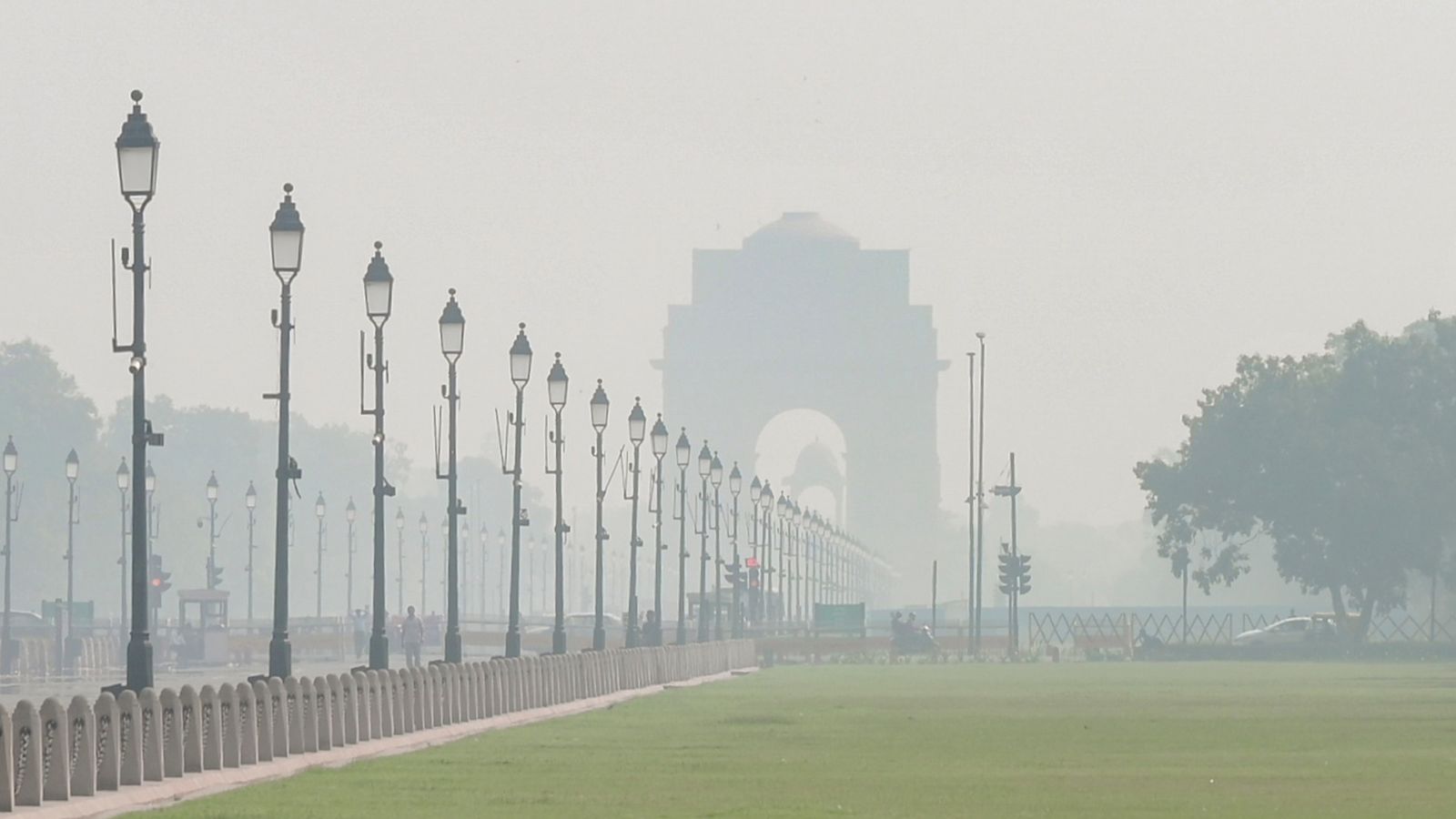
Delhi’s air quality hit the ‘poor’ category at 244 on October 21, forcing the Commission for Air Quality Management to start Stage I of GRAP across the region. Agencies got orders to intensify pollution control. Officials said the AQI is likely to remain in the ‘poor’ category over coming days.
With Delhi’s air quality deteriorating to the ‘poor’ category on Wednesday, the Commission for Air Quality Management (CAQM) invoked Stage I of the Graded Response Action Plan (GRAP) across the National Capital Region with immediate effect, directing agencies to intensify pollution-control measures.
The city’s Air Quality Index (AQI), which stood at 179 in the ‘moderate’ category on October 20, deteriorated to 244 at 2 pm on October 21 — entering the ‘poor’ category.
The India Meteorological Department (IMD) and the Indian Institute of Tropical Meteorology (IITM) have forecast that the AQI is likely to remain in the ‘poor’ category over the coming days, the CAQM said in its order.
The GRAP Sub-Committee reviewed the air quality , along with the weather and air quality forecasts, before deciding to invoke Stage I across the entire NCR, the order said.
Under the revised GRAP schedule issued on September 29, Stage I applies when Delhi’s AQI is between 201 and 300.
Schools and offices will continue to function normally under these curbs.
Stage II kicks in for ‘very poor’ air quality (301-400), Stage III for ‘severe’ air quality (401-450) and Stage IV for ‘severe+’ air quality (above 450).
Measures under GRAP 1:
Construction curbs: Projects with plot sizes of 500 sqm or more that are not registered on the relevant state or Delhi government web portal, or do not meet prescribed requirements for remote monitoring of dust-mitigation measures, not permitted to operate.
Ban on the use of coal and wood in eateries: Ban on coal and firewood as fuels in tandoors at hotels, restaurants and open eateries.
Ban on open waste burning: Authorities must strictly enforce prohibition on open burning of biomass and municipal solid waste.
Waste dumping prohibited: Illegal dumping of waste on open land is prohibited. Municipal bodies, pollution-control boards and district administrations must ensure regular lifting of municipal solid waste, construction and demolition waste, industrial waste and hazardous waste from designated dumpsites and industrial areas.
Curbs against polluting vehicles: Enforcement of existing court orders on restrictions on overage diesel and petrol vehicles. Transport departments and traffic police must strictly enforce pollution-under-control (PUC) norms and take action against visibly polluting vehicles, including impounding them or imposing the maximum applicable penalty.
Vehicle diversions: Inter-city and interstate buses entering Delhi from cities and towns in Haryana, Uttar Pradesh, Rajasthan and other specified adjoining states are restricted to electric, CNG or BS-VI diesel vehicles, subject to the coverage specified in the GRAP schedule. Authorities have been directed to enforce diversion of non-destined truck traffic away from Delhi through the Eastern and Western Peripheral Expressways.
Dust control measures:
Intensify dust suppression measures during road construction, widening, repair and maintenance work. These include the use of anti-smog guns and water sprinkling systems.
Carry out periodic mechanised sweeping and water sprinkling on roads. Dust collected must be disposed of scientifically at designated sites or landfills.
Traffic management: Police in Delhi and other NCR towns have been directed to synchronise traffic signals and deploy adequate personnel at identified congested corridors, intersections and other traffic bottlenecks to ensure smoother movement.
Transport boost: Additional public transport services through CNG and electric buses, Metro and the Regional Rapid Transit System (RRTS). Transport authorities have been directed to augment fleets and increase service frequency. Differential fares to encourage travel during off-peak hours are also included in the measures.
© The Indian Express Pvt Ltd
Sophiya Mathew is a Correspondent at The Indian Express, based in New Delhi. She joined the Delhi bureau in 2024, and has specialization in Integrated Multimedia Journalism from the Asian College of Journalism (ACJ), Chennai. Professional Background Core Beats: Her reporting is primarily focused on the Environment and Education. Specialization: She has gained recognition for her ground-level reporting on the Yamuna floodplains and the socio-economic challenges faced by those living on its banks. She also focuses on the disparities in Delhi's education system, ranging from elite private schools to government institutions and refugee education. Recent Notable Articles (December 2025) Her recent work has been heavily centered on Delhi's severe winter pollution crisis and the government's regulatory responses: 1. The Air Pollution Crisis "A tale of two cities: Delhi govt schools choke in bad air, private classrooms set up air filters" (Dec 20, 2025): A high-impact feature contrasting the "Clean Air Bubbles" in elite schools with the reality of government school students who are exposed to an equivalent of 17 cigarettes a day due to outdoor exposure. "Delhi sees season's worst air day, second worst December AQI in nearly a decade" (Dec 15, 2025): An analytical report on the meteorological patterns trapping pollutants in the NCR. "Delhi bans non-BS VI vehicles from outside: Why curbing vehicular pollution is key" (Dec 17, 2025): Explaining the science behind targeting specific vehicle vintages to lower particulate matter. 2. Enforcement & Regulations "No fuel at pumps in Delhi without valid PUC certificate from December 18" (Dec 17, 2025): Breaking the news on the environment ministry's strict "No PUC, No Fuel" policy. 3. Education Policy "Law to regulate school fee in Delhi risks becoming procedural, say parents" (Dec 13, 2025): Investigating the loopholes in the new Delhi School Education (Transparency in Fixation and Regulation of Fees) Bill, 2025. "Monsoon Session: Private school fee regulation Bill cleared after four-hour debate" (Aug 9, 2025): Covering the legislative passage of the controversial fee hike regulation. Signature Style Sophiya is known for her observational depth. Her reporting often includes vivid details from school corridors, hospital waitlists, or the banks of the Yamuna to illustrate how policy failures affect the city's most vulnerable residents. She is a frequent expert guest on the 3 Things podcast, where she explains the complexities of Delhi’s environmental laws. X (Twitter): @SophiyaMathew1 ... Read More