
A government panel recommended pre-clearance for two limestone mines near the Jaisalmer habitat of the Great Indian Bustard. The Expert Appraisal Committee gave the nod to Shree Cement East Pvt Ltd and Ambuja Cements Ltd during meetings held between November 2 and November 4. These projects now require environmental studies.
Expert Appraisal Committee recommends granting Terms of Reference for mining proposals by Shree Cement East Pvt Ltd and Ambuja Cements Ltd.
An expert panel of the Union Environment Ministry has recommended a key preliminary approval for two limestone mines proposed within 5-6 km of the 'priority area' habitat of the critically endangered Great Indian Bustard (GIB) in Rajasthan's Jaisalmer. The ministry's sectoral Expert Appraisal Committee (EAC) on non-coal mining recommended granting 'Terms of Reference' (ToR) for the mining proposal at Joga-IV limestone block by Shree Cement East Pvt Ltd and at the Joga-II block by Ambuja Cements Ltd.
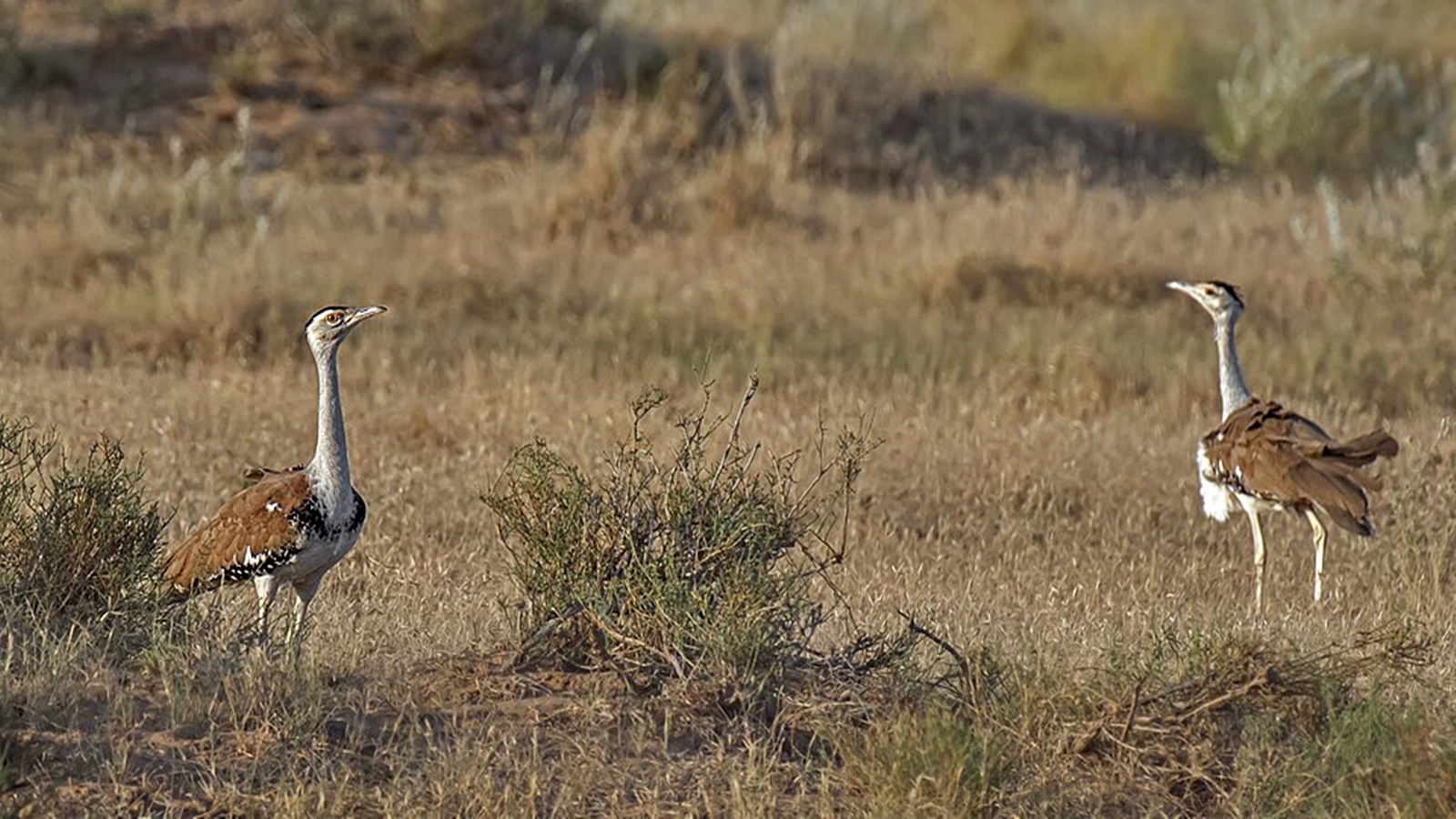
Fewer than 150 GIBs survive in the wild and the Supreme Court has ordered protection measures in the identified 'priority area' in Rajasthan. This habitat in Jaisalmer is where it is found predominantly.
The EAC recommended granting the ToR -- which prescribe what data must be collected and monitored, and what impacts must be studied as part of the Environmental Impact Assessment (EIA) study -- during its meetings between November 2 and November 4, as per minutes of its meetings. Once an EIA report is presented, an EAC appraises the project to decide if it should be recommended for environmental clearance.
The pre-clearance nod to these two proposals comes on the back of recent environmental clearance recommendations by the EAC to two other limestone mining proposals close to the GIB priority area, during its meetings on October 5-6, as per meeting minutes and official documents. One was the Parewar SN1 limestock block mining project of Wonder Cement Limited and the other was a proposal by Dalmia Bharat Green Vision Limited to mine in Ramgarh. Wonder Cement's proposal to expand the Parewar B limestone mine was also approved by the EAC in the October meeting.
As per proposal documents and EAC's discussions, Joga-IV block covers 368 hectares and Shree Cement East Private Ltd has proposed to produce 3 million tonnes of limestone per year, which it has projected to achieve by the 8th year of mining. The proposed mine is located 3.8 km from the GIB priority area.
Meanwhile, the Joga-II mine covers 376 hectares with a projected output of 5 million tonnes per year and it is located farther away from the GIB area, at 5.7 kms distance.
The Adani Group-owned Ambuja Cements Ltd and Shree Cement East Private Limited, owned by Shree Cement Limited, relied upon letters from the Deputy Conservator of Forests (Wildlife), Jaisalmer to back the information submitted on the distance from the GIB priority area, as per project documents submitted to the Environment Ministry.
Both the companies have proposed cement plants near their mines and a covered conveyor belt to move crushed limestone. There are plans to also sell limestone to other plants using road transport. The EAC noted this and directed both project proponents to avoid a route that passes through the GIB priority area for 3.5 kms.
Noting a recommendation of the Wildlife Institute of India on the issue, the EAC said, "The transportation of materials shall be carried out using the existing road infrastructure to minimize disturbance to suitable habitats in the surrounding areas. While new roads may be constructed within the lease area as per operational requirements, it must be ensured that any proposed road alignment does not pass through or near any small grassland patches. Accordingly, EAC suggested PP (project proponent) to follow the recommendation of WII."
Moreover, while recommending the grant of ToR, the EAC stated that in case the route passing through the GIB priority area is chosen, a GIB-specific conservation and mitigation plan for the transportation shall be prepared to assess the impact of noise, dust, and mineral movement on GIBs and their habitat.
"PP (project proponent) needs to carry out field surveys along the transportation corridor and adjoining areas to identify GIB presence, potential nesting, breeding and feeding habitats, grassland conditions and invasive species. The findings shall be incorporated in the EIA/EMP (Environmental Management Plan) Report along with suitable habitat management and seasonal protection measures, wherever required," the EAC stated.
Both companies must also draw up a site-specific wildlife conservation plan for Schedule-I species found in the study area, to be approved by the Chief Wildlife Warden. Because the mines lie outside the priority area, GIB conservation measures at the sites are limited to monitoring, mitigation and precautionary safeguards.