
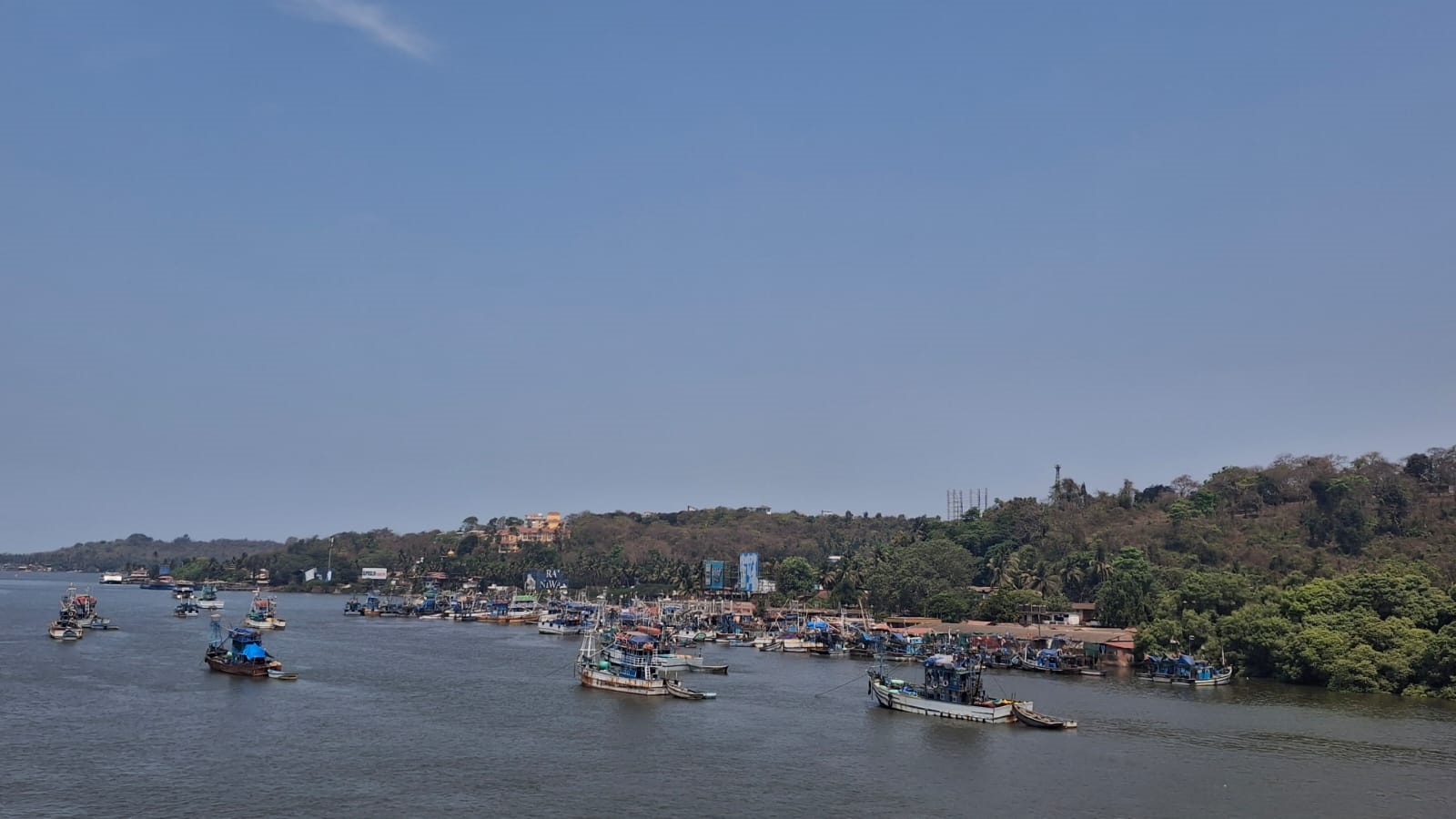
The Goa State Pollution Control Board found high faecal coliform levels at all 22 sampling points in the Mandovi river. An interim report shared with the High Court showed that every location exceeded the permissible limit of 100 MPN/100 ml. Contamination got significantly higher during low tide across the estuary.
Monsoon sampling was carried out at 22 different locations in the Mandovi estuary. All 22 sampling points saw the permissible limit being exceeded, the interim report, shared with the High Court, pointed out.
The Mandovi river in Goa capital Panaji has been found to have high faecal coliform levels, beyond the permissible limit, at all the sampling points in a study, an interim report by the Goa State Pollution Control Board (GSPCB) has flagged before the High Court of Bombay at Goa.
In fact, samples collected at all 22 points were found to be exceeding the permissible limit, it added.
The interim report on monsoon water quality characteristics of river Mandovi stated, "Faecal coliform numbers ranged from 130 to 540 MPN [most probable number]/100 ml during high tide and 130 to 940 MPN/100 ml during low tide. Based on the analysis reports of high tide samples, 22 out of 22 sampling points exceeded the permissible limit of 100 MPN/100 ml..."
It said, "Based on the analysis of low tide samples, all 22 sampling points exceeded the permissible limit...A comparative analysis of tidal conditions indicates that faecal coliform contamination is significantly higher during low tide times in comparison to those during high tide times. The same trend has also been reported in samples analysed during the pre-monsoon season."
The High Court of Bombay at Goa is hearing a suo motu petition on pollution in Mala lake after hundreds of dead fish were found floating in the waterbody earlier this year.
The High Court had, a few months ago, proposed to expand the scope of the petition to include the Mandovi river line area in order to remedy the water pollution. It had directed the member secretary of the GSPCB to conduct a similar quantitative and qualitative study and prepare a report on the quality of water within the Mandovi river, more particularly at the estuary of the river between IFFI jetty and the Mandovi bridges.
According to the Central Pollution Control Board (CPCB), the permissible limit for faecal coliform - a group of bacteria found in human and animal waste -- is 100 MPN/100 ml.
Higher MPN seen during low tide
The report said that the MPN of faecal coliforms was higher during the low tide collections, possibly due to the downstream flow of waters into the sampling zone. The coliform or sewage effluent quantities may also be higher in these waters, it added.
"Also, the 2026 monsoon being low to, at best, moderate in this region, the flushing out of terrestrial runoff apparently is weaker," it said.
The monsoon sampling was carried out on August 24 at 22 different locations in the Mandovi estuary, from IFFI jetty point in the downstream and Mandovi bridges point in the upstream.
The report, though, said that all six water quality parameters - Ph values, turbidity, biochemical oxygen demand, dissolved oxygen, nitrate, and nitrite - analysed from all the 44 water samples collected during the 2026 monsoon sampling, are well within the permissible limits of the CPCB.
"The water quality in terms of almost all chemical parameters in general, is falling within the safe permissible limits set by CPCB for SW II category. However, during both the high and low tide sampling, all 44 samples had higher numbers of faecal coliforms than the CPCB limits of 100 MPN/100 ml," it said.
'No disposal of wastewater from casinos'
The report said that from the records maintained by the GSPCB staff assigned to monitor the sewage collection, handling and final disposal to reach the sewage treatment plant at Patto, "it is evidenced that there is no disposal of wastewater from the casinos into the Mandovi estuary."
"In its future endeavour of identifying the point and non-point sources of wastewater/coliform contamination, the GSPCB is aiming to identify and contain the pollution from non-point sources," it said.
The report said that during monsoon sampling, the faecal coliforms were much higher in numbers than the permissible limits, citing a possible reason as a greater input of microbial load through non-point sources of sewage effluent runoff into the Mandovi.
"In summary, Mandovi river between the stretch of Mandovi bridges in the upstream and IFFI point in the lower reaches, the effluent outfall from Penha De Franca storm water drain, Rua De Ourem and St Inez Creek in increasing effluent volumes are of serious concern... likely non-point sources of pollution into the Mandovi estuarine stretch along the Panaji city shore mainly are Rio de Ourem, City market drainage, St Inez creek/canal, while along the opposite bank in Betim are the Betim Fishing jetty, Betim fish market, a few seasonal storm drains, etc," it said.
Mandovi River, which flows through Goa's capital Panaji, is considered a lifeline for the coastal state. Six offshore casinos are also anchored in the river.