
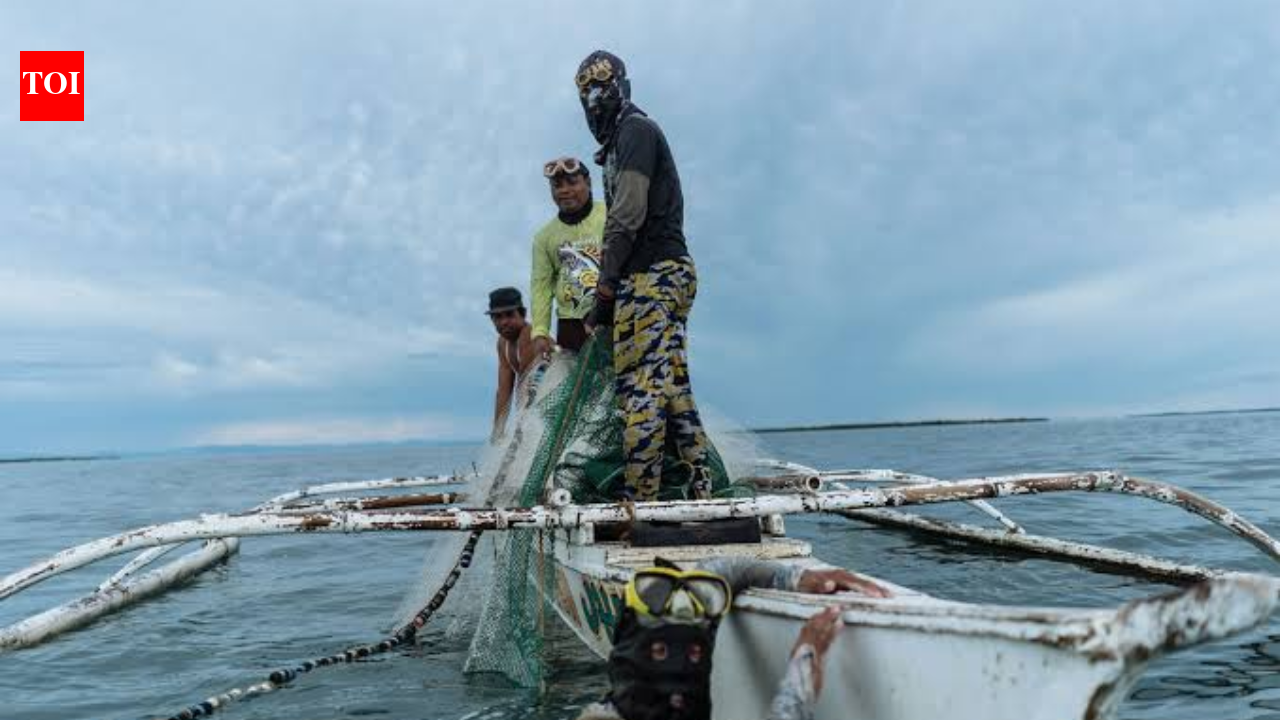
Fishermen in the Philippines started collecting abandoned nets that once damaged coral reefs and trapped marine life. This initiative turned discarded gear into nylon yarn for carpet manufacturing. It provided a new source of income for coastal communities near Danajon Bank, where many families struggled as fish catches fell.
Along parts of the Philippine coastline, old fishing nets had become a familiar sight. Some washed up on beaches, others collected among mangrove roots, while many remained underwater long after fishermen had lost or abandoned them. These nets continued to trap marine animals and damage coral reefs, adding to the pressure on already depleted fishing grounds. In communities around Danajon Bank, where declining fish catches had affected livelihoods for years, a different use for the unwanted equipment emerged. Local residents began collecting discarded nets and sending them into a recycling system that turned the material into nylon yarn used in carpet manufacturing.
Danajon Bank's unique reef system faced growing fishing pressure
Danajon Bank, situated between the Philippine islands of Bohol, Leyte and Cebu, is an unusual marine formation. It is the country's only double barrier reef and one of just six such reef systems worldwide. Its waters once supported abundant marine life, providing food and income for generations of fishing families.According to The University of British Columbia 2018 study titled, 'Coral reefs suffering in Philippines despite outlawing damaging fishing practices' estimated that fish stocks in the area had depleted by 240% per cent since 1960.
As catches became harder to secure, more fishing equipment was deployed, adding to the amount of material left behind when nets were lost, damaged or discarded.
The abandoned equipment, commonly known as ghost nets, did not simply disappear. Some became trapped in mangrove roots, while others continued drifting through the sea. Fish, crabs, sea cucumbers and other marine creatures could become caught in them. Nets settling on reefs also created problems for coral colonies, covering sections of the habitat and interfering with marine life.
The fishing equipment that continued to trap marine animals
Lost fishing gear was a problem that extended well beyond the Philippines. According to the Food and Agriculture Organisation of the United Nations annual fishing-net losses were approximately 640 000 tonnes worldwide as per 2009 report. By 2017, research on the Great Pacific Garbage Patch had also drawn attention to the large contribution made by fishing equipment to floating plastic debris.Although fishing gear was estimated to account for around 10% of ocean plastic waste, its effects on wildlife were considerably greater than that figure might suggest. World Animal Protection estimated that more than 100,000 large whales, seals and sea lions died each year after becoming entangled in fishing equipment. Seabirds, turtles and fish were also affected, although the full number of deaths was difficult to establish.Sea turtles faced particular risks. Research by Australian scientists Denise Hardesty and Chris Wilcox identified entanglement in discarded fishing nets as a leading cause of death among sea turtles in Australia. In the Gulf of Carpentaria, which lies between Queensland and the Northern Territory, abandoned nets washed ashore in particularly high concentrations. Estimates cited in the report put the annual accumulation at as much as three tonnes per kilometre of coastline.The scale of the problem was also demonstrated through recovery operations. According to the National Geographic, when 870 ghost nets were collected in Washington state, they contained more than 32,000 marine animals, including over 500 birds and mammals.
NetWorks created a different role for former fishermen
For communities around Danajon Bank, the problem was closely connected to the loss of traditional fishing income. More than 60% of local fishing families were living below the US poverty line, according to figures cited in the National Geographic report. The Zoological Society of London's NetWorks initiative began working in the region in 2012. Its approach linked the removal of abandoned fishing equipment with paid work for people whose livelihoods had become increasingly difficult to maintain.Former fishermen were employed to locate nets underwater, retrieve them and bring the material back to shore. The recovered equipment was then transported to a processing facility on Bohol, where workers compressed it into dense bundles suitable for transport. The work gave local residents another way to earn money from the same marine environment on which their families had depended for generations. Instead of relying entirely on declining fish catches, they could collect material that had previously been treated as waste.Heather Koldewey, a marine scientist and National Geographic fellow who worked with the Zoological Society of London, helped develop the programme. Her work focused on connecting marine conservation with an established commercial recycling system, allowing fishing communities to participate in a wider supply chain.
Old nets were shipped abroad and turned into carpet yarn
Once compressed, the collected fishing nets were shipped to Aquafil, a recycling company based in Slovenia. The company processed discarded fishing equipment into nylon yarn, which could then be supplied to manufacturers producing carpets.The programme was designed to generate enough income to support its operations over time, with the wider aim of creating a business that could continue without relying indefinitely on outside funding. The connection with international manufacturers was an important part of the model. Communities in the Philippines were not simply collecting plastic for disposal. Their work supplied material to an existing industry, giving the recovered nets a place in the manufacturing process.NetWorks also demonstrated that the approach was not limited to one fishing region. By the time of National Geographic's June 2018 report, the programme had expanded beyond its original location, establishing a second hub in the Philippines as well as operations in Cameroon and Indonesia.
Communities began changing how they handled unwanted nets
The programme also brought changes to the way some fishermen dealt with damaged equipment. Previously, unwanted nets could be burned, buried or left on the shoreline. These practices added to local waste problems and allowed plastic fishing gear to remain in the surrounding environment.Amado Blanco, then the programme's Philippines project manager, described how residents had begun keeping unwanted nets in sacks so they could sell them rather than dispose of them. The change meant that discarded equipment had acquired a financial value within the community.Blanco travelled between islands to meet fishermen involved in the scheme, including residents of Guidacpan, a small island reached by an outrigger boat journey from Cebu. Some of the participants came from families with several generations of fishing experience.