
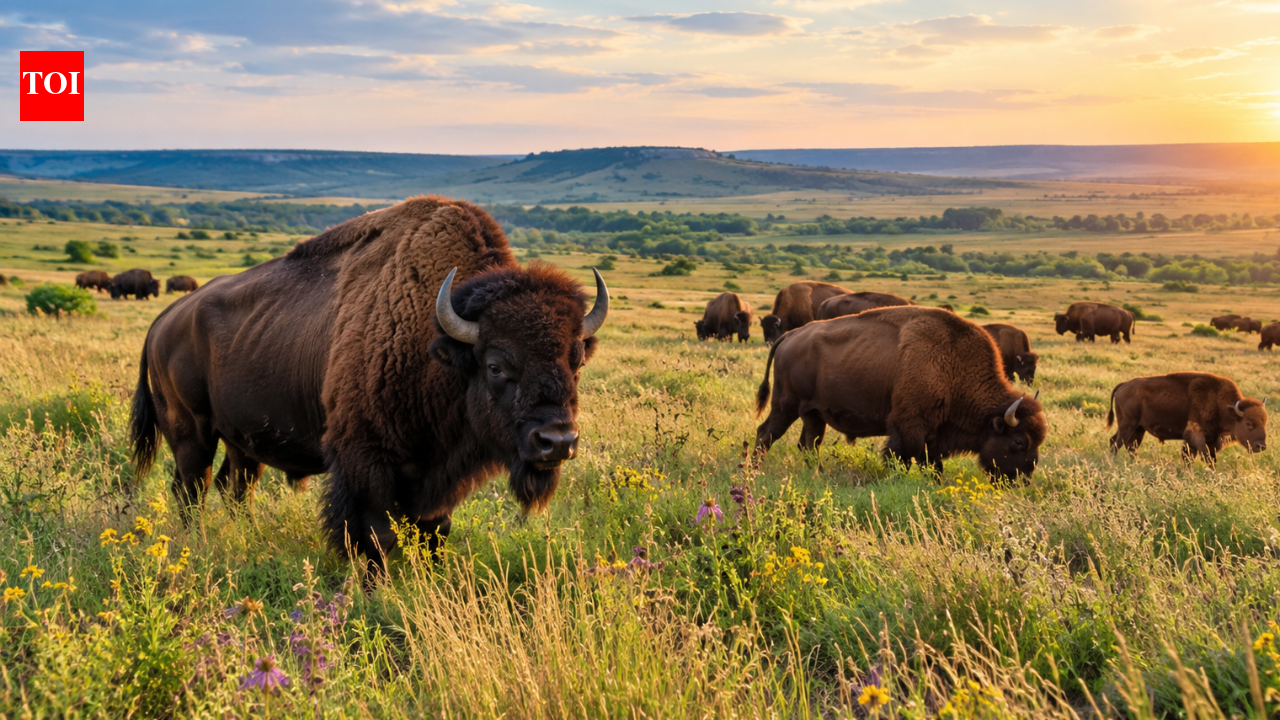
In 1993, ranchers Kenneth and Dianna Adams donated 300 American bison to The Nature Conservancy for an Oklahoma prairie. Today, more than 2,000 bison roam the Joseph H. Williams Tallgrass Prairie Preserve. These animals help restore the ecosystem by grazing on native grasses, which keeps the natural landscape healthy and balanced.
In 1993, Oklahoma ranchers Kenneth and Dianna Adams donated 300 American bison to The Nature Conservancy, setting in motion a conservation effort to restore one of North America's most threatened ecosystems. More than three decades later, the herd has grown to thousands of animals roaming the Joseph H. Williams Tallgrass Prairie Preserve near Pawhuska, Oklahoma. Spanning 39,650 acres, the preserve protects a rare stretch of native grassland where bison grazing and carefully managed fires help maintain the natural balance of the prairie. The animals influence the growth of native plants, create habitats for other species and help preserve the ecological processes that shaped the Great Plains for thousands of years. Their return is particularly significant because less than 4% of the original tallgrass prairie remains.
The bison were named the Christina Adams Bison Herd after the ranchers' daughter. Their growing population has become a defining feature of the preserve, where the animals roam across open grassland and graze among native vegetation.The conservation effort also demonstrates how restoring a native species can contribute to the protection of an entire landscape.
The preserve supports hundreds of plant and animal species, making the long-term management of its grasslands important for biodiversity.
From 300 bison to a herd of thousands
The original herd arrived in autumn 1993, when the Adams family donated the animals from their Ken-Ada Ranch. The Nature Conservancy had begun assembling the preserve through land acquisitions in 1989, with the goal of protecting and restoring the region's disappearing tallgrass prairie.The herd has since expanded considerably. The Nature Conservancy has reported around 2,700 bison during summer, including calves born that year, with numbers falling after the annual autumn roundup. The animals are managed as part of the preserve's conservation programme, which combines wildlife management with efforts to maintain the grassland's natural character.The preserve covers approximately 39,650 acres and is recognised as the largest protected remnant of tallgrass prairie in the world. Its landscape includes rolling grasslands, native wildflowers, scattered trees and waterways, offering a glimpse of an ecosystem that once covered vast areas of central North America.
How bison help restore the grassland
Bison play a central role in shaping the prairie through their feeding habits and movement. They primarily graze on grasses, influencing which plants dominate the landscape and creating opportunities for other vegetation to grow. This helps maintain a varied grassland rather than allowing a limited number of plant species to dominate every area.Their activities also affect the soil. As bison move through the preserve, they disturb patches of ground, redistribute nutrients through their waste and create depressions known as wallows by rolling in the soil. These shallow hollows can collect rainwater and provide small habitats for insects and other wildlife.The resulting variation in vegetation and ground conditions supports a wider range of organisms. Native grasses and flowering plants provide food and shelter for insects, while birds and mammals depend on the different habitats found across the prairie.
Why controlled fires are essential
Bison grazing is combined with prescribed burning, another important tool in tallgrass prairie management. Without periodic disturbance, woody plants can spread into open grasslands, gradually changing the landscape and reducing the habitat available to species adapted to prairie conditions.The Nature Conservancy uses a patch-burn approach, setting controlled fires in different sections of the preserve at different times. Recently burned areas produce fresh vegetation, while other sections retain older grasses and provide different feeding opportunities for wildlife.Bison graze across these contrasting areas, further shaping plant growth and maintaining a changing mosaic of habitats. Together, grazing and fire recreate some of the natural processes that historically sustained the Great Plains, helping keep the preserve an open grassland rather than allowing it to become dominated by shrubs and trees.
Research shows how bison can increase plant diversity
The ecological importance of bison is also supported by long-term research at the Konza Prairie Biological Station in Kansas. A study published in Proceedings of the National Academy of Sciences in August 2022 examined nearly three decades of vegetation data from areas grazed by bison, areas grazed by cattle and areas without large grazers.Researchers found that native plant species richness was 103% higher at the small-plot scale and 86% higher at the larger catchment scale in bison-grazed areas than in ungrazed areas. Cattle grazing also increased plant richness, although the gains were smaller.The research highlighted how grazing by native large herbivores can influence the composition of grassland vegetation over long periods. The study also found that the gains associated with bison grazing persisted through a period that included severe drought, underscoring the importance of grazing patterns in maintaining prairie biodiversity.
Protecting one of America's most threatened ecosystems
Tallgrass prairie once stretched across 14 US states, extending from Texas to Minnesota and into parts of Canada. Agricultural conversion and urban development have destroyed much of this habitat, leaving less than 4% of its original extent. Much of the remaining prairie is concentrated in Oklahoma and Kansas, particularly in the Flint Hills region.The Joseph H. Williams Tallgrass Prairie Preserve protects a significant part of this surviving landscape. It supports more than 700 plant species, over 300 bird species and around 80 mammal species, according to The Nature Conservancy. Its grasslands provide food, shelter and breeding habitat for wildlife while preserving native vegetation that has disappeared from much of the region.The return of the bison has helped restore a defining feature of the prairie. More than 30 years after the original donation, the herd remains central to the preserve's conservation work, showing how native wildlife and careful land management can help sustain a threatened ecosystem for future generations.