
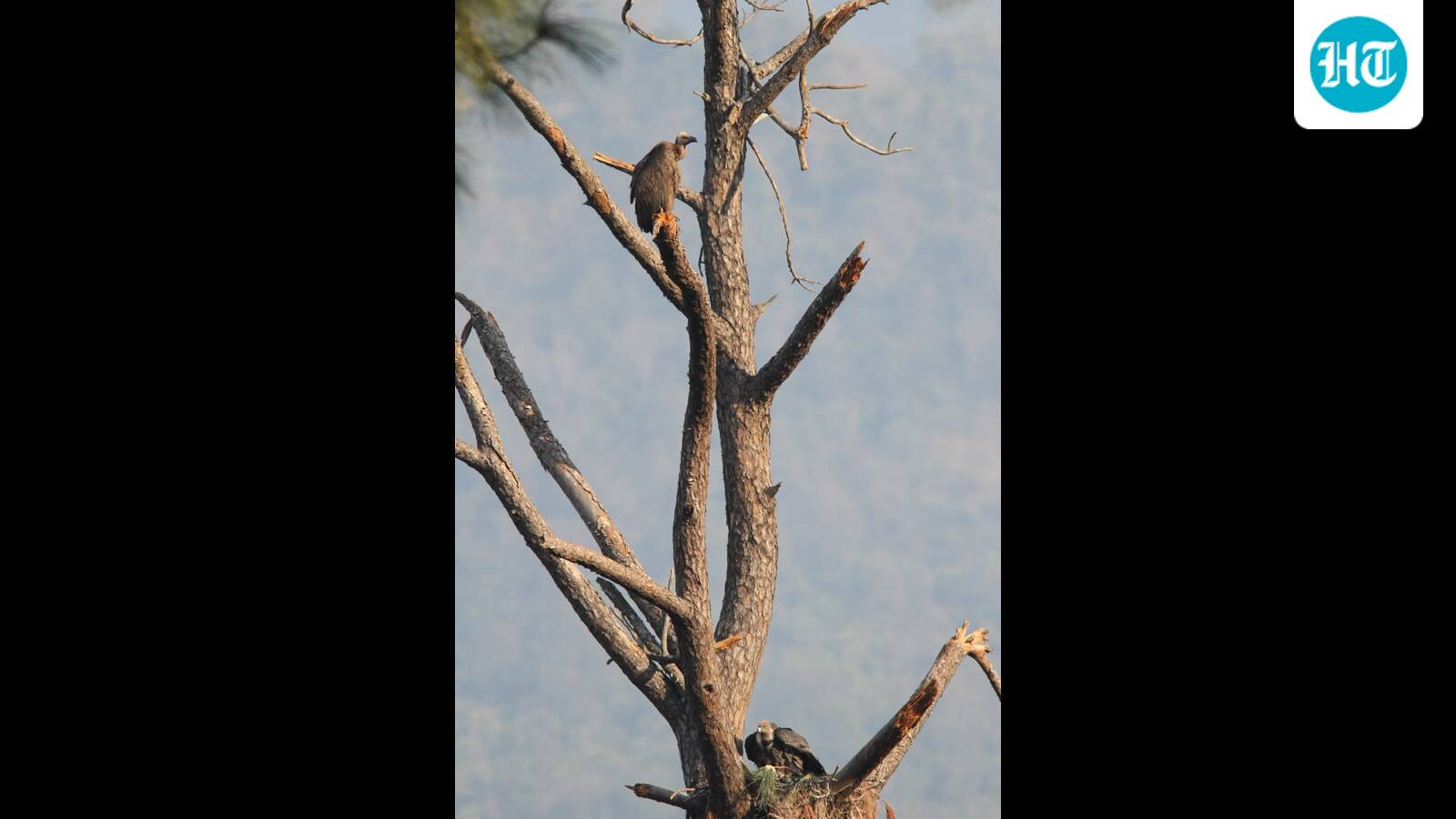
Vulture nests in Kangra valley rose from 26 in 2004-05 to 617 in 2024-25. Officials said, "A number of conservation measures were taken over the years to protect vulture nesting sites and habitats." These efforts helped the birds recover after a drug caused a major population collapse across the region.
Once pushed to the brink of extinction by widespread poisoning linked to a veterinary drug, vultures in Himachal Pradesh's Kangra valley have shown encouraging signs of recovery, with the number of nests and fledglings recording a notable increase over the past two decades.
According to data shared by the wildlife wing of Himachal Pradesh's forest department, an annual survey conducted over the past two decades has recorded an increase in vulture nests from 26 in 2004-05 to 617 in 2024-25. The number of fledglings has also risen from 23 to 559 during the same period.
Experts say the findings highlight Kangra valley as a key stronghold for vultures in the western Himalayas. The survey tracked the vulture population at various sites across Kangra.
Vultures, vital scavengers that help maintain ecological balance by feeding on animal carcasses, witnessed a severe population decline across the Indian subcontinent during the 1990s and early 2000s. Experts attribute the collapse primarily to diclofenac, a veterinary non-steroidal anti-inflammatory drug (NSAID) widely administered to livestock.
The survey data show that the number of nests increased to 206 and fledglings to 171 in 2010-11 and the numbers had further risen to 404 nests and 370 fledglings by 2020-21.
Department officials said that several conservation efforts for vultures were undertaken over the years which included a ban on the veterinary use of diclofenac, a drug identified as a major threat to their survival, and the promotion of safer alternatives such as meloxicam.
Sanjeev Singh, divisional forest officer (wildlife), headquarters (Dharamshala), said: "A number of conservation measures were taken over the years to protect vulture nesting sites and habitats. Designated sites were established to provide the birds with safe food. Efforts are also being made to ensure the safe disposal of animal carcasses with community participation, helping maintain a reliable food source for vultures while preventing environmental contamination."
Kangra valley is an important vulture habitat, supporting a majority of the nine species recorded in India. The Chir Pine forests of Kangra serve as the breeding habitat for the vultures including the critically endangered white-rumped vultures in the region.
The most commonly observed species include the White-rumped vulture (Gyps bengalensis), Egyptian vulture (Neophron percnopterus), Bearded vulture (Gypaetus barbatus), Himalayan griffon (Gyps himalayensis) and Eurasian griffon (Gyps fulvus).
The Red-headed vulture (Sarcogyps calvus),Slender-billed vulture (Gyps tenuirostris), Indian vulture (Gyps indicus) and Cinereous vulture (Aegypius monachus) are spotted less frequently in the region.
Humble beginnings
When the south Asian vulture population collapsed due to diclofenac poisoning, Devinder Singh Dhadwal, then range officer of Pong lake area, and his team launched a conservation drive in Kangra, initially identifying 26 nests of white-rumped vultures.
"We began voluntary surveys in and around the Pong lake area in 2003-04, when reports indicated nearly 97% mortality among White-rumped vultures. We identified 26 nests and gradually expanded our surveys across the district and we continued our volunteer survey till 2008-09. In 2009-10, the forest department stepped in with funding and support," said Dhadwal, who is now DFO of the flying squad division in Dharamshala.
He said that his team first identified breeding colonies and roosting habitats, and gathered information from Gaddi shepherds, resin-tapping labour and timber workers, and local residents about the possibility of breeding colonies and feeding points.
"After the department stepped in, the concerned divisional forest officers in the state were directed to stop resin tapping and timber logging in vulture habitats. We also conducted undercover surveys to monitor diclofenac and other NSAID availability. These efforts eventually led to a vulture conservation project approved by the state government later," he said.
He also added: Given the ecological importance of vultures, there is a need for a landscape-level conservation and management approach in northwestern Indian states and with other countries across Himalayas where some of the vulture species are migrating in and out. Himachal Pradesh must take the lead in this effort through the bird monitoring centre (ringing centre) at Nagrota Surian near Pong lake.
Kangra offers opportunity for long-term vulture conservation
Malyasri Bhattacharya, director and founder of Vulture and Nature Foundation (VANA) and Zoological Society of London (ZSL) EDGE Fellow, says: "While vulture populations have declined sharply worldwide, Kangra district continues to support an important wild population of the critically endangered White-rumped vulture.
Bhattacharya conducted her detailed doctoral study on the nesting ecology and behavioural dynamics of the critically endangered White-rumped vulture in Kangra valley with the Wildlife Institute of India (WII) from 2020 to 2024. The study found out that Kangra valley supports a significant population of White-rumped vultures.
It suggested targeted conservation efforts, including regular capacity-building workshops, nesting site protection, preservation of old-growth forests from resin tapping, relocating critical carcass dumping sites to forest lands, and establishing a vulture safe zone in Kangra district to ensure their long-term survival.
Pinjore-bred vulture nesting in Kangra's wild flocks
Hemant Bajpai, research biologist with the vulture conservation programme of the Bombay Natural History Society (BNHS), associated with the Jatayu Conservation Breeding Centre (JCBC), Pinjore, Haryana, said: "One of the White-rumped vulture released from the JCBC Pinjore in December 2024, has been staying in the Kangra region and well integrated with wild vultures since March 2025 till now. We have been monitoring its movements through the GPS transmitter attached to the bird."
He said that the Kangra region appears to support a healthy vulture population. An increase in the number of nests is an encouraging indication that the area offers suitable habitat conditions for vultures, including non breeders and other migratory vulture species. Vultures are adaptable and can utilise a range of habitats; however, they thrive in relatively undisturbed areas where food is readily available.