
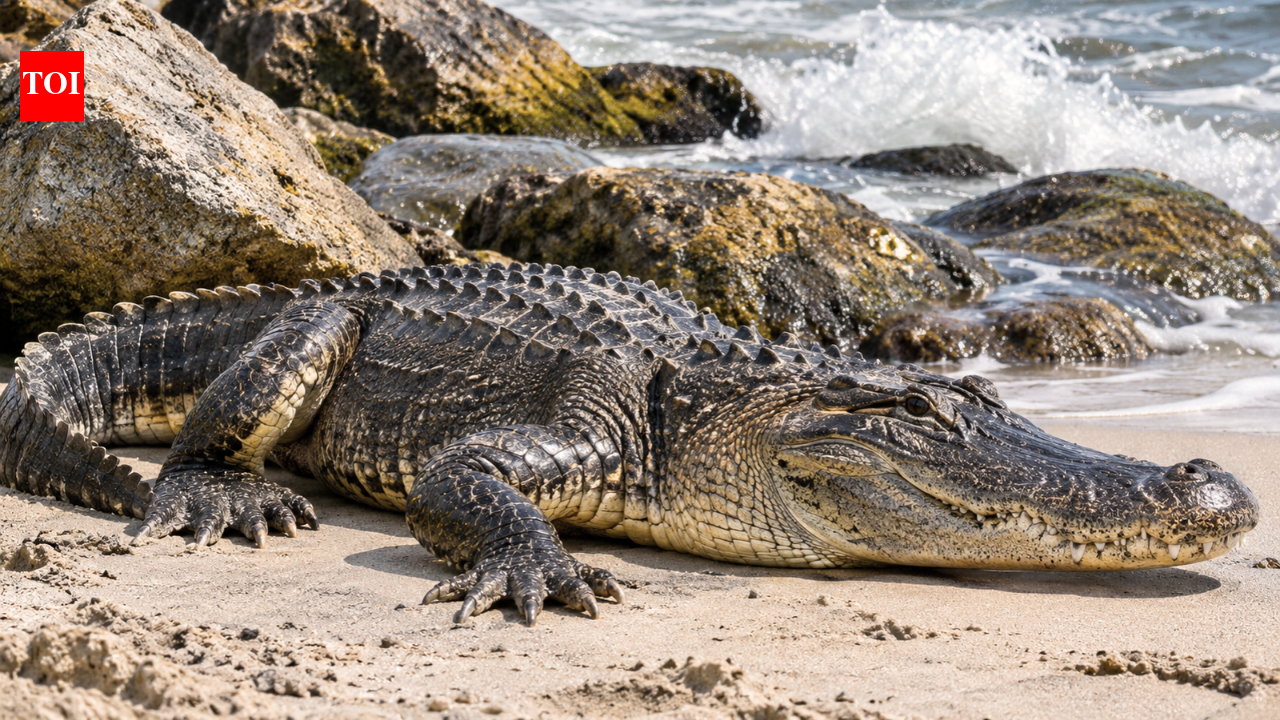
Justin Southerland sat on an eight-foot alligator on November 14 to help a wildlife officer at Fort Pierce Inlet State Park. The reptile got trapped between slippery rocks, and the officer’s capture pole failed during the rescue. Southerland said, "He was already trapped, he couldn't get above where he was."
A routine outing along Florida's Treasure Coast turned into an extraordinary wildlife rescue when a 41-year-old man spotted an eight-foot alligator trapped between slippery rocks near a popular surfing spot. Justin Southerland, from Okeechobee, Florida, initially thought the reptile was dead when he noticed it wedged beneath the rocks at Fort Pierce Inlet State Park. However, he soon realised that the animal was still alive but unable to climb out. After contacting wildlife authorities, Southerland and his friend Anthony Richards joined a Florida Fish and Wildlife Conservation Commission (FWC) officer in attempting to free it. When the officer's capture pole failed during the operation, Southerland resorted to an unusual move and sat on the alligator until they could secure it.
Florida man discovers alligator trapped between slippery rocks
The incident took place on November 14, 2026, when Southerland, 41, and his 26-year-old friend Anthony Richards were travelling along Florida's Treasure Coast. The two had been visiting pawn shops and bait stores before stopping at Fort Pierce Inlet State Park, a popular destination for surfers.
While watching a fisherman, Southerland noticed something unusual among the rocks below. An alligator was wedged between them, unable to get out because the surrounding surfaces were too slippery.Initially believing the reptile was dead, he soon realised that it was alive but struggling to escape its position."He was already trapped, he couldn't get above where he was at because everything was slick," Southerland told TCPalm.The two friends contacted the Florida Fish and Wildlife Conservation Commission (FWC), and a wildlife officer subsequently arrived to assist with the rescue.
Capture pole fails, forcing man to sit on alligator
The rescue initially involved using a capture pole to control the reptile and move it away from the rocks. However, the operation became more complicated when the equipment failed to hold the alligator securely.With the animal now on a flat rock, Southerland took an extraordinary approach to prevent it from moving while the rescuers worked to secure it.He sat directly on the eight-foot alligator until the group could get its mouth secured with tape.The rescue was not entirely without incident. The reptile reportedly struck Southerland with its tail during the operation, although the men eventually managed to restrain it.Once its mouth was secured, the alligator was loaded into the wildlife officer's truck for transportation.
Alligator relocated to nearby freshwater canal
After successfully freeing the reptile, the rescue team transported it to a nearby freshwater canal and released it there.Florida Fish and Wildlife Conservation Commission spokesperson Arielle Callender explained that alligators sometimes appear on beaches while travelling between different water bodies. Their presence in coastal areas does not necessarily mean they are lost or stranded.American alligators primarily inhabit freshwater environments, including lakes, rivers, marshes and swamps. However, they can tolerate salt water for limited periods.Southerland believed the rescued animal was in a severely weakened condition and suggested that exposure to cold water might have left it close to hypothermia. He also described the reptile as appearing unusually lethargic during the rescue.
Why alligators can become sluggish in colder temperatures
American alligators are ectothermic reptiles, meaning they rely on external sources of heat to regulate their body temperature. Their activity levels are closely linked to surrounding temperatures.According to the Florida Fish and Wildlife Conservation Commission, alligators are generally most active when temperatures are between 82 and 92 degrees Fahrenheit (28 and 33 degrees Celsius). They stop feeding when temperatures fall below approximately 70 degrees Fahrenheit (21 degrees Celsius) and become dormant at temperatures below 55 degrees Fahrenheit (13 degrees Celsius).During colder conditions, they may spend extended periods resting in sheltered locations or emerge to bask in sunlight.Their ability to tolerate changing environmental conditions helps them survive seasonal temperature fluctuations across Florida's wetlands and waterways.
Florida's alligator population and safety precautions
Florida is home to an estimated 1.3 million alligators, with the reptiles found in all 67 counties. They play an important ecological role by helping maintain wetland habitats and influencing the distribution of other wildlife.Despite their widespread presence, alligators are potentially dangerous wild animals. The FWC advises residents and visitors to maintain a safe distance, avoid feeding them and keep pets away from the water's edge.The agency also operates the Statewide Nuisance Alligator Program, which responds to reports of alligators considered a potential threat to people, pets or property.
People who encounter a potentially dangerous alligator in the US can contact the FWC's Nuisance Alligator Hotline at 866-FWC-GATOR (866-392-4286).For Southerland and Richards, however, their stop at the popular surfing location became an unexpected encounter with one of Florida's most recognisable reptiles, ending with an unusual rescue that helped the trapped alligator return to a freshwater habitat.