
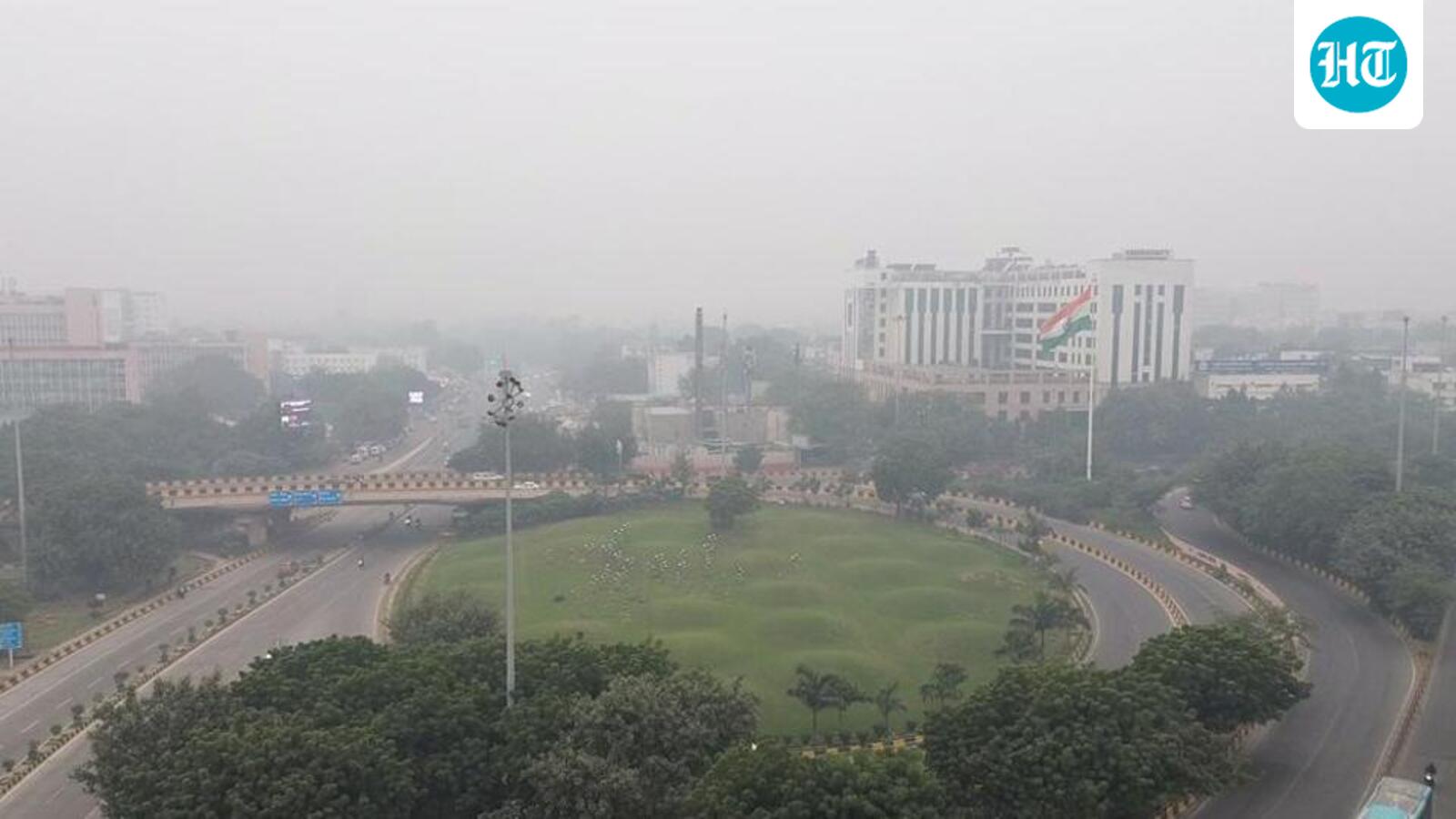
Delhi's air quality index remained in the 'poor' category on Monday morning as the city recorded an AQI of 218. Shallow fog covered many places while temperatures stayed between 14°C and 16°C. Meteorologist Navdeep Dahiya said, "As soon as night sets in and wind speeds slow down, the temperature."
Delhi's air quality index (AQI) remained in the 'poor' category on Monday morning as the national Capital woke up to a hazy morning.
The city recorded an AQI of 218 at 8am, falling in the 'poor' category. After touching 207 at 3am, the 24-hour rolling average of the AQI has started reversing its downward trend and is expected to deteriorate further during the day.
According to the India Meteorological Department (IMD), shallow fog was reported at several places in the city, with minimum temperatures ranging between 14°C and 16°C. The maximum temperature is expected to settle between 26°C and 28°C with a gradual fall in maximum temperature expected by 2-3°C during next three days.
Of the 59 air quality monitoring stations in the city, Siri Fort recorded the worst air quality, with an AQI of 350 at 8am, falling in the 'very poor' category. It was followed by NSIT Dwarka station at 327. As many as 38 stations were in the 'poor' category and 18 in the 'moderate' category. The Cantonment monitoring station was the only one to record 'satisfactory' air quality, with an AQI of 98.
The Air Quality Early Warning System (AQEWS) has forecast that Delhi's air quality is likely to remain in the 'poor' category on Monday before deteriorating to 'very poor' between November 17 and 18. The city is likely to continue experiencing 'very poor' air quality over the following six days, it said.
According to the Central Pollution Control Board (CPCB), an AQI between zero and 50 is considered 'good', 51 to 100 'satisfactory', 101 to 200 'moderate', 201 to 300 'poor', 301 to 400 'very poor', and 401 to 500 'severe'.
Delhi's official AQI relies on a 24-hour rolling average, which smooths out sudden spikes and can make real-time pollution levels appear lower during episodes of rapid deterioration.
Delhi has witnessed a series of 'very poor' air quality days this month, driven by factors including the widespread use of firecrackers, an increase in stubble burning and local pollution sources.
Experts attributed Sunday's improvement to increased wind speeds and a western disturbance, which aided the dispersion of pollutants. However, the city once again witnessed use of banned firecrackers on Sunday evening and Monday morning as Chhath Puja celebrations continued.
Meteorologist Navdeep Dahiya said air quality across Delhi-NCR was likely to deteriorate again.
"As soon as night sets in and wind speeds slow down, the temperature inversion effect, along with fresh emissions, starts taking effect. The temporary relief is over. Brace for smog during the night and morning hours over the next week. Only afternoons are likely to offer some respite, when northwesterly winds are expected to be stronger, in the range of 10-20 kmph," he said.