
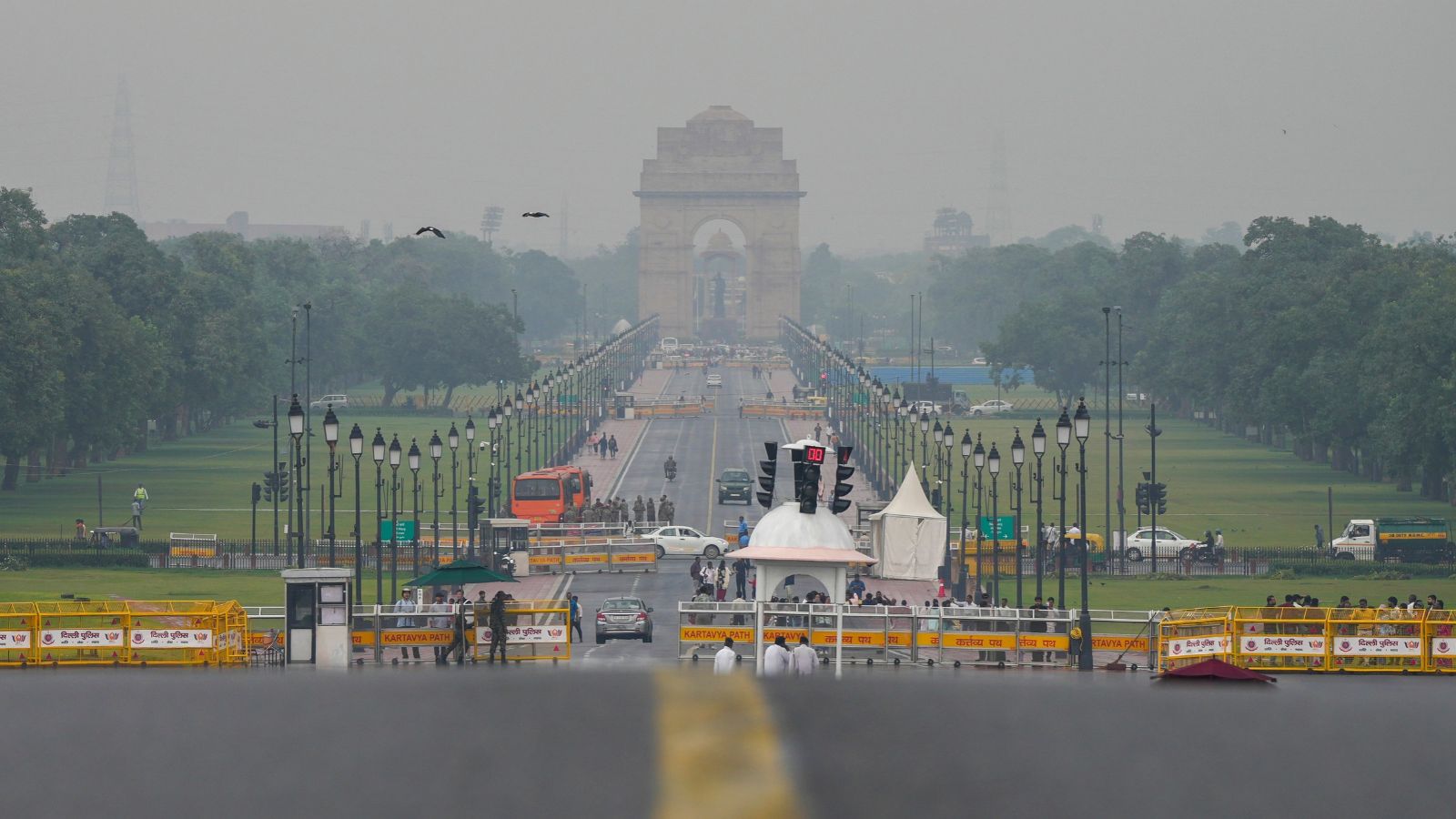
Delhi recorded its highest single-day October rainfall in four years on Friday, with the Safdarjung observatory receiving 61.4 mm of rain. These widespread showers helped the city’s air quality improve significantly. The average Air Quality Index fell to 90, moving from the poor category into the satisfactory range by morning.
The Capital received 61.4 mm of rain in 24 hours -- the highest single-day rain for the month since 2022.
Delhi recorded its highest single-day October rainfall in four years on Friday, with the Safdarjung observatory receiving 61.4 mm of rain in the 24 hours ending 8.30 am.
The widespread showers also brought a sharp improvement in air quality across the Capital. The city's average Air Quality Index (AQI) dropped to 90 in the satisfactory category at 9.30 am on Friday, from 222 in the poor category at 4 pm on Thursday, according to the Central Pollution Control Board.
Nearly half of October's total rainfall was recorded in the 24 hours ending Friday morning.
Several weather stations recorded more than 40 mm of rain. India Meteorological Department (IMD) data showed Lodhi Road received 63.4 mm, Ayanagar 55.4 mm, Chhatarpur 53.5 mm, the Ridge 50.3 mm and Palam 43.1 mm. Jharoda Kalan recorded the highest rainfall among the stations, at 89 mm, as of Friday morning.
The last time Delhi recorded higher single-day rainfall in October was on October 9, 2022, when Safdarjung received 74 mm.
The rain also brought a sharp change in temperatures. Delhi recorded its lowest maximum temperature for an October day in four years on Thursday, at 25.4°C at Safdarjung -- 5.6 degrees below normal. The last time the maximum temperature was lower was on October 8, 2022, when it stood at 23.4°C.
The minimum temperature, however, did not see a similar dip. It stood at 17.2°C on Friday, 1.1 degrees above normal. Cloud cover and high humidity can restrict the loss of heat from the surface, limiting the fall in night-time temperatures.
Is rain in October usual?
October is generally among Delhi's drier months, as it is a transitioning month from the post southwest monsoon season to the winter season.
However, IMD's historical data shows that the city has received spells of heavy rainfall in October in several recent years.
Between 2017 and 2020, Safdarjung had recorded either no rainfall or negligible precipitation during the month. The pattern changed in subsequent years, with Delhi receiving 122.5 mm in October 2021, 128 mm in October 2022 and 89.3 mm in October 2025.
In 2021, the monthly total was pushed up by 87.9 mm of rain in a single day. In October 2022, Safdarjung received 74 mm on October 9.
This year, the rain also pushed October's cumulative rainfall to more than seven times the monthly normal. According to IMD's historical data, Safdarjung has recorded 123.3 mm of rain so far this month, against the normal of 15.1 mm -- a surplus of 108.2 mm, or around 717%.
What brought the rain to Delhi?
An active Western Disturbance was the primary weather system responsible for the rainfall over Delhi and other parts of northwest India, according to IMD officials.
Western Disturbances are eastward-moving weather systems that originate in the Mediterranean region and adjoining areas. They travel across West Asia and bring moisture into northwest India, often resulting in cloud cover, rain, thunderstorms and, in winter, snowfall over the western Himalayan region.
The system triggered widespread rainfall over parts of Haryana, Uttar Pradesh, Uttarakhand and adjoining areas.
The IMD's national bulletin also referred to the remnant depression of Very Severe Cyclonic Storm 'Arnab', which was located over Chhattisgarh and adjoining Odisha on Thursday and was expected to weaken into a well-marked low-pressure area.
The two weather systems were influencing different parts of the country. While the cyclone remnant was affecting parts of central and eastern India, the Western Disturbance was driving the rainfall activity over northwest India, including Delhi.
The IMD forecast further spells of light to moderate rain accompanied by thunderstorms and lightning, prompting an orange alert in entire Delhi on Friday. The weather office has forecast partly cloudy skies on Saturday, followed by mainly clear skies from Sunday.