
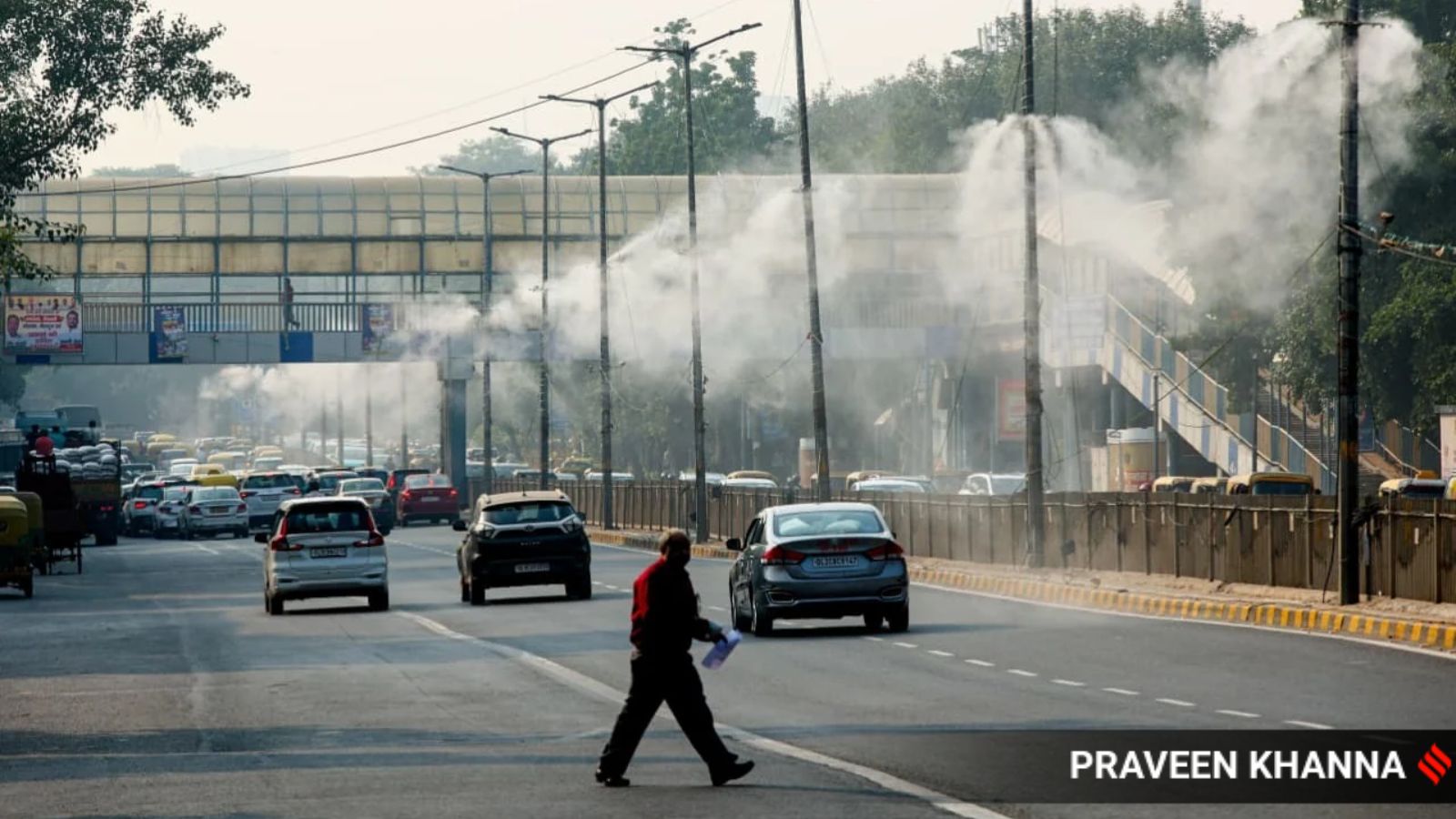
Delhi is stepping up its pollution crackdown by adding 125 patrol vehicles and conducting surprise checks at hotspots. The city recorded its worst Diwali-day air quality since 2021. Officials said, "Enforcement by Vayu Rakshak teams has been strengthened to prevent biomass burning and monitor identified hotspots" across the capital city.
With Delhi's air-quality worsening after Diwali, the government is stepping up ground-level enforcement -- more patrol vehicles, surprise inspections at pollution hotspots and more frequent mechanised road sweeping -- to ensure pollution-control rules are followed.
The city recorded its worst Diwali-day air quality since 2021, with pollution levels touching nearly 5,000 µg/m³ at some monitoring stations. The national 24-hour safe limit for PM 2.5 is 60 µg/m³ while for PM 10, it is 100 µg/m³. The average AQI touched 376 on Sunday, according to data maintained by the Central Pollution Control Board (CPCB).
Vayu Rakshak vehicles
According to government sources, 78 GPS-enabled Vayu Rakshak vehicles are currently deployed by the Delhi Pollution Control Committee (DPCC).
"These vehicles are manned by officials from the DPCC, Municipal Corporation of Delhi (MCD) and Civil Defence. In addition, 125 GPS-enabled vehicles have been deployed by the MCD. All these vehicles will be monitored to ensure that joint teams from the three agencies are enforcing the restrictions on the ground," sources said.
With this, more than 300 enforcement teams have been formed to remain on the ground round the clock. Each vehicle has around 3-4 officials.
"Enforcement by Vayu Rakshak teams has been strengthened to prevent biomass burning and monitor identified hotspots. Preventing dumping and burning of municipal solid waste is a special focus. Mist guns and sprinklers will cover locations where construction and demolition waste has accumulated," an official said.
Surprise checks
The government has also directed senior officials of all three agencies to conduct surprise inspections at identified hotspots to check whether enforcement teams are carrying out their duties effectively. Senior officials have been asked to ensure round-the-clock deployment of personnel to monitor compliance with the directions over the coming days.
Road sweeping machines
Delhi Environment Minister Manjinder Singh Sirsa said the number of shifts for MRSMs have been increased. "More MRSMs will also be deployed in the coming days. The number of rounds by water sprinklers across the city has also been doubled," he said.
Currently, 81 MRSM machines are deployed across Delhi to collect road dust.
Checking vehicle, construction curbs
While vehicular restrictions are already in force, stricter checks will specifically target BS-IV and older vehicles operating in Delhi. The Delhi Police and Transport Department are working together to ensure compliance with the restrictions on banned vehicles.
Despite the ban on construction activities, enforcement has been intensified to check violations at construction sites, with agencies directed to strengthen surveillance and take penal action against those flouting the restrictions.
Officials deployed at the Integrated Command and Control Centre (ICCC) have also been directed to remain more vigilant while monitoring calls and alerts. They have also been asked to track the movement of MRSM vehicles and enforcement teams while they are deployed on the ground.
The exercise also involves the Transport, Urban Development, PWD, and Irrigation and Flood Control departments. Senior secretary-level officers have been appointed as district-level nodal officers to coordinate the exercise while district Magistrates have been tasked with monitoring enforcement, with particular attention to areas within a 3-km radius of identified pollution hotspots.
Sirsa said the government had undertaken a coordinated, multi-departmental exercise to tackle pollution.
"This is perhaps the first time such a coordinated, multi-departmental exercise is being undertaken. Changing meteorological conditions have also helped improve pollution levels, with clearer conditions recorded today. The biggest immediate challenge remains preventing the dumping and open burning of municipal solid waste and biomass. But we have strengthened our enforcement teams on the ground," he said.