
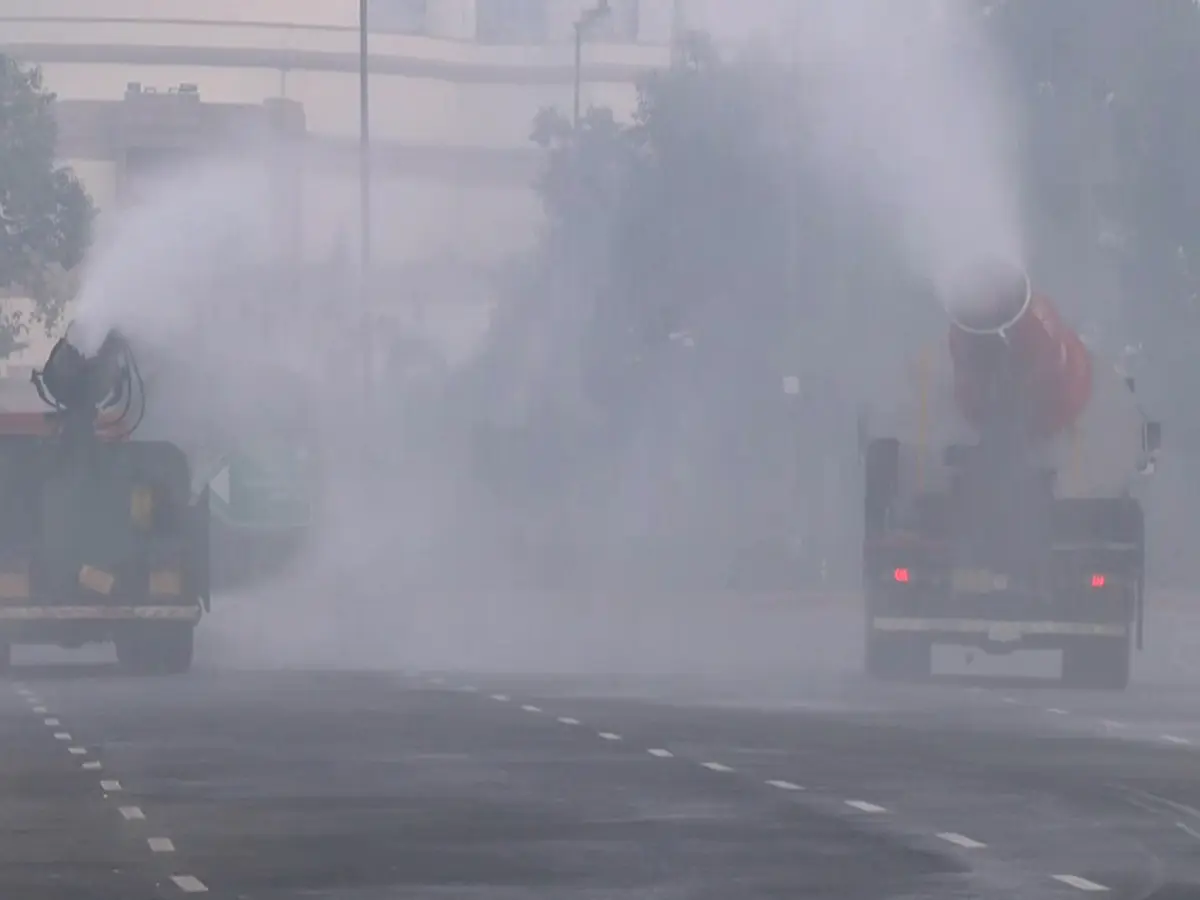
Delhi's AQI reached 384 on Diwali morning, with 11 monitoring stations crossing 400. The city woke up to a toxic haze as pollution levels climbed before the festival. Many areas recorded severe air quality, and experts said conditions could worsen further as smoke and calm winds trap pollutants nearby.
Delhi's AQI reached 384 on Diwali morning, with 11 monitoring stations crossing 400 as experts warn of worsening pollution after the festival.
Delhi woke up to a toxic haze on Diwali morning, with the capital's overall Air Quality Index (AQI) at 384, just short of the "severe" category, according to Central Pollution Control Board (CPCB) data.
The 6 am update showed the picture was worse at many individual stations. Eleven of the 23 monitoring stations listed crossed 400, the threshold for "severe" air. The other 12 were in the "very poor" band of 301 to 400.
Punjabi Bagh recorded the city's highest reading at 450, followed by RK Puram at 449 and IIT Delhi at 446. Chandni Chowk and Delhi University's North Campus both logged 423, Pusa 415, Burari Crossing 411 and NSUT Jaffarpur 409.
The deterioration began before the festival. Saturday's 24-hour average of 369 made it Delhi's most polluted Diwali eve in a decade, though it was slightly below Friday's 382. The reading climbed to 384 by 7 am Sunday, before most of the day's firecracker use.
The deterioration came despite Stage III of the Graded Response Action Plan (GRAP), which the Commission for Air Quality Management invoked across Delhi-NCR on Friday as a precaution ahead of the festival. The curbs halted non-essential construction and demolition, restricted stone crushers and mining. They barred BS-III petrol and BS-IV diesel four-wheelers, on top of measures already in force under Stages I and II. Primary classes were also shifted online. Even so, the AQI stood at 364 on Saturday morning and has since climbed further. According to the Delhi government's Decision Support System, the transport sector was the largest contributor of pollution on Friday at 21.4%.
The slide began before the festival. Saturday's 24-hour average of 369 made it Delhi's most polluted Diwali eve in a decade, though it was slightly below Friday's 382. The reading reached 384 by 7 am Sunday, before most of the day's firecracker use.
Historical trends suggest the conditions are likely to worsen. Monday could be the most polluted post-Diwali day in several years, as stubble smoke from neighbouring states and calm winds trap pollutants close to the ground. On Friday, 589 crop-residue burning incidents were reported across six states: Punjab 357, Madhya Pradesh 139, Rajasthan 58, Uttar Pradesh 23, Haryana 9, and Uttarakhand 3.
Residents, especially children, older people and those with respiratory or heart conditions, are advised to limit outdoor activity and wear N95 masks if they must go out.