
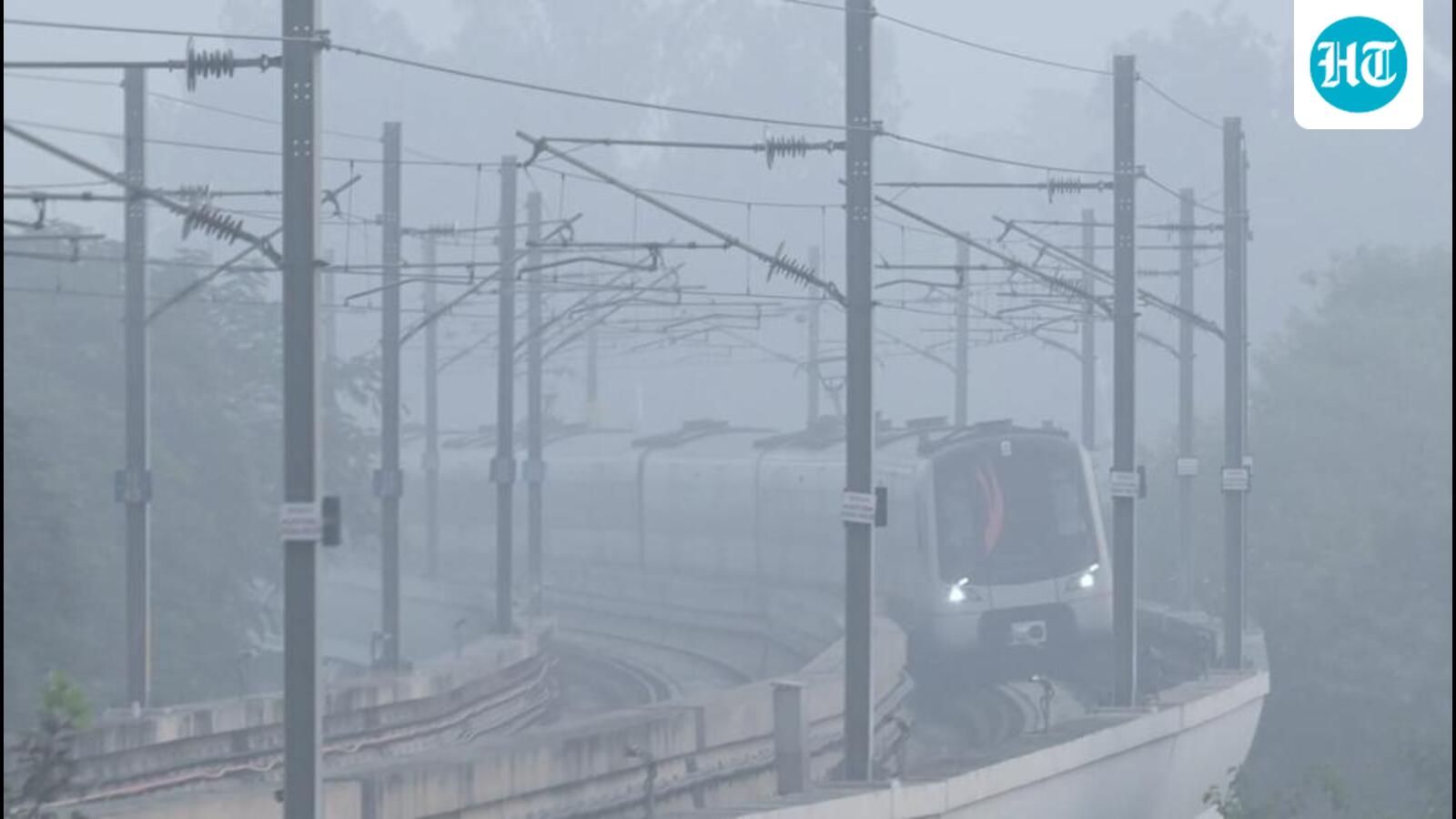
Delhi's air quality remained in the very poor category on Saturday, with seven stations recording severe pollution levels. Moderate fog reduced visibility in parts of the capital during early morning hours. Meanwhile, NASA data showed 4,165 farm fires in Punjab and Haryana between October 1 and November 13 this year.
Delhi's air quality remained in the very poor category on Saturday, with seven of the city's 59 monitoring stations recording severe pollution levels, even as moderate fog reduced visibility in parts of the capital during the early morning hours.
PM2.5 continued to be the dominant pollutant, being the primary pollutant at 50 stations. Eight stations recorded poor air quality, while Delhi Cantonment was the only station in the moderate category. The city's average AQI was 373 on Friday.
On Friday morning, the air quality dipped into the severe category for nearly eight hours before marginally improving to very poor.
Meanwhile, NASA satellite data showed that 4,165 farm fires were detected in Punjab and Haryana between October 1 and November 13, including 58 on Friday. Punjab accounted for 3,782 fires, while Haryana recorded 383.
The cumulative count is lower than the 4,341 fires detected in the two states during the corresponding period last year. However, the comparison needs to be treated with caution**,** as the timing of stubble burning has been shifting later each year.
Meteosat data showed that 98% of the fire heat recorded in 2025 occurred after 3pm, compared with 94% in 2024. Both annual counts are likely underestimates, as most farm fires now occur after the satellite's overpass at around 1.45pm, potentially leaving a substantial number undetected.
Visibility at Safdarjung deteriorated sharply overnight, dropping from 2,000 metres at 5.30pm on Friday to 350 metres by 2.30am on Saturday, indicating moderate fog conditions, according to India Meteorological Department (IMD) data. Visibility remained at 350 metres at 5.30am. At Palam, visibility declined from 2,100 metres at 5.30pm to 1,100 metres by 5.30am, with no fog category recorded.
The IMD classifies visibility below 50 metres as very dense fog, 50-199 metres as dense fog, 200-499 metres as moderate fog and 500-999 metres as shallow fog. Visibility of 1,000 metres and above falls under the no-fog category.
Delhi recorded a relatively warm night on Friday, with the minimum temperature at the Safdarjung weather station settling at 16.4°C on Saturday, 2.9 degrees above the season's normal.
The minimum temperature was marginally higher at most weather stations across the city. Palam recorded a low of 16.7°C, 2.5 degrees above normal, while Lodhi Road registered 17.2°C, 5.2 degrees above normal. The Ridge recorded a minimum of 17.3°C, 1.9 degrees above normal, and Ayanagar logged 16.7°C, 2.2 degrees above normal.
The minimum temperature at Safdarjung rose by 0.2 degrees over the past 24 hours. No rainfall was recorded at any of the five stations.